
Best Cold Plunge for a Small Space: A Practical Buying Guide
The smallest cold plunge isn’t automatically the best fit. The best cold plunge for a small space leaves room to get in and out, accommodates its equipment, and works for your home routine. Footprint matters, but so do the route into the room, access to the chiller, and the space you need to use the tub comfortably.
This guide walks you through measuring your available floor area, planning access and setup, and comparing comfort, construction, and cooling. Iceology Cold Plunge tubs have hard-sided construction, efficient insulation, and built-in chillers that can cool water to 39°F. That means you can consider a controlled Ice Bath routine without making ice for every session. As you compare options, account for the complete setup, including equipment and working space, not just the tub’s base dimensions.
Key Takeaways
- Measure the usable area around a potential tub, not just the floor space it occupies, so entry and routine care remain practical.
- Compare the best cold plunge for a small space by footprint, access, comfort, and cooling approach rather than dimensions alone.
- A compact room doesn’t automatically mean compromising on comfort or a controlled cold-water routine; assess those needs separately.
- Map the delivery route and intended placement before choosing a tub, accounting for obstacles and the space needed to use it.
- Iceology Cold Plunge’s USA-made, hard-sided tubs offer features to consider when choosing a durable, convenient home setup.
Best Cold Plunge for a Small Space: Start With Your Available Footprint
A smaller home can still support a deliberate cold-water routine. Plan for the tub as something you need to deliver, reach, and use, not simply an object that must fit between two walls. A listed footprint describes the base. It doesn’t show whether you can approach the entry comfortably, open nearby doors, or reach the equipment for routine care.
A usable cold plunge footprint includes the tub’s base and the clear space needed to deliver it, enter and exit, and access its controls and care points. This fuller view can change which location works and which dimensions matter most when comparing tubs.
If you’re new to cold-water immersion, this general overview of the ice bath can provide broader context. To plan a location, start with your home’s layout and measure in the same sequence each time: intended spot, delivery route, turns, then obstacles.
What should you measure before shopping for a cold plunge?
Measure the intended placement area first, then trace the route the tub would take to get there. Record the narrowest points and consider whether the tub can be angled through each turn. A route that looks clear on paper may still be blocked by a door, corner, or fixed feature, so check the whole path.
- Placement: Measure the available floor length and width where the tub would sit. Note which direction it could face.
- Delivery route: Record doorway and hallway widths, stair access, and turning space along the full path.
- Obstacles: Mark walls, cabinets, doors, and other equipment that could limit movement or access.
Check the route as well as the destination. A tub may fit in a room but be difficult to move through a narrow hallway or around a tight corner. Put the measurements in one note or simple sketch, including door swings and fixed protrusions, then compare them with product dimensions instead of relying on memory.
How much working space does a compact plunge need?
There isn’t one working-space figure that suits every layout. Separate the tub’s listed dimensions from the room you’ll need to use it. Think through your approach, how you’ll enter and exit, and whether everyday movement through the room remains practical once the tub is in place.
- Entry and exit: Identify the side you’ll use and keep the approach clear enough for controlled, unhurried movement.
- Controls and care: Consider how you’ll reach the controls, cleaning points, and integrated chiller without shifting the tub or surrounding items.
- Daily layout: Account for doors, storage, and household pathways that need to remain usable around the plunge.
Use the product’s stated requirements for equipment clearance rather than estimating. The best cold plunge for a small space isn’t simply the tub with the narrowest base. It’s the one whose complete setup fits your measured room and delivery route while leaving practical access.
How to Compare Small-Space Cold Plunges Without Guessing
Once you’ve measured the room and delivery path, compare tubs against those actual constraints, not just their appearance or a “compact” label. A smaller base doesn’t guarantee an easier setup: the chiller, entry point, controls, and care access all affect how a tub works at home. Put the specifications side by side to see how each option fits your priorities.
Which specifications matter most in a compact home?
Keep exterior size separate from usable interior space. Exterior dimensions help you assess whether a tub may fit in the intended location; interior dimensions help you judge the space available to use. Compare both when they’re provided, and don’t infer interior room from the outside measurements alone.
| Comparison factor | Iceology cold plunge tub | What to compare |
|---|---|---|
| Exterior footprint | 59.875 inches long by 38.5 inches wide | Compare these dimensions with your measured placement, then account separately for equipment and usable access space. |
| Chiller layout | Built-in chiller; placement requires 10 inches of rear clearance. | Note where the chiller sits and whether its arrangement works with walls, doors, and nearby equipment. |
| Interior space | Use the product’s stated interior dimensions. | Assess comfort using published interior measurements, not the exterior size as a substitute. |
| Cooling and insulation | Integrated chilling and efficient insulation. | Separate documented product features from broad marketing descriptions and consider how each suits your routine. |
The exterior dimensions don’t tell the whole placement story. For the Iceology tub shown above, the listed placement footprint is 77 inches by 40 inches, plus 10 inches of clearance behind it for the chiller. Include these product-specific figures in your plan. For other tubs, use their own stated dimensions and requirements rather than assuming every unit needs the same space.
How do you compare tubs when room dimensions are limited?
Rank your priorities: fit first, then usable access, cold-water control, and routine convenience. A built-in chiller can simplify regular use by removing the need to add ice for each session. Efficient insulation supports maintaining cold water, while hard-sided construction is worth considering if you want a durable home setup. These features matter, but they don’t reduce the space needed around the tub.
Keep your comparison factual. Record dimensions and equipment clearances as specifications; put subjective descriptions such as “space-saving” or “easy to use” in a separate notes column. Then compare each candidate with your room plan and delivery route. If a tub fits only by blocking a doorway or making controls difficult to reach, it may be compact on paper but inconvenient in practice.
As you weigh your shortlist, explore Iceology Cold Plunge to review its hard-sided tubs and integrated cooling. The best cold plunge for a small space is one that fits your layout and supports a routine you can use comfortably.
Does a Small Cold Plunge Mean Compromising on Comfort or Cooling?
No. A small room doesn’t automatically rule out a cold plunge, and a compact setup doesn’t automatically mean less capable cooling. Ask whether the tub fits your space, feels usable once installed, and can reach the water temperature you want. These are related decisions, but one doesn’t guarantee the others.
Think of them as three separate checks. Fit means the tub and its equipment work within your layout. Comfort means you can enter, exit, and use the tub without awkward movement. Cooling depends on the chilling system and the product’s stated capabilities, not simply on how little floor space it occupies.
Can a compact setup still support a consistent cold-water routine?
It can, if the placement makes the tub practical to use and care for. A plunge tucked into a tight corner may technically fit but feel inconvenient if the entry point is blocked or routine access is awkward. Consider the entire use pattern: approaching the tub, getting in and out, and reaching controls or care points.
Iceology Cold Plunge tubs combine hard-sided construction and efficient insulation with built-in chilling. The integrated cooling removes the need to make and add ice for each session, which can simplify a home routine. Iceology chillers can cool water to 39°F. When comparing options, include the chiller’s placement and access needs in your home plan.
What trade-offs should small-space buyers weigh?
A tub at home can make cold-water immersion more accessible as part of your routine, but a tight layout may limit placement options. Before choosing a spot, picture the tub in daily use, not just at delivery. Consider whether the area feels private enough, whether you can enter comfortably, and whether nearby surfaces and household pathways will remain practical.
- Access: A narrow approach or obstructed entry can make a well-sized tub feel less comfortable to use.
- Care: Controls and routine-care areas need to remain reachable after the tub is in place.
- Surroundings: Nearby walls, furniture, and household activity can affect privacy and ease of movement.
- Cooling: Compare each system by its documented features. Don’t assume a smaller tub cools faster or uses less energy.
Hard-sided construction and efficient insulation are practical features to weigh alongside your room plan. They don’t make a tub smaller, but they’re relevant when choosing a durable home setup. The best cold plunge for a small space balances a workable location with comfortable access and controlled cooling. Measuring carefully helps you choose a setup that feels deliberate, not squeezed into a leftover corner.
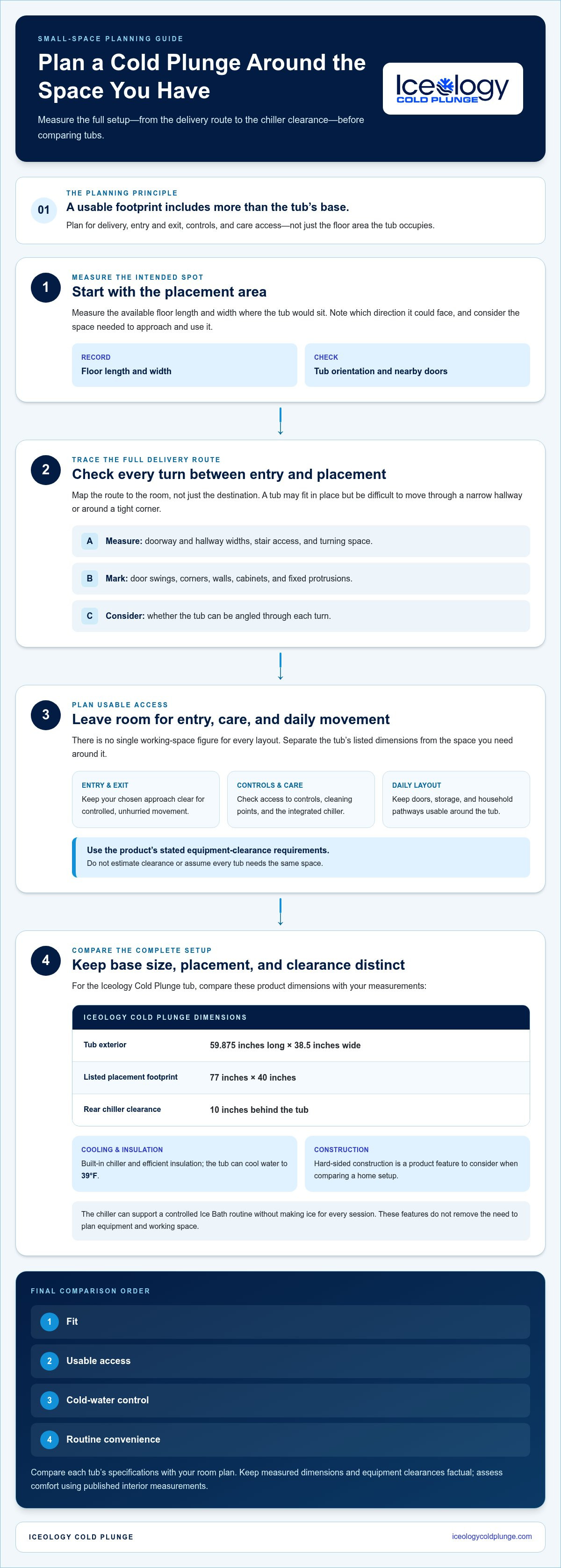
Plan a Small-Space Cold Plunge Setup From Delivery Route to Daily Use
A tub can fit your floor plan and still be difficult to move into place or use comfortably. Plan the setup as one sequence: how it gets inside, where it will sit, what the product requires, and how you’ll reach it during a normal routine. Keep the product information handy so each decision is based on stated dimensions and requirements, not assumptions.
How do you check whether a tub can reach its intended location?
Measure from the entry point to the final position, including the narrowest passage and every turn. Compare those measurements with the product’s stated dimensions and handling information. Account for packaging or handling needs when the product information specifies them, rather than guessing.
- 1. Map the route. Record doorway and hallway widths, stair access, turns, and the final approach to the room.
- 2. Compare the product dimensions. Use stated exterior measurements to assess whether the tub can pass through the route and reach its intended location. Include attached equipment or other protrusions if the specifications describe them.
- 3. Confirm the placement. Compare the product’s full placement requirements with the room, including the chiller position and any clearance specified in its documentation.
- 4. Review the supporting surface. Check the product’s guidance for the surface and floor support before settling on a location. Don’t infer floor suitability from the tub’s empty dimensions.
- 5. Plan utilities and water handling. Review product-specific electrical, drainage, and water-handling information. If ventilation guidance applies to the selected setup, account for it according to the product documentation.
What should you plan around the tub after placement?
Test the location as if you were about to use the tub. Is the approach clear? Can you enter and exit without squeezing past a wall or nearby furniture? Can you reach the controls and routine-care points once the tub is in position? These checks help distinguish a technically possible placement from one that feels workable day to day.
Use the product’s stated equipment requirements instead of applying a generic clearance rule. The same goes for power, drainage, ventilation, and supporting surfaces: requirements depend on the product and setup. If your room plan depends on an assumption about one of these details, compare it with the relevant product guidance before finalizing the layout.
A simple sketch can bring the plan together. Mark the route, tub outline, chiller location, nearby doors, and intended access side. Then compare the sketch with the product specifications before settling on the position. A broader cold plunge tub setup guide can also help organize home-planning questions beyond fit.
Once the route and placement plan are clear, explore Iceology Cold Plunge tubs as you consider a home setup.
Why Iceology Cold Plunge Fits a Thoughtful Small-Space Buying Decision
A considered purchase starts with a clear plan: the tub fits its intended location, you can reach it comfortably, and its cooling and care features suit the way you’ll use it. A small room doesn’t make those priorities less important. It makes measuring and comparing them essential.
Iceology Cold Plunge designs USA-made, hard-sided cold plunge tubs for home use. Built-in chillers and efficient insulation provide a controlled alternative to adding ice for each session, while hard-sided construction suits buyers looking for a durable setup. Iceology chillers can cool water to 39°F.
Which Iceology features matter when space is limited?
Each feature supports a different part of ownership, so weigh it alongside the room plan rather than treating it as a substitute for measuring. Hard-sided construction is relevant to durability; insulation supports maintaining cold water; and built-in chilling can simplify your routine. These features offer a practical home-use profile, but they don’t mean the tub will fit every compact layout.
- Hard-sided construction: A durable option for buyers planning a dedicated home setup.
- Efficient insulation: A thermal-management feature that supports maintaining cold water, without a promised energy-savings figure.
- Built-in chilling: Helps you avoid manually adding ice for each session and supports a more convenient routine.
These benefits work best when the placement works, too. A tub with integrated cooling still needs a suitable location for its equipment and comfortable access for entry and routine care. Treat product dimensions and placement details as part of the decision, not as details to review after choosing a spot.
How can you make a confident final choice?
Return to your measurements before deciding. Compare product dimensions and placement requirements with both the room and delivery route, then picture how you’ll approach the tub and reach its controls in everyday use. A useful shortlist separates specifications from preferences such as appearance or perceived convenience.
Use a premium cold plunge selection guide to weigh broader buying criteria, but keep your own layout at the center of the decision. If a tub fits only by making entry awkward or routine care difficult, its footprint alone doesn’t make it the right choice. Look for a balance of measured fit, usable access, dependable cold-water control, and features that suit your home routine.
The best cold plunge for a small space works both on your floor plan and in daily life. Explore Iceology Cold Plunge’s hard-sided tubs with integrated cooling and insulation as you plan your home setup.
Make Room for a Routine That Works
The best cold plunge for a small space supports the way you want to use your home, not just a set of dimensions on a product page. Once you’ve chosen a practical option, consider how it will fit into the rhythm of your day. A clear, intentional place for cold-water therapy can help the setup feel like part of your home rather than an obstacle.
Picture the finished space. Does it feel functional, comfortable, and easy to return to? A thoughtful choice can bring a focused recovery practice within reach while respecting your layout. You don’t need a large room to make a deliberate start.
Choose carefully, then make the space your own. A well-planned setup can be the first step toward a consistent home routine.
Frequently Asked Questions
What is the best cold plunge for a small space?
The best choice suits both your room and the route into it. Compare stated exterior dimensions with the available interior space, then consider the chiller’s position and whether the tub’s insulation and layout suit your intended use. For the best cold plunge for a small space, prioritize a workable setup over a compact label. Iceology Cold Plunge offers hard-sided tubs with built-in chillers; compare the product dimensions with your measurements.
Can you put a cold plunge in a small bathroom?
It depends on whether the tub can reach the bathroom and whether the room can support its intended use and care. Measure the route from the entrance, including door swings and turns, and check whether the tub would obstruct bathroom fixtures or everyday movement. Then review the product’s guidance for electrical access, water handling, and supporting surfaces. The available floor area alone doesn’t establish whether a particular setup is suitable.
How much space do you need for a cold plunge tub?
There’s no universal space requirement because tub dimensions and equipment layouts vary. Start with the stated exterior dimensions, then map the route through your home and account for usable access at the final location. A spot may fit the tub but leave its controls difficult to reach. Include the chiller’s position and space for care, and use the product’s stated details rather than generic clearance estimates.
Are cold plunge tubs with built-in chillers too large for small homes?
Not necessarily. The chiller arrangement and complete product dimensions determine how a particular tub works in a compact home. Compare the full setup with your measured space, including equipment orientation and access for routine care. A built-in chiller can simplify cold-water preparation by reducing the need to add ice manually for each session. Convenience and size are separate considerations, so evaluate both before choosing.
Can a cold plunge tub be used indoors?
Indoor use depends on the product’s requirements and the suitability of the chosen space. Before deciding, review the tub’s guidance for its supporting surface, electrical access, and water handling rather than assuming an indoor room is automatically appropriate. Consider how the delivery route reaches the room and whether the finished placement leaves space for ordinary movement and routine care. Follow the product-specific instructions when planning the setup.
Do you need to add ice to an Iceology Cold Plunge?
No. Iceology Cold Plunge tubs have built-in chillers, so you don’t need to rely on manually adding ice for every session. This can make preparation more straightforward for a home routine. Use the product information and instructions for the specific tub to understand its cooling system and care needs before planning your space.
How do I choose between a cold plunge tub and an ice bath for a small space?
Compare the space each setup occupies and the effort needed to prepare cold water. A manually prepared ice bath may involve bringing ice to the tub and adding it before use, while a cold plunge with an integrated chiller manages cooling through its system. Consider where supplies would be stored and how each option fits your routine. Then compare stated dimensions and setup requirements with your available space.