
Best Cold Plunge for Chiropractic Offices: Buying Guide
The best cold plunge for a chiropractic office isn’t necessarily the one with the longest feature list. It’s the one your space, schedule, and patient flow can support. A clinic needs to account for filled weight, entry and exit, water care between sessions, and keeping water cold during office hours. Those practical details matter as much as the tub itself.
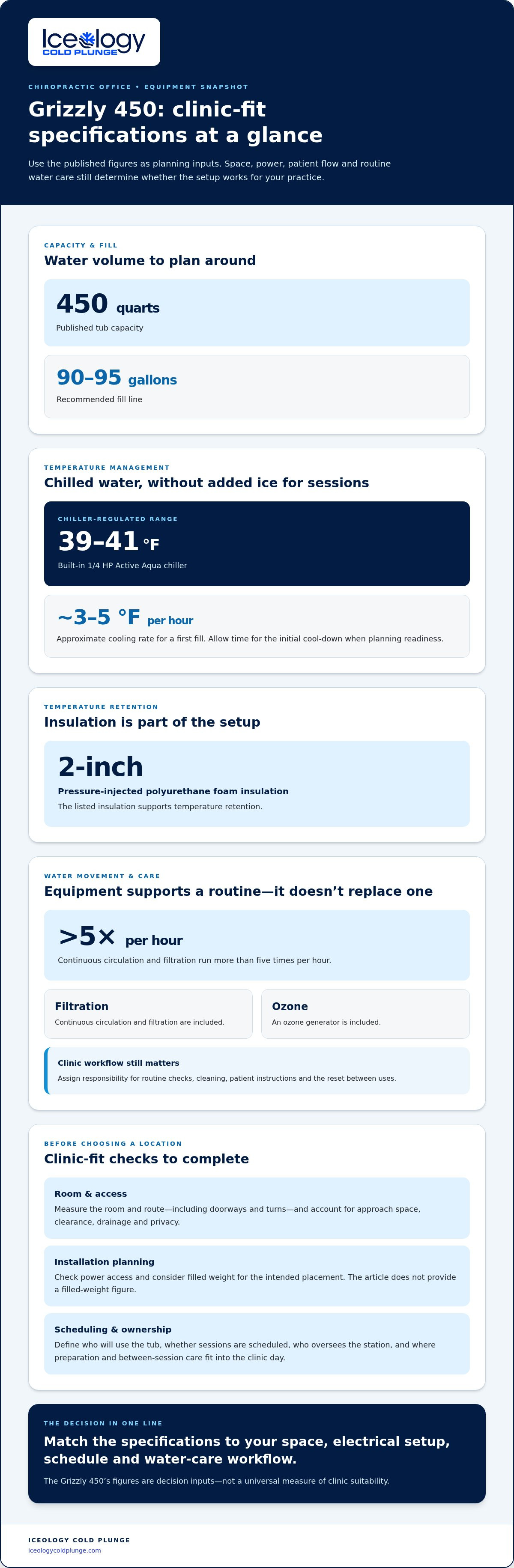
Iceology Cold Plunge’s Grizzly 450 is best assessed against your clinic’s needs and its published specifications. It holds 450 quarts, with a recommended fill line of 90-95 gallons, and includes a built-in 1/4 HP Active Aqua chiller, 2-inch pressure-injected polyurethane foam insulation, continuous circulation and filtration, and an ozone generator. The chiller regulates water between 39-41 °F and requires no ice, reducing manual preparation while leaving routine water care essential. Use this guide to assess space, power, capacity, sanitation workflow, and patient experience before buying. The goal is a manageable, repeatable process, not a promise of clinical results.
Key Takeaways
- Choose the best cold plunge for a chiropractic office by matching it to intended use, patient flow, and upkeep, not a generic ranking.
- Compare ice-dependent baths and chiller tubs by preparation effort, temperature management, and fit with your appointment schedule.
- Measure the room and access route, and account for filled weight, clearance, drainage, and privacy before choosing a location.
- Plan water care and assign responsibilities so sanitation remains part of the clinic’s routine between sessions.
- Use the Grizzly 450’s specifications as decision inputs, then compare them with your office space, electrical setup, and workflow.
What Makes the Best Cold Plunge for a Chiropractic Office?
Choose for clinic workflow and upkeep, not a generic best-of ranking. A tub that suits a home routine may not suit a practice where appointments, staff responsibilities, privacy, and water care shape the experience. The best cold plunge for a chiropractic office is the one that fits its intended role and can be managed consistently within the available space and schedule.
Start by defining the use case. A practitioner-led recovery session has different supervision and scheduling needs from an optional wellness amenity patients use as part of a broader visit. Staff use is another possibility, but it shouldn’t be assumed to reflect patient demand or clinic workflow. A defined use case helps set expectations for access, instructions, and who prepares the station.
Which chiropractic-office use case are you planning for?
Map the experience from arrival to departure. Decide who the intended users are, whether sessions will be scheduled, and what level of staff guidance the practice plans to provide. Assign a person or role to oversee the station, communicate patient-facing instructions, and coordinate its reset between uses.
Keep the purpose measured. Cold water immersion can be offered as a wellness amenity or as part of a planned recovery experience, but the tub itself doesn’t establish that it treats a condition or delivers a particular clinical outcome. Clear expectations support a professional, comfortable experience.
What should a clinic assess before comparing tubs?
Measure the proposed room and the route to it, including doorways, turns, and the area needed to approach and use the tub. Note nearby power access, privacy needs, and how people will move through the space. Then estimate the session cadence your practice wants to accommodate. This is a planning input, not a promise of capacity. Actual turnover also depends on preparation, cleaning, and staff workflow.
Make upkeep part of the plan before choosing equipment. Assign responsibility for routine checks, cleaning, and patient instructions, and decide how these tasks fit into the clinic’s daily rhythm. A tub that is ready when expected still requires a defined care routine.
Clinic-fit checklist: essentials and preferences
Separate must-haves from features that would be welcome but aren’t necessary to operate the station well.
- Essential: A workable location and access route, power access, suitable privacy, a clear supervision plan, and assigned responsibility for routine care.
- Essential: A scheduling approach that leaves time for preparation and the between-session routine.
- Preference: A particular room layout, a more discreet placement, or a setup that integrates smoothly with the practice’s existing wellness flow.
- Preference: Features that make the station simpler for staff to prepare and easier for patients to understand.
Resolve the essentials first. Once the clinic has a defined use case, a realistic session rhythm, and clear ownership of water care, product comparisons become more useful. Next, compare the features that support those requirements.
Which Cold Plunge Features Matter Most in a Chiropractic Office?
Compare features by the job they need to do in your clinic. Capacity tells you how much water the tub holds; footprint tells you whether it fits the room; filled weight informs site planning. Power, temperature control, filtration, and water care are separate considerations. Assess each one rather than assuming a single specification answers every question.
The Iceology Grizzly 450 provides a concrete example, not a universal measure of clinic suitability.
| Feature | Clinic relevance | Evidence to look for |
|---|---|---|
| Chilling and temperature range | Supports predictable readiness and a consistent session routine. | Temperature range, cooling rate, and whether preparation requires added ice. |
| Insulation | Helps limit heat transfer and retain water temperature. | Insulation material and thickness. |
| Capacity and footprint | Informs water volume and whether the unit fits the intended room. | Stated capacity, recommended fill level, and physical dimensions. |
| Filled weight | Matters when evaluating the installation site and placement. | Filled-weight information for the tub under its intended fill conditions. |
| Circulation, filtration, and sanitation | Support water movement and a planned water-care routine. | Circulation details, filter specification, sanitation components, and care instructions. |
| Electrical setup | Determines whether the planned location can power the system appropriately. | Voltage and the manufacturer’s electrical recommendations. |
How do chiller and insulation features affect daily readiness?
An ice-dependent bath requires staff to source and add ice during preparation. A built-in chiller cools water directly, so sessions don’t require added ice. The Grizzly 450’s chiller regulates water between 39-41 °F and can cool a first fill approximately 3-5 °F per hour. Its 2-inch pressure-injected polyurethane foam insulation supports temperature retention. These specifications help with readiness planning, but the first fill still needs time to cool.
How should clinics evaluate circulation, sanitation, and power?
The Grizzly 450’s continuous circulation and filtration run more than five times per hour. It includes a 50-micron filter and an ozone generator with an air pump, diffuser stone, and timer. The Ozone Sanitation System is a sanitation feature, not a replacement for routine water care or manufacturer instructions. The tub uses a standard 110 V outlet, and Iceology recommends a dedicated breaker with GFCI.
Compare ice-dependent and chiller-equipped setups against your operating rhythm: the staff preparation each requires, how temperature is managed, and how water care fits between sessions. For the product specifications, explore the Iceology Grizzly 450 and weigh its features against your clinic’s space, power access, and care plan.
Ice-Dependent Baths vs. Chiller Tubs: Which Setup Fits Clinic Operations?
Neither setup is automatically right for every practice. An ice-dependent bath may suit a clinic where use is occasional and staff can prepare it around appointments. A chiller tub may better match a planned schedule that benefits from managed water temperature. The best cold plunge for a chiropractic office depends on how each setup fits preparation time, session timing, and ongoing care, not on a universal ranking.
Compare the whole routine, not just the moment a patient enters the water. Ice preparation and temperature checks take staff attention. A chiller reduces the need to add ice, but still requires a responsible care routine and attention to the equipment.
| Clinic schedule | Ice-dependent bath | Chiller tub |
|---|---|---|
| Occasional, planned use | Staff can prepare ice and check water temperature before a scheduled session. The routine depends on having preparation time available. | The system can manage water temperature between planned uses, while staff still handle routine checks and water care. |
| Appointments grouped close together | Staff need to account for ice preparation and temperature checks as the schedule moves from one session to the next. | Direct cooling can reduce repeated ice preparation, but staff still need to coordinate sessions with the care and reset routine. |
| Unpredictable or changing demand | Preparation can be adjusted to the day’s plan, though timing and water temperature require active attention. | Managed temperature may support readiness, but it doesn’t guarantee availability at every moment or remove operational tasks. |
When might an ice-dependent setup make sense?
An ice-dependent setup can be practical when sessions are occasional, planned in advance, and manual preparation fits the staff workflow. Include the full sequence in your planning: sourcing and adding ice, allowing time for preparation, checking water temperature, and managing the tub after use. If staff can consistently fit those tasks around appointments, this straightforward setup may meet the practice’s needs.
When can a built-in chiller simplify the routine?
A built-in chiller cools the water directly, so staff don’t need to add ice before each session. Temperature regulation and circulation can support a more consistently managed station, particularly when use is scheduled. They don’t remove the need for routine water care, cleaning, or equipment attention. Build those responsibilities into the workflow instead of treating cooling as the entire preparation process.
Think through a typical day before deciding. For occasional use, the key question may be whether staff can reliably prepare the water when needed. For a fuller appointment schedule, consider whether avoiding repeated ice preparation would make station management easier. In either case, assign responsibility for checks and care, and leave time between sessions for the clinic’s procedures. Upfront simplicity and ongoing upkeep are different considerations; weigh both against your practice’s actual schedule.
How to Check Space, Floor Load, and Clinic Workflow Before Buying
A tub can fit on a floor plan and still disrupt the clinic if there isn’t enough room to enter, move comfortably, or maintain patient privacy. Work through the site in sequence before purchase. The Grizzly 450’s dimensions and filled weight are practical planning inputs, not a guarantee that a particular room or floor is suitable.
Will the tub fit, and can the space accommodate its filled weight?
The Grizzly 450 measures 59.875 inches long, 38.5 inches wide, and 30.75 inches high. Its total space requirement is 77 by 50 inches, including 10 inches of rear clearance. Its approximate filled weight is 855-900 pounds. Treat that weight as a site-planning requirement and verify that the selected floor location is suitable for it. Dimensions alone don’t establish whether placement is appropriate.
- Measure the room and access route. Record the proposed placement area, doorways, turns, and route from delivery access to the room. Compare the space with the tub’s total requirement, not just its exterior dimensions.
- Review placement and movement. Mark the tub footprint and rear clearance on the floor. Consider how patients and staff will approach, enter, and exit without obstructing the clinic’s usual paths.
- Assess the intended floor location. Use the approximate filled weight in your site planning and verify that the selected location is suitable for the load. Don’t assume that enough floor space also means the floor is appropriate for a filled tub.
- Plan utilities and drainage. Locate nearby power access and decide how the clinic will handle water during routine care. Base these plans on the room and the tub’s instructions rather than assuming every treatment space is set up the same way.
- Map the patient experience. Trace the route from arrival to the plunge area and onward to the next appointment. Decide how privacy, changing needs, staff oversight, and clear patient instructions will fit into that path.
- Assign ongoing responsibilities. Identify who handles filtration checks and water care, and schedule those tasks according to the manufacturer’s guidance. A written routine helps keep upkeep from becoming an informal, easily missed task.
How can the station fit into a clinic day?
Think beyond the plunge itself. If the route crosses a busy treatment area, consider whether a more private placement would make the experience smoother. Make space for staff oversight and patient instructions, and account for the transition to the next appointment. “Cold Plunge Tub Setup: The Comprehensive Guide to Home Installation 2026” offers a related installation-planning reference. Clinic placement still depends on your own site and workflow.
Once you’ve mapped the route and responsibilities, compare the layout with the Grizzly 450’s footprint and clearance needs. This helps identify practical constraints before the tub arrives and shows whether the space can support an organized routine.
Is the Iceology Grizzly 450 a Fit for Your Chiropractic Office?
The Grizzly 450 is a hard-sided, USA-made cold tub with built-in chilling and features for a planned cold plunge routine. Its specifications are useful decision inputs, not proof of a universal clinic fit. The best cold plunge for a chiropractic office is one that works with the practice’s space, electrical setup, patient flow, and water-care routine. Assess those conditions alongside the product details before deciding.
Which Grizzly 450 specifications deserve a final review?
The Grizzly 450 holds 450 quarts, with a recommended fill line of 90-95 gallons. Its built-in 1/4 HP Active Aqua chiller cools without added ice, and an optional 1/2 HP upgrade is available. The tub uses a standard 110 V outlet. Its approximate 232-pound empty weight is distinct from its filled weight, so account for both when planning delivery and placement.
Other specifications relate to daily operation. The chiller regulates water between 39-41 °F, while 2-inch pressure-injected polyurethane foam insulation supports temperature retention. The integrated ozone generator is a sanitation feature, not a replacement for routine water care or manufacturer instructions. Iceology includes a 1-year standard warranty, with an optional extension.
- Capacity: Compare the 450-quart capacity and recommended fill line with your intended use.
- Cooling: Consider whether no-ice operation and the chiller setup fit the clinic’s schedule.
- Placement: Revisit room dimensions, clearance, access, and filled-weight planning for the intended location.
- Care: Make sure staff responsibilities for water care and equipment oversight are clearly assigned.
What should the practice decide before moving forward?
Start with the intended location. Confirm that it can accommodate the tub, required clearance, and filled weight, and consider how patients will move through the area. Then map the station into the clinic day: who oversees patient flow, communicates instructions, performs routine water care, and attends to the equipment? A feature-rich tub still depends on a workable plan.
For broader product-selection context, the premium cold plunge tub selection guide can help frame the specifications against your priorities. The final decision should reflect the practice’s actual room, power access, schedule, and care routine, rather than a general claim of commercial suitability.
If those criteria align with your clinic’s plans, explore Iceology Cold Plunge and review the Grizzly 450 as a potential fit.
Turn Your Clinic Plan Into a Confident Next Step
Before choosing, turn your preferred setup into a simple operating plan: identify who will use the plunge, how it fits into appointments, and who owns the care routine. Then review the room, power access, and patient flow together. This practical check helps determine whether the best cold plunge for a chiropractic office is a realistic addition to your practice, rather than a feature-driven purchase that’s difficult to manage day to day.
Iceology Cold Plunge makes USA-made cold plunge tubs, and the Grizzly 450 brings together features for a managed cold-water routine. Iceology also served as the official cold plunge and recovery partner for the 2025 Official Strongman Games. Use those product details as context while assessing the tub against your clinic’s needs, without assuming it’s the right fit for every office.
A clear plan gives your team a stronger foundation for introducing cold water therapy with care and intention.
Frequently Asked Questions
Can a cold plunge tub work in a chiropractic office?
Yes, if the office can support its space, electrical setup, workflow, and water-care routine. A practice might offer immersion as an optional wellness amenity, distinct from claiming it treats a condition or produces a specific clinical result. The Grizzly 450’s capacity, dimensions, power details, and filled weight can help with planning, but they don’t establish a fit for every clinic. The best cold plunge for a chiropractic office depends on the practice’s own setup.
What should a chiropractic office look for in a cold plunge?
Prioritize a footprint and filled weight suited to the intended location, along with temperature management, power access, circulation, filtration, and a care routine staff can maintain. The right balance depends on whether the tub is for occasional staff use, a scheduled wellness amenity, or practitioner-led sessions. The Grizzly 450 combines an Active Aqua chiller, continuous circulation and filtration, and an ozone generator, but no single feature makes a tub right for every clinic.
Does the Iceology Grizzly 450 need ice?
No. Its built-in Active Aqua chiller cools water directly, so ice isn’t required. The chiller regulates water between 39-41 °F and can cool a first fill approximately 3-5 °F per hour. That rate describes the initial cooling process; maintaining temperature afterward is a different operating situation. Allow time for the first fill to reach the desired temperature rather than assuming it will be immediately ready.
How much room does the Grizzly 450 need?
The tub’s exterior dimensions are 59.875 inches long, 38.5 inches wide, and 30.75 inches high. Its stated total footprint is 77 by 40 inches; adding 10 inches of rear clearance brings the total required space to 77 by 50 inches. Treat that as a starting point for your room plan. Also map the access route and leave practical room for patients and staff to move around the station.
Can the Grizzly 450 use a standard outlet?
Yes. The Grizzly 450 uses a standard 110 V outlet and draws up to 7 A. Iceology recommends a dedicated breaker with GFCI. These are product specifications and a manufacturer recommendation, not confirmation that a particular office’s existing electrical setup is appropriate. Include the proposed tub location and outlet in your planning, alongside the room layout and clinic workflow.
How heavy is the Grizzly 450 when filled?
The tub weighs approximately 232 pounds empty and approximately 855-900 pounds with water. The filled figure is a planning input, not a guarantee that every room or floor is appropriate for installation. Assess the intended location before placing the tub, considering the filled weight along with access and the planned position. Don’t use the empty-tub weight alone to make a placement decision.
Does the Grizzly 450 ozone system replace water maintenance?
No. The tub includes an ozone generator with an air pump, diffuser stone, and timer, alongside continuous circulation and filtration. These are system components, not a reason to skip cleaning or routine water care. Assign responsibility for maintenance as part of the clinic’s operating plan, and follow the manufacturer’s guidance for caring for both the water and the equipment.