
Cold Plunge for Autoimmune Conditions: What to Know in 2026
A cold plunge isn't an established autoimmune treatment. That distinction matters when claims about cold exposure and immune health sound convincing, yet leave you wondering whether a cold plunge for autoimmune conditions could help, aggravate symptoms, or simply feel like too much.
It makes sense to look for clear answers before trying something that places physical stress on your body. But research on general responses to cold water doesn't establish that plunging is safe or beneficial for every autoimmune condition, or that it changes a disease's course. Your diagnosis, current symptoms, medications, and overall health all belong in a conversation with your healthcare professional.
This guide separates what research suggests from what remains uncertain, outlines questions to take to your clinician, and offers a grounded way to weigh potential risks and personal preferences. It also keeps wellness information distinct from equipment details, so any decision can start with your health, not a product.
Key Takeaways
- Understand what cold plunging involves and why a short-term response to cold doesn’t prove a lasting effect on autoimmune disease.
- For cold plunge for autoimmune conditions, evidence specific to individual diagnoses remains limited. Don’t treat it as a cure or replacement for prescribed care.
- Prepare for a clinician conversation by sharing your diagnosis, current symptoms, relevant health history, and the exposure you’re considering.
- Keep health decisions separate from equipment choices: Iceology Cold Plunge sells hard-sided tubs with built-in chillers, not medical care.
Cold Plunge for Autoimmune Conditions: What the Question Really Means
Looking for careful information before trying cold exposure is sensible. Advice online can blur the line between personal wellness stories and medical evidence, especially when the topic is immune health. With a cold plunge for autoimmune conditions, start by clarifying what the practice involves and what it can’t establish about a particular diagnosis.
Cold plunging is not an established treatment for autoimmune disease. It shouldn’t replace prescribed care or be taken as evidence that an autoimmune condition will improve. Autoimmune diseases differ, and people with the same diagnosis can have different symptoms, health histories, and treatment plans. One person’s positive or negative experience can’t establish what’s safe or appropriate for someone else.
What does cold-water immersion involve?
Cold-water immersion means deliberately entering water that has been cooled. “Cold plunge” and “ice bath” are often used for similar practices; the wording alone doesn’t establish a meaningful difference in method or effect. The broader topic of Cryotherapy includes several forms of cold exposure, including immersion. No single temperature, duration, or routine should be assumed to suit everyone.
More intense exposure isn’t automatically better. Choosing colder water or staying in longer doesn’t prove a greater health benefit, particularly for a specific autoimmune condition. If you’re considering immersion, focus first on whether it fits your individual health context rather than trying to match someone else’s routine.
Why do people with autoimmune conditions ask about it?
People may be curious about cold immersion as part of a wellness or recovery routine, or because they’ve encountered broad claims about mood, inflammation, or immune function. Those claims don’t, by themselves, demonstrate a benefit for a particular diagnosis. General responses to cold exposure and disease-specific outcomes are different questions.
The practical question is personal: could exposure be appropriate given your condition, current symptoms, relevant health history, and care plan? A healthcare professional familiar with your situation can help you weigh that context. You don’t need to try cold immersion to make progress in your care, and choosing not to use it is a valid decision.
How Cold Exposure Affects the Body, and What That Does Not Prove
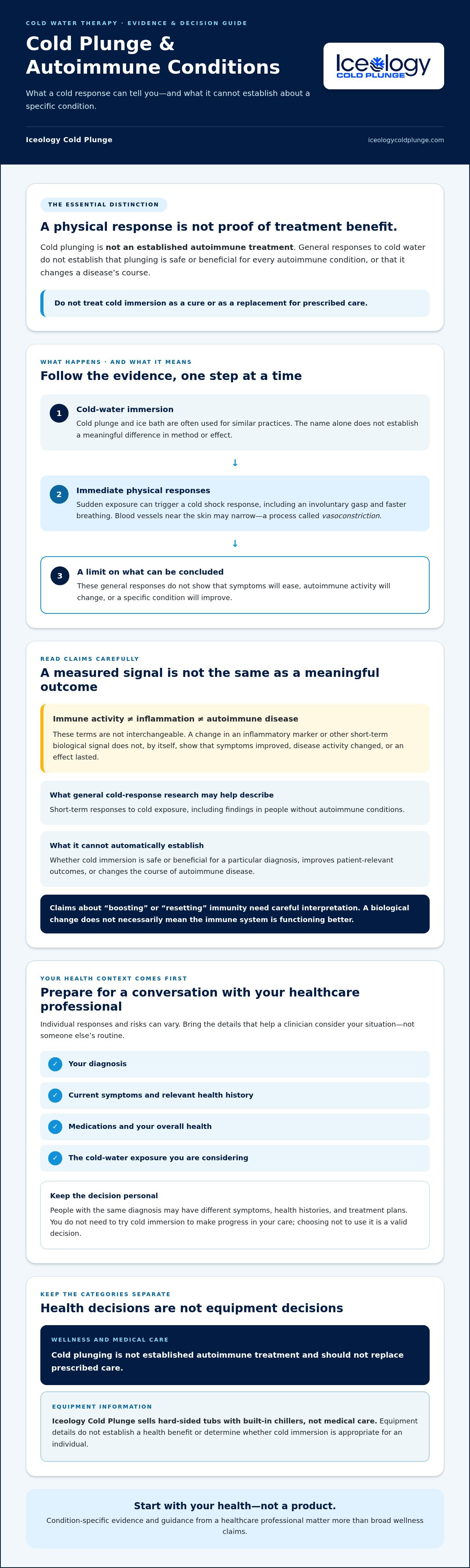
Cold water prompts immediate physical responses, but observing a response is not the same as showing a health benefit. That distinction matters when evaluating cold plunge for autoimmune conditions: findings about the body’s short-term reaction to cold don’t establish what happens to a specific disease over time.
What happens during cold-water exposure?
Sudden cold-water exposure can trigger a cold shock response, which may include an involuntary gasp and faster breathing. The body may also narrow blood vessels near the skin, a process called vasoconstriction. These are general responses to cold, not evidence that symptoms will ease or autoimmune activity will change.
How a person responds can vary with the exposure and their individual health context. A general description of physiology can’t establish whether immersion is safe for someone with a particular diagnosis. Specific responses, risks, and evidence should be checked against credible clinical sources before publication, especially where research concerns people without autoimmune conditions.
Why immune-system claims need careful interpretation
“Immune activity,” “inflammation,” and “autoimmune disease” aren’t interchangeable terms. A study may measure a change in an inflammatory marker or another short-term biological signal. That result alone doesn’t show that a person’s symptoms improved, that disease activity changed, or that the effect lasted.
A measured short-term response is not evidence of clinical benefit. To support a claim about an autoimmune condition, research needs to assess meaningful health outcomes in people with that condition. Findings from studies of healthy adults or athletes may help researchers understand general cold responses, but they can’t automatically be applied to people with autoimmune disease. Even a change in a marker needs context: what was measured, in whom, and whether it corresponds to an outcome that matters to patients.
That’s why broad claims about “boosting” or “resetting” immunity deserve caution. A biological change doesn’t necessarily mean the immune system is functioning better, and it doesn’t establish that cold exposure treats or improves an autoimmune disease. For individual decisions, condition-specific evidence and a clinician’s guidance matter more than a wellness claim.
If a healthcare professional agrees that cold immersion is appropriate for you, equipment remains a separate consideration, not medical care. Iceology Cold Plunge makes hard-sided tubs with built-in chillers. Learn more about Iceology Cold Plunge tubs without treating equipment features as evidence of a health effect.
Cold Plunge and Autoimmune Conditions: Evidence, Limits, and Common Misconceptions
Claims about cold water and “immune benefits” can sound relevant to autoimmune health, but the evidence needs to match the claim. Research on general responses to cold exposure isn’t the same as research showing that cold plunging improves a particular autoimmune condition. For cold plunge for autoimmune conditions, don’t assume condition-specific benefits without relevant clinical evidence.
Does cold plunging help autoimmune conditions?
The direct answer is that broad wellness claims don’t establish that it helps. A personal account may describe one person’s experience, but it can’t show whether cold exposure caused the change or predict what another person will experience. Controlled research can offer stronger evidence, yet its relevance depends on who took part, what was measured, and whether the study examined the condition and outcomes in question.
A 2025 systematic review in PLOS ONE examined randomized trials of cold-water immersion, but research into general cold-exposure responses does not, by itself, demonstrate a benefit for autoimmune disease. Evidence about a specific diagnosis, symptom, or outcome shouldn’t be generalized to other conditions. Nor should a change in a measured marker be presented as proof of improved symptoms or altered disease activity.
Keep the claims distinct:
- What evidence may support: researchers can measure responses to cold exposure in the populations they study.
- What remains uncertain: whether those findings apply to a person with a particular autoimmune condition.
- What is not established: cold plunging as a cure, treatment, immune reset, or substitute for prescribed care.
Could cold exposure feel unsuitable for some people?
Possibly. Cold immersion is a physical stressor, and comfort and responses can differ between individuals. A routine that someone describes as manageable doesn’t establish that it will feel suitable for you or that it’s appropriate alongside your health history and care plan.
There isn’t one answer that applies across autoimmune diagnoses, symptom patterns, or individual circumstances. If you’re considering exposure, ask a healthcare professional who understands your situation to help assess whether it’s appropriate. Don’t rely on an online anecdote or a general wellness claim to make that decision, and don’t change prescribed care based on cold-plunge claims. Choosing not to try it is also a reasonable choice.
How to Discuss Cold Plunging With Your Healthcare Professional
A clinician-led conversation can help you assess whether cold exposure fits your circumstances, rather than relying on a routine designed for someone else. This isn’t a request for a blanket yes or no. It’s a chance to share relevant details and ask for advice based on your diagnosis, current health, and care plan. The discussion supports individual medical advice; it doesn’t replace it.
Questions to bring to a medical appointment
Before the appointment, describe what you’re considering as clearly as you can. Share your specific diagnosis, current symptoms, relevant health history, and the exposure you have in mind. You don’t need to arrive with a set temperature or schedule. The goal is to make sure your healthcare professional understands what you’re asking about.
Questions you might raise include:
- Does my specific condition or current health situation raise concerns about cold-water immersion?
- Could my existing care plan or medications affect whether I should consider it?
- What symptoms or changes should prompt me to stop and contact you for medical guidance?
- If you think it may be appropriate, what individualized guidance should I follow?
These questions keep the conversation grounded in your situation. Avoid treating a clinician’s general comments about cold exposure as approval for every method or routine. If you’re uncertain about what they recommend, ask them to clarify before making a decision. For individuals seeking more information on how prescription medications and autoimmune flare-ups are managed, you can discover Healthy Gut to explore digestive and immune health resources.
If a clinician says cold exposure may be considered
Follow the guidance they give you, not a generic online protocol or another person’s account. There’s no universal temperature, exposure duration, or routine to apply to everyone with an autoimmune condition. If you feel unwell during or after exposure, stop and contact a healthcare professional as appropriate. Ask your clinician what follow-up makes sense for your circumstances.
A simple record of your experience may be useful only if your clinician agrees. If they recommend tracking it, keep the notes neutral: record what happened and how you felt, rather than assuming a change was caused by cold immersion. Bring those observations back to your healthcare professional for interpretation. Don’t change prescribed treatment based on an experience or online claims.
Taking time to ask questions is a meaningful step. You can decide not to try cold exposure, or revisit the conversation later if your health circumstances change. If your clinician considers it appropriate, keep any equipment decision separate from medical advice: a tub is equipment, not treatment.
Choosing Cold-Plunge Equipment Without Confusing It With Treatment
After weighing the evidence and discussing your circumstances with a healthcare professional, you may decide cold-water immersion isn’t right for you, or you may independently choose to consider it. Either way, keep the health decision separate from equipment research. A tub is not medical care, and no equipment feature establishes a benefit for autoimmune disease.
That distinction matters when considering a cold plunge for autoimmune conditions. A chiller’s cooling capability describes what the equipment can do, not what temperature is appropriate for you or whether immersion is medically suitable. Follow your clinician’s individualized guidance for health decisions, rather than treating a product specification as a recommendation.
What equipment features can, and cannot, tell you
Iceology Cold Plunge designs and manufactures hard-sided tubs with built-in chillers. The tubs are made in the USA, and the chiller can lower water temperature to 39°F. These are equipment details only. The stated cooling capability isn’t a medically recommended setting, and it doesn’t show that using the tub will affect autoimmune symptoms or disease activity.
Assess equipment only if you’ve independently decided it fits your needs. Review the available product information to understand the tub and chiller features, then consider whether that setup suits your intended use. Don’t assume that the tub, its materials, or an accessory changes the health effects of cold exposure. A feature can describe how equipment functions without proving anything about treatment.
A measured next step for interested readers
Keep your healthcare professional’s advice at the center of any personal decision about cold immersion. If you haven’t discussed it with them, equipment research doesn’t need to come first. You can pause, ask questions, and decide not to proceed. There’s no obligation to buy or try a cold plunge to support your health.
If you’ve already decided that equipment research is useful, review Iceology Cold Plunge’s information with that clear boundary in mind: it’s an equipment option, not medical care or evidence of an autoimmune benefit. Let your personal health decision stand on clinician guidance, not on cooling capacity or product claims.
Make Your Next Step an Informed One
Cold exposure creates physical responses, but those responses don’t establish a lasting benefit for autoimmune disease. The evidence for a cold plunge for autoimmune conditions remains uncertain, and general wellness claims shouldn’t be treated as proof for a specific diagnosis. Your condition, symptoms, health history, and care plan matter, so discuss personal suitability with your healthcare professional before deciding.
If you choose to explore equipment, keep that decision separate from medical advice. Iceology Cold Plunge tubs are made in the USA and have built-in chillers that can lower water temperature to 39°F. These are equipment details, not treatment recommendations or evidence of autoimmune benefit.
There’s no pressure to try cold immersion. Ask questions, weigh your options, and choose the path that feels right for your circumstances.
Frequently Asked Questions
Is cold plunging safe for people with autoimmune conditions?
Safety can’t be determined for everyone from an autoimmune diagnosis alone. Conditions, symptoms, health histories, and care plans differ, so one person’s experience doesn’t establish what’s appropriate for someone else. Before trying cold exposure, discuss it with a healthcare professional who understands your circumstances. They can help you consider personal concerns and what guidance applies to you. There’s no universal answer or routine that suits everyone.
Can cold plunging reduce inflammation caused by an autoimmune condition?
That benefit shouldn’t be assumed. General claims about cold exposure or changes in biological markers don’t establish a meaningful effect on a specific autoimmune disease, its symptoms, or its course. The relevant question is whether research has studied people with your condition and outcomes that matter to you. Ask a qualified healthcare professional how to interpret condition-specific evidence, and don’t use cold plunging as a substitute for prescribed care. For individuals managing autoimmune disorders through medically supervised treatments, specialized providers like Vital Care of Syracuse offer home infusion therapies to support ongoing clinical care plans.
“Strengthen” and “reset” aren’t precise clinical outcomes, so those phrases can make cold exposure sound more certain than the evidence supports. A short-term body response doesn’t demonstrate improved immune health or treatment of autoimmune disease. Any explanation of physiological effects should be checked against current, credible sources and interpreted in light of who was studied. Immune activity, inflammation, and disease outcomes aren’t interchangeable measures.
Should I ask my doctor before trying a cold plunge with an autoimmune condition?
Yes, discuss the idea with a healthcare professional familiar with your diagnosis and health circumstances before trying cold exposure. Share your current symptoms, relevant health history, and what kind of exposure you’re considering. Ask whether your situation raises concerns, what signs should prompt you to stop and seek guidance, and whether your care plan affects the decision. General online information can help prepare questions, but it can’t replace individualized medical advice.
Can cold plunging make autoimmune symptoms worse?
It can’t be said that cold plunging will or won’t worsen symptoms for everyone. Individual responses and health circumstances differ, and evidence about one condition or group shouldn’t automatically be applied to another. Ask your healthcare professional whether condition-specific evidence or personal factors are relevant to your decision. If you try cold exposure with their guidance and feel unwell, stop and contact a healthcare professional as appropriate.
What should I consider before choosing a cold plunge tub for wellness?
Separate the health decision from the equipment decision. If you have an autoimmune condition or health concerns, discuss cold exposure with a healthcare professional first. If you independently decide a tub suits your needs, assess its stated features without treating them as medical benefits. For example, Iceology Cold Plunge tubs are made in the USA and have built-in chillers that can lower water temperature to 39°F. These are equipment details, not treatment recommendations.