
Cold Plunge for Improving Deep Sleep Cycles: What Science Says in 2026
Could a cold plunge help you sleep more deeply, or might the timing leave you feeling alert instead? Interest in a cold plunge for improving deep sleep cycles is growing, but the effects aren’t as simple as “colder means better sleep.” Research suggests cold-water immersion may support short-term sleep quality. Evidence about deep sleep specifically is more limited.
It’s understandable to want a clear answer when claims about cold exposure and bedtime point in different directions. Deep sleep and REM sleep are distinct stages, while sleep quality describes the broader experience of resting well. A change in one doesn’t automatically mean the others have improved.
This article separates those measures, looks at what current research can and can’t establish, and explains why timing and individual response may matter. You’ll also find a practical way to observe your own response without treating cold exposure as a sleep cure or assuming a change on a wearable device proves a meaningful improvement.
Key Takeaways
- Learn why deep sleep, REM sleep, and overall sleep quality are different measures, and why a change in one doesn’t automatically signal a change in the others.
- Explore what emerging research suggests about cold exposure and sleep, while keeping the limits of current evidence in view.
- Consider how plunge timing may affect your experience. An evening session isn’t automatically more sleep-promoting.
- Use a simple observation routine and change one variable at a time to better understand your own response.
- See how Iceology Cold Plunge’s Grizzly 450 supports consistent cold-water access, without treating its features as evidence that a cold plunge for improving deep sleep cycles is guaranteed.
Cold Plunge and Deep Sleep Cycles: What the Connection Really Means
Can cold-water immersion genuinely increase deep sleep, or might it simply change how rested you feel? The balanced answer depends on what “better sleep” means and how it’s measured. A cold plunge is an intentional immersion in cold water. Claims about its effects may refer to relaxation, perceived sleep quality, sleep duration, or changes in sleep stages. Those outcomes are related, but they aren’t interchangeable.
What counts as deep sleep, and how does it differ from REM?
Sleep cycles through stages of non-rapid eye movement (NREM) and rapid eye movement (REM) sleep. Deep sleep is the deepest NREM stage, often called N3 or slow-wave sleep. REM is a separate stage, associated with vivid dreaming and distinct patterns of brain and body activity. Lighter NREM stages also matter: sleep is a sequence of changing states, not a contest in which one stage is always best. This overview of sleep stages and their importance provides more context on how those stages fit together.
Deep sleep is the slow-wave NREM stage, while REM is a separate sleep stage with its own characteristic brain and body patterns. Feeling refreshed after a night’s sleep can’t show whether N3, REM, or another part of the night changed. Feeling rested is useful personal feedback, not a measurement of sleep stages.
What does the phrase cold plunge for sleep actually claim?
The phrase cold plunge for improving deep sleep cycles can bundle together several different claims. A plunge might feel calming to one person and stimulating to another. A report of improved sleep quality might mean someone felt more satisfied with their rest. It doesn’t necessarily mean they slept longer or spent more time in deep sleep. Those outcomes need to be described separately.
- Relaxation describes a person’s immediate sense of calm or tension.
- Sleep quality often refers to a broader experience, such as how restorative or uninterrupted sleep seems.
- Sleep duration is the time spent asleep.
- Sleep architecture describes how sleep is distributed across stages, including NREM and REM.
To establish a change in sleep architecture, researchers need to measure sleep stages, rather than rely only on someone’s impression of the night. A personal story can be meaningful as an account of experience, but it can’t establish that the plunge caused the change. Exercise, stress, schedule, and other routine shifts may also affect sleep. Iceology Cold Plunge’s guide to the scientific benefits of cold plunging offers broader context for evaluating cold-exposure claims. The same distinction applies here: a possible wellness benefit is not proof of a specific sleep-stage effect.
How Cold Water Immersion May Interact with Deep Sleep and REM
Cold exposure creates an immediate physical challenge, followed by a recovery period. That sequence gives researchers plausible ways to investigate sleep, including changes in alertness, heart rate patterns, and temperature regulation. But a possible pathway is not the same as a demonstrated outcome. If you’re exploring a cold plunge for improving deep sleep cycles, ask whether research measured sleep stages directly or only asked participants how well they slept.
Cold exposure, alertness, and the body’s recovery response
Immersion in cold water can prompt an acute stress response. A person may feel more alert during or shortly after a plunge, and the body’s response can differ with the individual, exposure conditions, and timing. As the body recovers, some measures may shift in the opposite direction, but a predictable transition into relaxation isn’t guaranteed.
Researchers have proposed that changes in heart rate variability and parasympathetic activity could be relevant to recovery. These are mechanisms to investigate, not proof that cold exposure reliably shifts the body into a sleep-ready state. A plausible mechanism does not establish a clinical sleep outcome. Feeling calm after a plunge is a real experience, but it doesn’t confirm that deep sleep or REM has changed.
What research can say about sleep stages and temperature
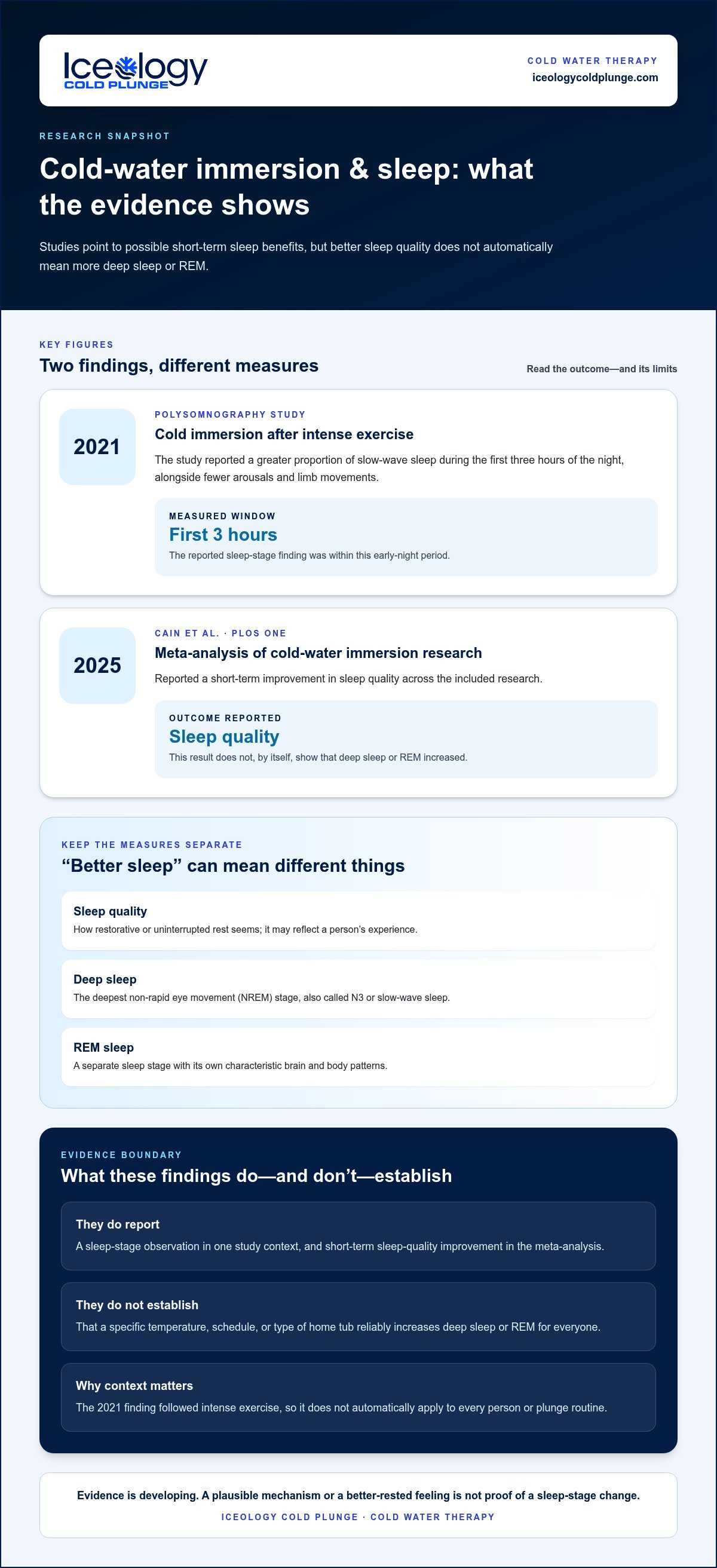
A 2021 polysomnography study examined whole-body cold immersion after intense exercise. It reported a greater proportion of slow-wave sleep during the first three hours of the night, alongside fewer arousals and limb movements. Polysomnography measures sleep physiology, making this different from a participant simply reporting better rest. Still, the setting matters: findings after intense exercise don’t automatically apply to everyone, every plunge routine, or cold plunge tubs used at home.
Other evidence addresses a different outcome. Cain et al.’s 2025 meta-analysis in PLOS ONE reported short-term improvement in sleep quality across the included cold-water immersion research. Sleep quality findings can reflect how participants experienced their rest. They don’t, by themselves, show that deep sleep or REM increased. The evidence is developing, and the studies don’t establish that a specific temperature, schedule, or type of tub produces a dependable stage-level effect.
Core body temperature follows a daily rhythm associated with sleep and wake timing. That makes temperature a reasonable subject for sleep research, but it doesn’t prove that cooling the body through immersion will improve sleep architecture. The plunge’s timing and the body’s individual response could shape the experience. Claims about a universal nervous-system shift or a guaranteed deep-sleep effect go beyond what these findings establish.
For consistent cold-water access at home, Iceology Cold Plunge offers home cold plunge tubs. Equipment can make access more convenient, but it can’t turn an emerging research question into a promised sleep result.
Cold Plunge Before Bed vs. Earlier: Timing, Trade-Offs, and Misconceptions
A cold plunge immediately before bed isn’t automatically sleep-promoting. Cold water can feel invigorating in the moment, and that alerting response may work against winding down for some people. Others may feel calmer later. Neither response establishes a universal best time, so treat timing as a personal factor to observe rather than a fixed bedtime rule.
Could an evening cold plunge feel stimulating?
Yes. The body’s immediate response to cold can include increased alertness, which may make it harder for some people to transition into a relaxing evening routine. A later sense of calm is also possible, but it doesn’t cancel out the initial response or happen for everyone. Pay attention to how you feel after immersion, not just how you hope it will affect sleep.
Earlier-day exposure
May fit more easily into a routine that leaves time to notice your response before bedtime. It may still feel stimulating or uncomfortable, depending on the person and circumstances.
Evening exposure
May suit someone who finds the later experience calming, but the immediate alerting response could make winding down harder for others. Consider how it fits with your usual sleep schedule.
These are considerations, not predictions. The table can help you think through a choice, but it can’t tell you how your body will respond on a given day.
Why timing claims need individual context
Daily routines, sleep schedules, and sensitivity to cold vary. A plunge after a demanding workout may feel different from one on a quiet day, and a time that works around one person’s bedtime may not fit another’s. One author’s timing or frequency is a personal routine, not an evidence-based prescription for everyone. Iceology’s broader guide to cold-water immersion therapy can add context about the practice, but it can’t establish a sleep schedule that suits every individual.
If you’re exploring a cold plunge for improving deep sleep cycles, keep the question specific: does the timing leave you feeling more alert, more settled, or unchanged as bedtime approaches? Track the experience alongside your regular sleep routine rather than assuming a plunge caused any difference. A wearable score or a single restful night may offer a clue, but neither proves that a particular sleep stage changed.
There’s no need to force cold exposure into the last moments before bed to make it part of a wellness routine. Iceology Cold Plunge offers home cold plunge tubs for consistent cold-water access. The equipment supports the routine; your own response should guide how it fits into your day.
How to Test a Cold Plunge Sleep Routine Without Guesswork
A useful personal experiment doesn’t need to become a strict sleep protocol. The aim is to notice whether cold exposure seems to fit your routine, not to prove that it changes deep sleep. Keep the observation simple and resist changing several habits at once. If bedtime, exercise, caffeine, and plunge timing all shift together, it’s difficult to tell what might be influencing how you feel.
A measured approach to observing your response
Choose one routine variable to observe, such as when you plunge in relation to bedtime. Keep other sleep habits as consistent as practical while you notice what happens. Record observations in a brief journal rather than relying on memory alone. Consistency makes comparisons more meaningful, without turning the process into a treatment plan or a promise of better rest.
For each night you’re observing, note a few simple details:
- Whether you plunged, and the approximate time in relation to bedtime.
- Your usual bedtime and whether it shifted that night.
- How settled or alert you felt as you got ready for sleep.
- Your subjective sense of morning restfulness, including whether the night felt unusually disrupted.
- Major routine changes, such as a later workout or an unusual evening schedule.
Look for a repeated pattern across nights, not a conclusion from one unusually good or poor night. Consistent observations are more useful than a single sleep score because they show whether a pattern repeats amid ordinary variation. Even then, a pattern can’t establish cause and effect. It can help you decide whether the routine seems comfortable and worthwhile for you.
If you use a consumer sleep tracker, treat its stage estimates as approximations, not diagnoses or definitive measurements of deep sleep and REM. A device may help you notice broad trends, but a score for one night can’t tell you with certainty what happened in each sleep stage. Include your own experience in the record, too, and avoid treating the tracker’s number as a verdict on your routine.
When to pause and seek qualified guidance
If the routine consistently seems to worsen your sleep, or the experience causes concern, pause rather than pushing through in pursuit of a hoped-for benefit. People with health concerns or questions about whether cold exposure is appropriate for them can seek individualized guidance from a qualified healthcare professional. This observation framework isn’t a substitute for medical advice, and it shouldn’t be used to diagnose or treat a sleep condition.
Thoughtful tracking can help you describe your experience more clearly, but it can’t guarantee a result from a cold plunge for improving deep sleep cycles. Keep the goal modest: learn what you notice, preserve what’s already working in your sleep routine, and adjust only when your observations give you a reason to reconsider.
Choosing a Cold Plunge for a Consistent Sleep-Wellness Routine
Once you’ve considered the limits of sleep research and your own response to cold, equipment becomes a practical question of access and routine. A plunge tub can make cold-water immersion available at home, but it can’t determine whether the practice suits your sleep schedule or how you’ll feel afterward. Think of the equipment as a way to support a cold-water routine, not as a sleep intervention.
How controlled chilling can support routine access
Iceology Cold Plunge’s Grizzly 450 has a built-in Active Aqua chiller, so it cools water without requiring added ice. The standard chiller is 1/4 HP, with an optional 1/2 HP upgrade, and regulates water between 39 and 41°F. The water can reach 39°F. This built-in system provides controlled cold-water access as part of the tub itself.
The Grizzly 450 has two-inch pressure-injected polyurethane foam insulation. That construction helps maintain cold water; it doesn’t establish a particular energy outcome or a sleep benefit. For a routine, the practical consideration is having a consistent setup available, while choosing whether and when to use it remains a personal decision. A reliable water temperature is an equipment feature, not a prescription for bedtime or a reason to assume colder is better for sleep.
What the Grizzly 450 offers, and what it can’t promise
An integrated ozone generator is another feature of the Grizzly 450. It’s part of the tub’s setup, not a medical benefit or evidence of improved rest. The product specifications describe how it provides cold-water immersion at home; they don’t show that the tub changes sleep stages.
That distinction is especially important if your goal is a cold plunge for improving deep sleep cycles. Current research doesn’t support treating a consistent setup as a guarantee of deeper sleep, more REM, or relief from a sleep disorder. Individual responses and timing still matter, and equipment can’t replace qualified care for ongoing sleep concerns.
If cold-water immersion fits your broader wellness routine, the Grizzly 450 offers a home option with built-in chilling and insulated construction. Choose a tub based on practical needs such as access to a built-in chiller and the space available for the setup, not on an assumption that owning or using a cold plunge will produce a particular sleep result.
Make Your Next Step a Thoughtful One
Let your own observations guide what comes next. If cold exposure feels like a useful part of your wellness routine, keep exploring with curiosity rather than expecting a guaranteed change in deep sleep. The question of a cold plunge for improving deep sleep cycles is still developing, so a measured approach leaves room for both the research and your individual response.
If you’re considering a home setup, Iceology Cold Plunge’s Grizzly 450 is made in the USA and chills water without added ice. Choose equipment for the cold-water routine you want to support, not as a substitute for care or a promise of better sleep. Small, considered decisions can help you build a wellness practice that feels sustainable and personal.
Stay curious, pay attention to what works for you, and let consistency matter more than a single night’s result.
Frequently Asked Questions
Can a cold plunge cure insomnia?
No. A cold plunge shouldn’t be treated as a cure for insomnia or a replacement for evidence-based care. A cooling routine might feel relaxing for some people, but that experience doesn’t show it addresses the causes of persistent insomnia. If trouble sleeping continues to affect your work, mood, or daily functioning, speak with a qualified healthcare professional about appropriate care. Keep cold exposure optional, and don’t delay support while trying it.
Is cold plunging safe for everyone who wants better sleep?
No single cold-plunge routine is right for everyone, and general information can’t assess your individual medical risks. Cold exposure can place physical stress on the body. If you have health concerns, a relevant condition, or uncertainty about trying it, seek individualized advice from a qualified healthcare professional first. Don’t push through symptoms that concern you, and don’t treat online claims about sleep as personalized medical guidance.
Can a cold plunge help with jet lag?
There isn’t enough evidence here to say that a cold plunge treats jet lag or resets your body clock. Travel can shift sleep timing, and circadian rhythms involve more than exposure to cold water. A plunge during a trip shouldn’t be assumed to correct a new time-zone schedule. If disrupted sleep is persistent or severe, discuss it with a qualified healthcare professional rather than relying on cold exposure alone.
Does a cold plunge treat sleep apnea?
No. A cold plunge shouldn’t be considered a treatment for sleep apnea. General claims about relaxation or cold exposure don’t show that immersion addresses the breathing interruptions associated with this condition. If you’re concerned about possible symptoms, speak with a qualified healthcare professional about assessment and appropriate care. Don’t postpone a recommended evaluation or treatment in favor of trying a wellness routine.
How can I tell whether a cold plunge changes my sleep?
Look for a pattern across comparable nights, not a dramatic score from one morning. If you’re exploring a cold plunge for improving deep sleep cycles, note the session’s approximate timing, bedtime, and how rested you feel the next day. Keep other habits reasonably steady where practical. Consumer trackers estimate sleep stages and aren’t diagnostic tools, so treat their readings as one imperfect observation, not proof of a change.
Should I stop cold plunging if I feel more awake at bedtime?
If a plunge repeatedly leaves you feeling alert or unsettled at bedtime, don’t force yourself to continue. You could pause and notice whether the difficulty eases, or consider whether another time of day feels different, without assuming a timing change will solve it. If sleep disruption continues or you have health concerns, seek individualized guidance from a qualified healthcare professional before deciding how to proceed.