
Cold Plunge for Muscle Recovery: The Ultimate How-To Guide for 2026
You've just finished a heavy squat session and your first instinct is to jump straight into the ice, but doing so immediately after lifting might actually be sabotaging your hard-earned muscle growth. It's a common mistake in the pursuit of peak performance. Most athletes have felt the crushing weight of Delayed Onset Muscle Soreness (DOMS) after a high-intensity day, often resorting to messy, inconsistent bags of ice in a bathtub to find some semblance of relief. If you've ever felt the frustration of being too sore to train effectively the next day, you aren't alone. Using a cold plunge for muscle recovery is about more than just enduring the chill; it's about mastering the science of thermal management to achieve repeatable results.
This guide will empower you with the exact science-backed protocols needed to accelerate muscle repair and reduce systemic inflammation without blunting your gains. You'll learn how to transition from guesswork to a disciplined practice that enhances both mental clarity and sleep quality. We'll examine the latest 2026 standards for water safety and temperature precision, providing a clear roadmap to optimize your physical recovery. From timing your sessions to hitting the ideal temperature range of 39°F to 59°F, we've refined the details so you can focus entirely on your personal evolution.
Key Takeaways
- Understand the physiological mechanisms of vasoconstriction to efficiently flush metabolic waste and accelerate the body's natural healing process.
- Master the 11-minute rule by using a cold plunge for muscle recovery for a total of eleven minutes per week to achieve the "Minimum Effective Dose" for peak performance.
- Identify the optimal recovery window to ensure your cold water immersion sessions support rather than hinder your strength and hypertrophy gains.
- Learn why active water circulation in a chilled tub provides more effective cooling than traditional ice baths by breaking the body's insulating thermal layer.
- Get a professional blueprint for designing a home recovery station that prioritizes precise temperature control, proper ventilation, and long-term durability.
The Physiology of Cold Plunge for Muscle Recovery
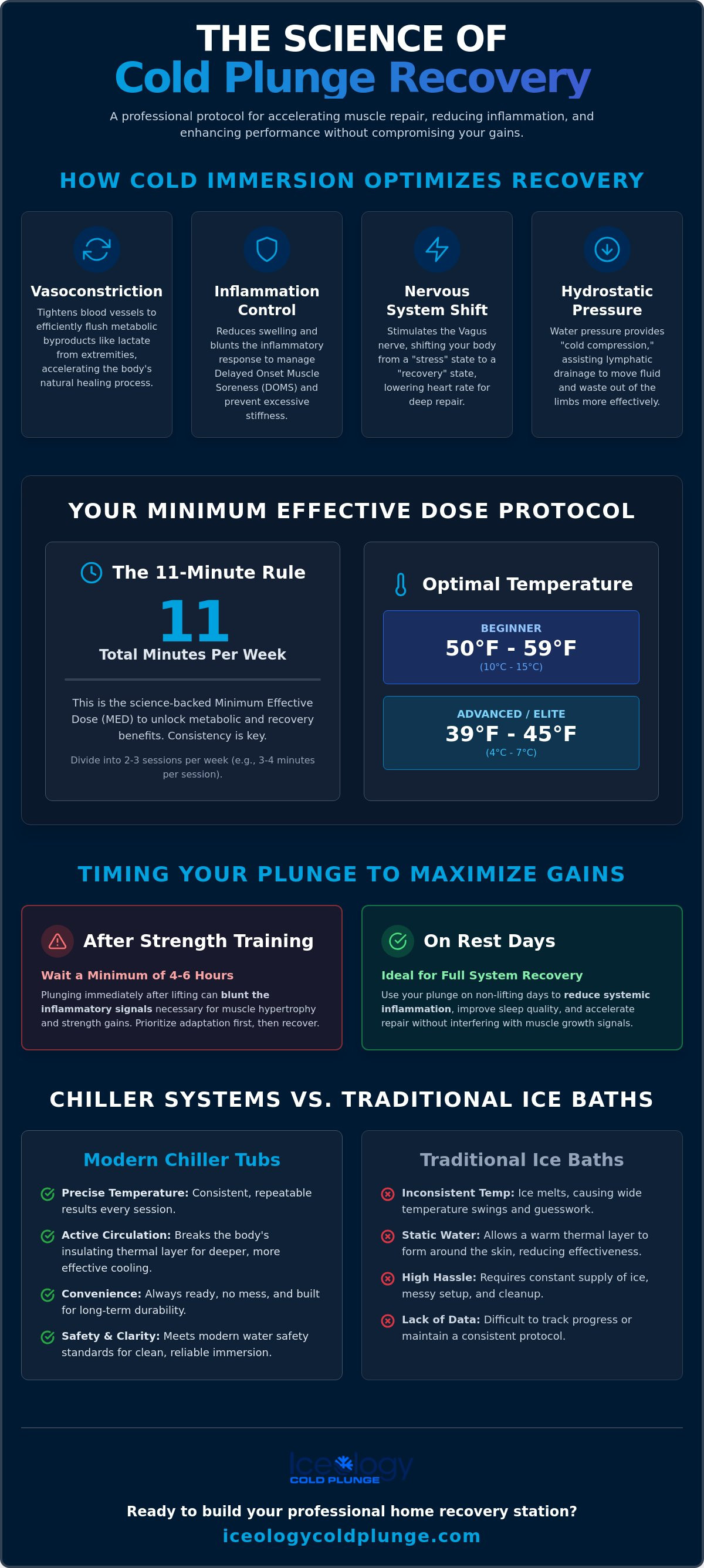
Implementing a cold plunge for muscle recovery is a tactical decision to optimize your biological reset. Cold water immersion (CWI) is no longer just a post-game ritual for elite athletes; it's a precision tool designed to manage the physiological stress of training. When you submerge in an Ice bath or a chilled tub, you're initiating a complex internal response. The primary mechanism is vasoconstriction. As the cold hits your skin, your peripheral blood vessels tighten, forcing blood toward your core to protect vital organs. This process effectively "flushes" metabolic byproducts like lactate from your extremities, clearing the way for repair.
This thermal shift also addresses secondary tissue damage and swelling. By lowering the temperature of the muscle tissue, CWI reduces edema and limits the chemical reactions that lead to further cellular breakdown. Beyond the physical, the cold acts as a catalyst for mental recovery. The initial shock stimulates the Vagus nerve, which is the main component of the parasympathetic nervous system. This stimulation helps shift your body from a sympathetic "stress" state into a parasympathetic "recovery" state. It lowers your heart rate and prepares your system for deep, restorative repair.
Combating Inflammation and DOMS
High-intensity training naturally triggers an inflammatory response as the body attempts to heal micro-trauma. Using a cold plunge for muscle recovery helps blunt this response, preventing excessive inflammation from causing unnecessary pain or stiffness. This is particularly effective for managing Delayed Onset Muscle Soreness. DOMS is characterized by micro-tears in muscle fibers that require oxygenated blood flow for repair. By controlling the inflammatory cascade, you can significantly reduce the window of time you spend feeling immobile between training sessions. You aren't just masking the pain; you're modulating the body's recovery timeline.
The Hydrostatic Pressure Factor
Immersion offers a mechanical advantage that cold showers simply cannot match. When you submerge in a hard-sided tub, the water exerts hydrostatic pressure on your body. This pressure assists in lymphatic drainage, helping to move fluid and waste products out of the limbs and back toward the heart for processing. It creates a synergistic effect where the cold reduces the volume of fluid while the pressure physically moves it. This "cold compression" is vital for athletes who need to maintain peak performance through consecutive days of heavy lifting. It ensures that every minute spent in the water is working toward total-body optimization.
Your Cold Plunge Protocol: Temperature, Time, and Frequency
Establishing a protocol is the bridge between a simple dip and a disciplined recovery practice. For those using a cold plunge for muscle recovery, the goal is to find the Minimum Effective Dose (MED). You don't need to stay in until you're numb; you only need to stay in long enough to trigger the body's adaptive response. Research suggests that the "11-minute rule" is the gold standard for weekly exposure. This means that 11 minutes of total immersion per week, divided into two or three sessions, is sufficient to unlock metabolic and recovery benefits. Consistency over time will always outperform a single, heroic session that leaves you too depleted to train.
Safety remains the foundation of any high-performance routine. When you're first acclimating to the cold shock, you should never plunge alone. Having a partner present ensures that if the initial shock becomes overwhelming, you have immediate support. Before you even touch the water, practice the "Sober Second." This is a moment of honest physical assessment. If you're feeling unusually lightheaded, sleep-deprived, or ill, it's better to skip the session. A professional recovery mindset means knowing when to push and when to prioritize rest.
Finding Your Optimal Temperature
Precision is what separates a professional setup from a DIY experiment. Beginners should aim for a range between 50°F and 59°F. This temperature is cold enough to trigger cold shock proteins without being dangerously restrictive for the uninitiated. As your resilience grows, you can graduate to advanced zones. Elite athletes often target the 39°F to 45°F range to maximize the anti-inflammatory effects. Using a dedicated cold plunge tub with an integrated chiller ensures these temperatures remain stable, providing a level of precision that manual ice addition simply can't match.
Step-by-Step Entry and Breathwork
Mastering the entry is a mental game as much as a physical one. Follow these steps to maintain control:
- Step 1: The Initial Shock. Focus on a slow, controlled exhalation as you submerge. This prevents the reflexive gasp that can lead to hyperventilation.
- Step 2: Box Breathing. Once submerged, use box breathing (inhale for four, hold for four, exhale for four, hold for four) to lower your heart rate and signal safety to your brain.
- Step 3: The Hands and Feet Rule. If the pain is too intense, keep your hands and feet out of the water. These extremities have high surface-area-to-volume ratios and lose heat the fastest.
- Step 4: Natural Rewarming. Exit the tub slowly. Instead of jumping into a hot shower, allow your body to rewarm naturally. This "sobering up" period encourages your metabolism to work harder, extending the recovery benefits of the session.
Timing Your Plunge: Post-Workout vs. Rest Days
Strategic timing is the difference between a recovery routine that supports your goals and one that actively undermines them. The most frequent question athletes ask is whether using a cold plunge for muscle recovery will "kill their gains." It's a valid concern rooted in the body's natural signaling processes. When you lift heavy weights, you create a controlled inflammatory response. This inflammation is the primary signal for muscle growth and adaptation. If you submerge in freezing water immediately after a session, you risk blunting that signal before it can trigger the necessary repairs.
For strength and hypertrophy athletes, the consensus is to wait. Research indicates a 4-to-6 hour window is necessary for the body to establish its initial repair signals. By delaying your session, you allow the primary inflammatory markers to do their work before applying the cold to manage systemic soreness. Conversely, on non-training days, the cold serves as a powerful Central Nervous System (CNS) reset. It assists in shifting the body out of a chronic "fight or flight" state, allowing for deeper systemic recovery that carries over into your next training block. This intentional delay ensures your hard work in the gym translates into physical results.
The Hypertrophy Paradox
The science centers on mTOR signaling, the primary pathway for muscle protein synthesis. Cold exposure can dampen this pathway if applied too close to resistance training. This creates a paradox: the cold makes you feel better, but it might limit your total growth potential. To navigate this, prioritize your plunge on cardio-focused days or during deload weeks. During "in-season" maintenance where performance matters more than raw growth, immediate plunging is acceptable. If you're in an "off-season" mass phase, keep the cold away from your heavy lifting sessions to maximize every ounce of progress. Discipline in timing is just as important as discipline in the tub.
Endurance and Conditioning Recovery
Endurance athletes operate under a different set of physiological rules. Runners, cyclists, and triathletes often face the challenge of elevated core temperatures and systemic heat stress. For these individuals, using a cold plunge for muscle recovery immediately after a session is highly beneficial. It brings the core temperature back to baseline quickly, reducing the strain on the cardiovascular system. This is especially critical for those performing "doubles" or two-a-day training sessions. Rapid cooling between sessions ensures the second workout is just as productive as the first. You can explore more on these metrics in our guide on The Benefits of Cold Plunge for Physical Performance. Precision in timing ensures your recovery matches the specific demands of your sport.
Chiller Systems vs. Ice Baths: The Recovery Difference
Choosing between a manual ice bath and a dedicated chiller system is more than a matter of convenience; it's a matter of biological efficiency. When you sit in a traditional tub filled with stagnant water and ice, your body immediately begins to warm the water directly surrounding your skin. This creates a "thermal layer" or sleeve of slightly warmer water that acts as an unintended insulator. This insulation slows the rate of cooling and prevents the cold from penetrating deep into the muscle tissue. A circulating system solves this by keeping the water in constant motion, effectively breaking the thermal sleeve and ensuring your cold plunge for muscle recovery provides maximum impact from the first second to the last.
Beyond the physics of cooling, there's the psychology of friction. High-performance recovery requires consistency, yet the logistical burden of purchasing, transporting, and dumping 40 to 60 pounds of ice for every session is a significant barrier. When you remove this friction, compliance becomes effortless. A dedicated system is always ready at your target temperature, transforming a chore into a seamless part of your daily discipline. Investing in an insulated, hard-sided tub also offers superior energy efficiency. High-density insulation ensures the water stays cold without forcing the chiller to run constantly, making it a sustainable, long-term asset for your physical longevity.
Precise Thermal Management
Precision is the hallmark of professional recovery. While many casual users settle for "cold enough," elite athletes often target the 39°F gold standard to maximize metabolic benefits and the release of cold shock proteins. Manual ice baths often fluctuate, frequently hovering in a "lukewarm" zone above 60°F that fails to trigger the body's full adaptive response. Consistent temperature control is the variable that separates professional recovery from casual use. This level of accuracy allows you to fine-tune your sessions based on your specific training load and recovery needs.
Durability and American Craftsmanship
The structural integrity of your setup directly impacts your safety and the effectiveness of your sessions. Hard-sided tubs provide the necessary stability for controlled, deep-immersion recovery, allowing you to focus entirely on your breathwork rather than the stability of the vessel. Selecting USA-made cold plunge tubs ensures you're receiving a product built with high-grade components and meticulous attention to detail. These systems often utilize advanced polyurethane foam insulation to maintain thermal integrity, keeping your performance high while keeping operational costs low. To elevate your home setup with a system built for longevity, explore our professional recovery systems designed for peak efficiency.
Building Your Professional Home Recovery Station
Creating a dedicated space for your cold plunge for muscle recovery is the final step in professionalizing your physical maintenance. It's about intentional environment design. You need a location with a stable, level surface capable of supporting the significant weight of a filled, hard-sided tub. Logistics are paramount. Ensure you have access to a drainage point for periodic water changes and a dedicated power outlet for the chiller system. If you're setting up indoors, proper ventilation is crucial to manage the ambient moisture that naturally occurs with cold water immersion. A well-planned layout prevents the friction that often leads to skipped sessions.
Your station should be more than just a tub; it's a sanctuary for performance. Include high-quality non-slip mats to ensure a safe transition when exiting the water with cold, damp feet. Keep a digital timer within your line of sight to track your exposure precisely, and have heavy, absorbent towels ready for the natural rewarming process. Many athletes choose to integrate their plunge into a total wellness routine by pairing it with a sauna. This contrast therapy alternates between extreme heat and cold to further stimulate blood flow and metabolic efficiency, ensuring you're addressing recovery from every biological angle.
Setup and Maintenance Essentials
Filtration is a non-negotiable component for any recovery tub used on a daily basis. Without a robust system, skin oils and environmental debris can quickly compromise water quality. Maintaining proper water chemistry is essential for both hygiene and the longevity of the equipment. Use a simple testing kit to monitor sanitizer levels, keeping the environment pristine for every session. Beyond the technical requirements, consider the aesthetics of your placement. Creating a 'Zen' space free from distractions helps you focus on your breathwork. This mental clarity is a vital part of the recovery process, turning a physical challenge into a tool for long-term resilience.
The Iceology Cold Plunge Experience
Iceology Cold Plunge tubs are engineered to meet the specific rigors of high-level athletic recovery. Every component, from the structural housing to the thermal management system, is built for durability and precision. Unlike manual setups that require constant monitoring, our integrated chillers allow you to reach that 39°F threshold at the touch of a button. This provides the consistency required for long-term physiological adaptation. You've mastered the science of the cold plunge for muscle recovery; now it's time to invest in the craftsmanship that supports your journey. Explore Iceology Cold Plunge's Premium USA-Made Recovery Tubs to finalize your home recovery station and optimize your physical potential.
Master Your Physical Evolution
Consistency is the final variable in the science of recovery. We've defined the physiological benefits of cold water immersion and established the precise protocols needed to protect your hard-earned muscle gains. Mastering a cold plunge for muscle recovery is no longer a luxury reserved for elite professionals; it's a foundational practice for anyone committed to sustained peak performance. By prioritizing the 11-minute weekly rule and respecting the critical hypertrophy window, you're transforming your body's ability to manage systemic stress and repair tissue with efficiency.
True progress requires precision and reliable equipment that matches your dedication. Optimize Your Recovery with an Iceology Cold Plunge. Our systems are handcrafted in the USA and utilize military-grade polyurethane foam insulation for superior thermal management. With the power to chill water down to a precise 39°F at the touch of a button, you can eliminate the logistical friction of manual ice and focus entirely on your physical results. Take control of your recovery state today. Your path to optimized performance and long-term resilience is waiting in the cold.
Frequently Asked Questions
Is a cold plunge better than an ice bath for muscle recovery?
A cold plunge is superior because it maintains a precise temperature and circulates water to prevent a warm thermal layer from forming around your skin. While traditional ice baths allow stagnant water to warm up near the body, the constant movement in a chilled tub ensures deeper, more consistent cooling. This structural advantage maximizes the physiological impact of every session. It also removes the logistical burden of purchasing and transporting heavy bags of ice.
How long should I stay in a cold plunge for muscle recovery?
You should aim for two to five minutes per session to trigger the desired adaptive response. Research indicates that the minimum effective dose for metabolic and recovery benefits is approximately 11 minutes of total weekly exposure. Spending more time in the water doesn't necessarily lead to better results and may increase the risk of overexposure. Focus on high-quality, disciplined sessions rather than endurance contests to optimize your physical state.
Should I cold plunge immediately after lifting weights?
You should wait at least four to six hours after resistance training before submerging to avoid blunting your gains. Cold exposure immediately after lifting can dampen the inflammatory signaling required for muscle hypertrophy and strength adaptations. If your primary goal is building muscle, it's better to use a cold plunge for muscle recovery on rest days or after cardiovascular sessions. This timing preserves your hard-earned progress while managing systemic soreness.
What is the best temperature for a cold plunge post-workout?
The optimal temperature range for most athletes is between 39°F and 59°F. Beginners should start at the higher end of this spectrum to build cold shock protein resilience safely and comfortably. Advanced users often find that temperatures near 40°F provide the most profound metabolic and anti-inflammatory benefits. Integrated chiller systems allow you to maintain these specific zones with a level of precision that manual ice addition simply cannot match.
Can cold plunging help with joint pain as well as muscle recovery?
Cold water immersion is highly effective for managing joint pain by reducing systemic inflammation and edema. The cold constricts blood vessels and slows nerve conduction, providing an immediate analgesic effect for aching joints. Additionally, the hydrostatic pressure of deep immersion helps move fluid away from swollen areas. This dual action makes it a versatile tool for both orthopedic health and total-body maintenance after high-impact training sessions.
How many times a week should I cold plunge for the best results?
Plunging two to four times per week is ideal for most disciplined recovery routines. This frequency makes it easy to hit the recommended 11-minute weekly total without overwhelming your central nervous system. Spacing your sessions throughout the week ensures you're managing inflammation consistently rather than sporadically. Listen to your body's signals and adjust your frequency based on the intensity and volume of your current training block.
Does a cold plunge help with lactic acid removal?
Using a cold plunge for muscle recovery assists in the removal of metabolic waste by initiating a process called vasoconstriction. When you submerge, your peripheral blood vessels tighten, which helps flush lactate and other byproducts from your muscle tissue toward your core for processing. Once you exit and rewarm, the subsequent vasodilation brings fresh, oxygenated blood back to the limbs. This cycle accelerates the repair process and helps you return to peak performance faster.
Is it safe to cold plunge every day?
It is generally safe for healthy individuals to plunge daily, provided you monitor your body's recovery signals and avoid overtraining. Daily immersion can enhance mental clarity and metabolic health, but you should avoid it immediately following heavy strength training sessions to protect muscle growth. Always ensure you're rewarming naturally and avoid plunging alone if you're feeling unwell. A disciplined, daily practice can become a powerful cornerstone of your long-term wellness strategy.