
NSF-Certified Commercial Cold Plunge Buyer's Guide
An NSF-certified component does not necessarily make an entire commercial cold plunge ready for daily operation. Certification can apply to a specific part of a system, not the complete tub, chiller, filtration, and sanitation setup. That distinction matters when you’re evaluating an NSF certified cold plunge for commercial use.
Look beyond the label. A workable setup must align certification records with your facility’s needs, including water treatment, cooling, cleaning routines, and equipment access. Those details affect both the user experience and the staff time needed to operate the system.
This guide explains how to assess NSF certification claims, check what a certificate covers, and compare sanitation, chilling, and maintenance features with your use case. It also covers practical equipment considerations, including Iceology Cold Plunge’s hard-sided tubs, efficient insulation, and built-in chillers capable of lowering water to 39°F. Use these criteria to compare documentation and day-to-day operation before choosing equipment.
Key Takeaways
- Check certification claims against the certifier’s current listing, matching the model and certificate scope.
- Compare an NSF certified cold plunge for commercial use by considering cooling, construction, sanitation, maintenance, and documentation together.
- Define expected demand, installation needs, sanitation responsibilities, routine upkeep, and equipment access before selecting a setup.
- Assess Iceology Cold Plunge’s USA-made craftsmanship, hard-sided construction, and built-in chilling as equipment features, separate from certification claims.
Why NSF Certification Matters When Buying a Commercial Cold Plunge
A commercial cold plunge must fit more than a product specification. Buyers need clear documentation, an appropriate user experience, and equipment that suits the facility’s daily workflow. Understanding exactly what an NSF claim covers helps you evaluate those priorities without treating a certification mark as proof that the entire setup suits every operation.
NSF International provides third-party certification and related services for a range of products and systems. Its National Sanitation Foundation (NSF) Wikipedia article provides general background on the organization and its certification activities. In a product listing, phrases such as “designed to meet” or “NSF compliant” do not, by themselves, establish that a product has been certified.
Certification is evidence tied to a named product and a documented scope. The scope may cover an entire product, a component, a material, or a defined application. It does not automatically extend to every part of a cold plunge system or every way a facility might use it.
What does NSF certification tell a commercial buyer?
Third-party evaluation can provide documented evidence that the product or component identified in a certification record was assessed against stated criteria. There is no blanket NSF certification that you can assume covers every cold plunge or system element. Match the record to the exact model, covered parts, and intended application. A certification mark alone does not describe the complete installation, water-care process, or operating workflow.
Why commercial use changes the buying conversation
A household may use a cold tub occasionally, while a facility may need to plan for repeated access by different users. That makes practical questions more important: who manages water care, how users enter and exit, what routine upkeep involves, and how staff will handle equipment needs. These factors help determine whether a system fits daily operations, independently of its certification status.
Certification can inform a purchase, but it is not a substitute for evaluating the complete setup. For example, certification for a filtration component does not establish how the chiller, tub, sanitation approach, and facility procedures work together. Treat each claim as specific evidence, then assess the equipment against your actual use case.
Do not assume certification is universally required for every commercial cold plunge. Requirements can vary by jurisdiction and intended use, so consider the applicable requirements alongside the product documentation. Establish what has been evaluated, what falls outside that scope, and whether the overall system fits your operation. That is the basis for assessing an NSF certified cold plunge for commercial use with confidence.
How to Verify an NSF Certificate for a Cold Plunge
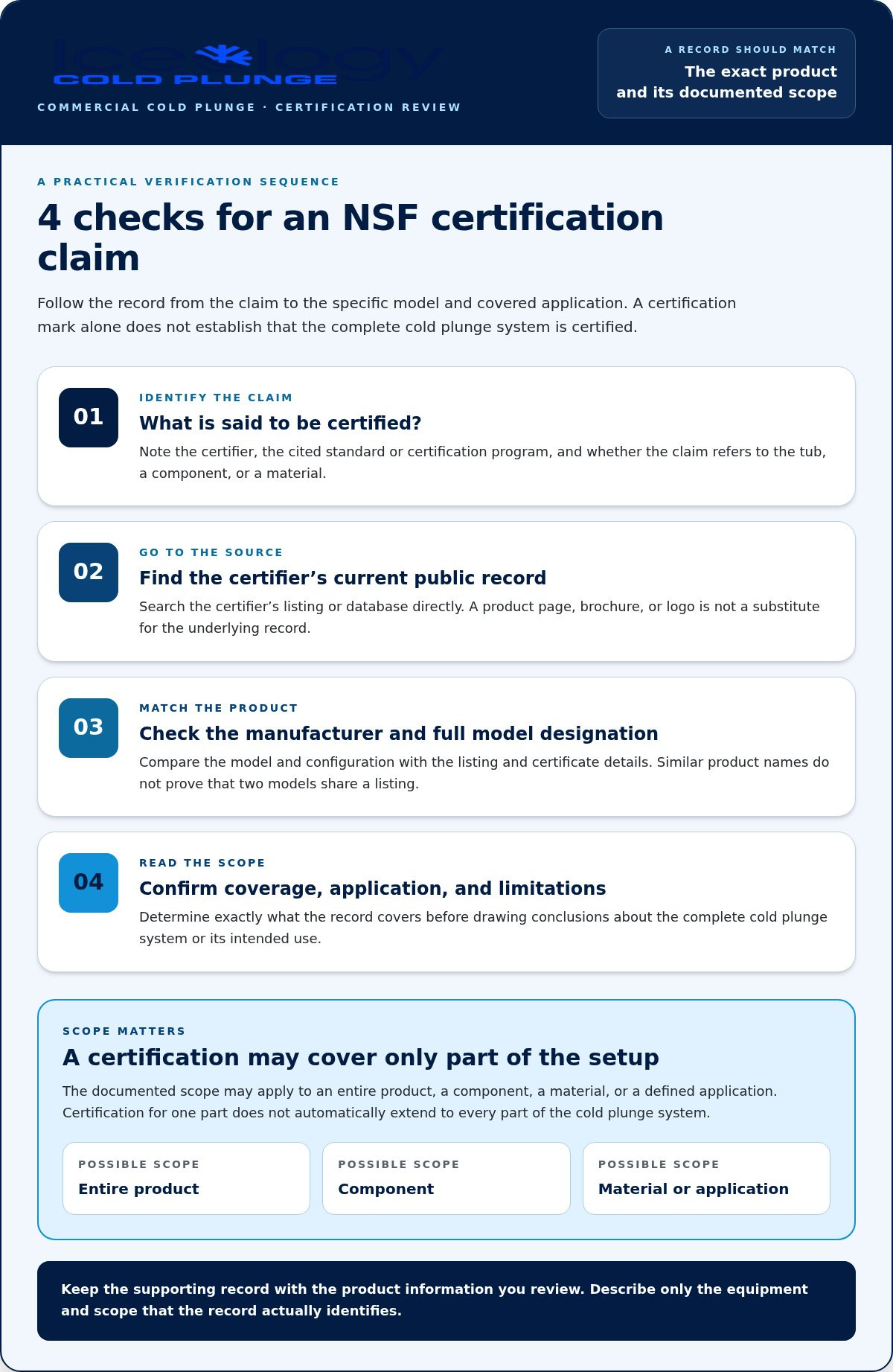
A certification claim is useful only when you can trace it to a current, relevant record. Use the same review process each time you assess an NSF claim for a purchase or product description.
- Identify the exact claim. Note the certifier, the standard or certification program cited, and whether the claim refers to the tub, a component, or a material.
- Find the certifier’s public record. Search the certifier’s current listing or database instead of relying only on a product page, brochure, or logo.
- Match the model and configuration. Compare the manufacturer and full model designation with the listing and certificate details.
- Read the scope. Confirm what the certification covers, its stated application, and any limitations before drawing conclusions about the complete system.
Check the certifier’s current public listing and certificate details directly, and keep the supporting record with the product information you review. Marketing material can point you toward a claim, but it does not replace the underlying record.
Match the certificate to the exact product
A valid claim must match the exact model and stated certification scope. Compare the manufacturer and model designation, including any configuration differences shown in the documentation. Similar product names do not prove that two models share a listing. Then determine whether the record names a complete cold plunge or only a particular filter, fitting, or other component. If it covers one component, describe that component accurately rather than calling the full tub certified.
This distinction prevents a common mistake: assuming that a certified sanitation or filtration component makes the assembled cold plunge a certified product. For an NSF certified cold plunge for commercial use, the relevant record must support the specific wording used to describe the covered equipment and its intended application.
Read the standard and scope without overclaiming
Standards have defined scopes. NSF/ANSI 50 and NSF/ANSI/CAN 61 are examples to investigate, but mentioning either does not establish that it applies to a particular tub, component, or use. Check the current listing and the standard’s relevance before attributing certification. Do not infer that a product meets a standard simply because a manufacturer references it or a related component is listed.
Apply the same care to ozone sanitation. The presence of an ozone system or a sanitation claim is separate from whether that equipment has third-party certification. Check each claim independently, and do not turn a feature description into a certification statement.
Keep equipment claims grounded in records rather than assumptions. As you compare options, explore Iceology Cold Plunge equipment alongside the documentation and operating needs that matter to your facility.
Compare Commercial Cold Plunge Features Beyond Certification
Certification is one part of an equipment decision, not a verdict on whether a cold plunge fits your facility. Compare how the system cools and holds water, how it is built, how sanitation is managed, and what routine care requires. These features affect workflow and user experience, but do not by themselves establish health outcomes or regulatory compliance.
Use the framework below to compare options with your facility’s expected use in mind. Iceology Cold Plunge’s equipment features are useful points of comparison, not evidence of NSF certification or suitability for a particular regulated use.
| Feature | What to compare | Operational question |
|---|---|---|
| Cooling | Integrated chiller or ice-dependent cooling | How will the method support the facility’s usage pattern and desired temperature? |
| Construction | Hard-sided build and insulation | Does the design suit the installation setting and regular handling? |
| Sanitation | Water-treatment approach and equipment | What process and responsibilities are part of routine water care? |
| Maintenance | Cleaning, upkeep, and access to equipment | Can staff incorporate these tasks into the operating workflow? |
| Documentation | Product details and certification scope | Do records clearly identify the model and what is covered? |
Chiller performance and temperature control
An integrated chiller actively cools water, while an ice-dependent approach relies on adding ice to lower or maintain the temperature. Consider which method best fits staff routines and the facility’s pattern of use. Iceology Cold Plunge tubs have built-in chillers capable of lowering water to 39°F. Operating needs also depend on facility load, environment, and usage patterns, so assess the full context rather than temperature capability alone. For more background, see this premium cold plunge tub buying guide.
Construction, insulation, and sanitation
Hard-sided construction offers a different physical setup from less rigid designs, while efficient insulation supports temperature management. Treat these as equipment characteristics and evaluate sanitation separately: identify the treatment approach, the tasks staff must perform, and the records supporting any certification claim. A sanitation feature is not proof of certification. The cold plunge tub with chiller guide offers additional context on chiller-equipped tubs.
Make the comparison specific to your operation. Match documented claims to the exact equipment, then weigh practical features against the installation setting and staff workflow. That gives you a more useful basis for evaluating an NSF certified cold plunge for commercial use than relying on a certification mark alone.
Build a Commercial Cold Plunge Evaluation Checklist
Start with how your facility will operate, not with a product label. Define the use case, expected demand, installation setting, and staff workflow, then compare equipment and documentation with those needs. This turns the search for an NSF certified cold plunge for commercial use into a practical assessment of what your facility can operate consistently.
Plan for the facility’s users and workflow
Map the user journey from arrival through entry and exit, including the next cleaning or water-care task. Decide who supervises access, explains facility procedures, and manages daily operations. Assess the tub’s placement, how users move around it, and whether the room layout or nearby equipment affects access, cleaning, or upkeep. Do not assume a capacity or usage limit without product-specific information.
- Use case: Define who will use the cold plunge and how it fits the facility’s recovery or wellness offering.
- Expected demand: Estimate activity from your own operating plan, then consider how repeated use affects water care and staff workload.
- Installation setting: Review placement, cleaning access, surrounding equipment, and facility requirements that apply to the location.
- Operating workflow: Assign responsibility for user guidance, sanitation tasks, routine upkeep, and responding to equipment needs.
- Service access: Check whether staff can reach areas that need regular attention and whether equipment access fits the space.
Document applicable facility requirements rather than treating one checklist as universal. Requirements can depend on location and use. Keep relevant guidance with the equipment evaluation and note how it affects placement, operation, or records.
Create a documentation and maintenance file
Keep core records together so staff can refer to the same information. Include product identification, manuals, available certification documents, sanitation procedures, maintenance records, and the roles responsible for recurring tasks. Clear records help connect a certification claim to the covered equipment and maintain continuity when staff responsibilities change.
- Record the manufacturer, exact model designation, and installed configuration.
- File certification records with their scope and the equipment or component they identify.
- Document sanitation steps, assigned responsibilities, and routine upkeep described in the manufacturer’s guidance.
- Log maintenance activity and note equipment issues or follow-up actions.
- Set review intervals using manufacturer guidance and applicable facility requirements, then update procedures when either changes.
Before choosing equipment, review the checklist with the people responsible for installation planning and daily operation. A setup that fits the facility’s space, documentation needs, and staff workflow is easier to assess than one chosen on certification language alone.
Choosing Iceology Cold Plunge for a Commercial Setup
Choosing facility equipment means comparing what the tub offers with what your operation requires. Iceology Cold Plunge designs and manufactures premium cold plunge tubs in the USA. Its hard-sided construction, built-in chilling, and efficient insulation give commercial buyers concrete features to evaluate. These attributes can inform an equipment decision, but they do not establish NSF certification or confirm compliance with a particular facility requirement.
A hard-sided tub with integrated chilling
Iceology Cold Plunge tubs combine hard-sided construction with a built-in chiller capable of lowering water temperature to 39°F. Efficient insulation supports temperature management, and the integrated design includes the chilling function in the tub setup. For a commercial evaluation, compare these features with the planned installation setting, expected operating pattern, and facility requirements. A stated temperature capability is a product attribute, not a guarantee of performance under every operating condition.
Consider construction in context, too. Assess how the tub’s design fits the space and the facility’s cleaning and maintenance workflow. Evaluate the chiller as part of the complete setup, including equipment access and how staff will perform routine tasks. These considerations help determine whether the features fit your use case, rather than relying on one specification to make the decision.
Make the decision with clear documentation
Bring product details together with your facility’s documented requirements. If certification is part of your evaluation, verify the current certificate record, exact model, and scope. Then compare the covered product or component with the complete setup you intend to operate. Treat construction, chilling, and insulation as equipment considerations, and assess sanitation procedures and routine responsibilities separately.
This approach gives you a grounded way to evaluate an NSF certified cold plunge for commercial use without assuming certification alone settles the question. A sound decision accounts for documentation, operating needs, the installation environment, and confirmed product features. Iceology Cold Plunge’s USA-made craftsmanship and hard-sided tubs offer concrete points to consider in that comparison.
Explore Iceology Cold Plunge equipment as you assess the right cold plunge setup for your facility.
Choose a Setup That Supports Your Next Step
Turn your facility’s needs into clear purchase criteria. Keep the equipment’s documented scope distinct from your operating priorities, and use both to guide your decision. The right NSF certified cold plunge for commercial use is one that fits the intended setting and can be managed within your facility’s day-to-day workflow.
As you narrow your options, consider how Iceology Cold Plunge equipment fits your plans. A deliberate choice helps you create a consistent, considered cold-water experience for the people who use your facility.
Explore Iceology Cold Plunge tubs and accessories to find equipment that fits your facility’s plans.
Frequently Asked Questions
What does NSF certification mean for a cold plunge?
NSF certification means a third party evaluated a product or part within a defined scope. For a cold plunge, the documentation should identify the certifier, model or component, applicable standard, and intended use. If a listing names a filter, for example, treat it as evidence about that filter, not the entire tub. A certification mark alone cannot fill gaps in the record or establish what was not evaluated.
Does every commercial cold plunge need NSF certification?
There is no single answer for every facility. Requirements may depend on the plunge’s intended use, location, facility policies, and applicable authorities. A gym and a private wellness facility may have different operating considerations, so identify the requirements that apply to your setup before selecting equipment. Then compare those needs with the exact product documentation. Avoid relying on broad claims that certification is always required or never necessary.
How can I verify whether a cold plunge is NSF certified?
Start with the manufacturer and exact model, then search the certifier’s current public listing or review its certificate. Check the named standard, scope, and whether the record refers to the whole unit or a specific part. For an NSF certified cold plunge for commercial use, the model and configuration in the record should match the equipment under consideration. A logo or general sanitation statement alone does not establish that match.
What is the difference between NSF certification and an NSF-compliant claim?
Certification points to a third-party evaluation and documented scope. The phrase “NSF compliant” needs supporting detail before you can tell what it means. Look for the certifier, model, standard, and covered scope, then check whether those details can be independently verified. A brochure that says “compliant” but names no model or record leaves important questions unanswered. Do not treat promotional wording as equivalent to a verified certification listing.
Is an ozone sanitation system the same as NSF certification?
No. An ozone sanitation system describes equipment or a method used in water treatment, while NSF certification refers to an evaluation within a defined scope. One does not automatically prove the other. If a product description mentions ozone, assess how the sanitation system operates separately from whether that equipment has a certification record. Also consider how the facility will document and manage sanitation in its operating procedures.
Can a commercial cold plunge have a certified component but an uncertified tub?
Yes. A certificate may apply to a component, material, or particular configuration rather than the complete cold plunge. For example, if the documentation names a filter but not the tub, do not use the filter’s record to describe the whole unit as certified. Match the record to the equipment’s manufacturer and model, and limit product descriptions to the item and scope the documentation identifies.
What should a commercial buyer compare besides NSF certification?
Compare the equipment’s intended use, construction, chilling approach, sanitation process, and routine maintenance needs with the facility’s workflow. Consider who will handle access and water-care tasks during normal operation, and whether staff can complete upkeep in the available space. Review product documentation alongside facility requirements. Certification can inform the decision, but it does not determine on its own whether a setup suits the people, space, and routines involved.