
Sauna and Cold Plunge: The Ultimate Guide to Contrast Therapy in 2026
Most people view recovery as a passive act of resting. In reality, the most effective recovery is an intentional, high-intensity workout for your vascular system. This "vascular gymnastics" requires a precise thermal delta that your standard shower can't provide. As you look to elevate your home setup, the debate of DIY cold plunge vs buying often centers on upfront costs, yet the true value lies in the consistency and precision of the thermal experience. Professional-grade systems offer integrated chillers that maintain exact temperatures, ensuring you spend less time hauling bags of ice and more time reaping the biological rewards of the Nordic Cycle.
You've likely felt the lingering fatigue that follows a heavy training session or the frustration of a recovery routine that feels more like a chore than a benefit. We understand that achieving peak performance requires more than just grit; it requires the right tools and a clear, science-backed protocol. This guide will teach you how to master the Nordic Cycle to flush toxins, boost circulation, and build unshakeable mental resilience. We'll explore the optimal temperatures for contrast therapy, provide a definitive protocol for your sessions, and help you decide which equipment will sustain your wellness journey for years to come.
Key Takeaways
- Master the precise timing and transitions of the Nordic Cycle to transform your recovery from a passive rest into an active vascular workout.
- Understand the science of hormesis and how exposing your body to controlled thermal stress builds long-term cellular resilience and mental fortitude.
- Weigh the long-term performance and maintenance trade-offs of a DIY cold plunge vs buying a professional-grade system that offers consistent, ice-free cooling.
- Identify the specific equipment requirements for high-heat environments like Florida, where superior insulation is critical for maintaining a 39°F baseline.
- Learn how to structure your home recovery oasis to ensure your cold plunge and sauna work in tandem without compromising energy efficiency.
The Nordic Cycle: Mastering the Sauna and Cold Plunge Ritual
The Nordic Cycle represents a deliberate, rhythmic transition between extreme heat and biting cold. While it finds its roots in the ancient sauna culture of Finland, the practice has transitioned from a cultural tradition into a pillar of modern sports science. This "Fire and Ice" methodology isn't just about testing your endurance. It's a sophisticated tool used by elite performers to trigger a massive circulatory and hormonal response that single-temperature treatments simply cannot replicate. By alternating between these extremes, you force your body into a state of rapid adaptation, effectively "flushing" the system at a cellular level.
The primary goal is to leverage the body's natural response to acute stress. When you subject the body to these swings, you initiate Contrast bath therapy, a process that alternates the expansion and contraction of blood vessels. This creates a powerful internal pump. It moves oxygen-rich blood to your muscles while simultaneously whisking away metabolic byproducts. Whether you're weighing the merits of a DIY cold plunge vs buying a professional system, the effectiveness of this ritual depends entirely on your ability to maintain these extreme temperature thresholds consistently. Without a significant gap between the heat and the cold, the biological "pump" loses its power.
Why the Sequence Matters: Heat Before Cold
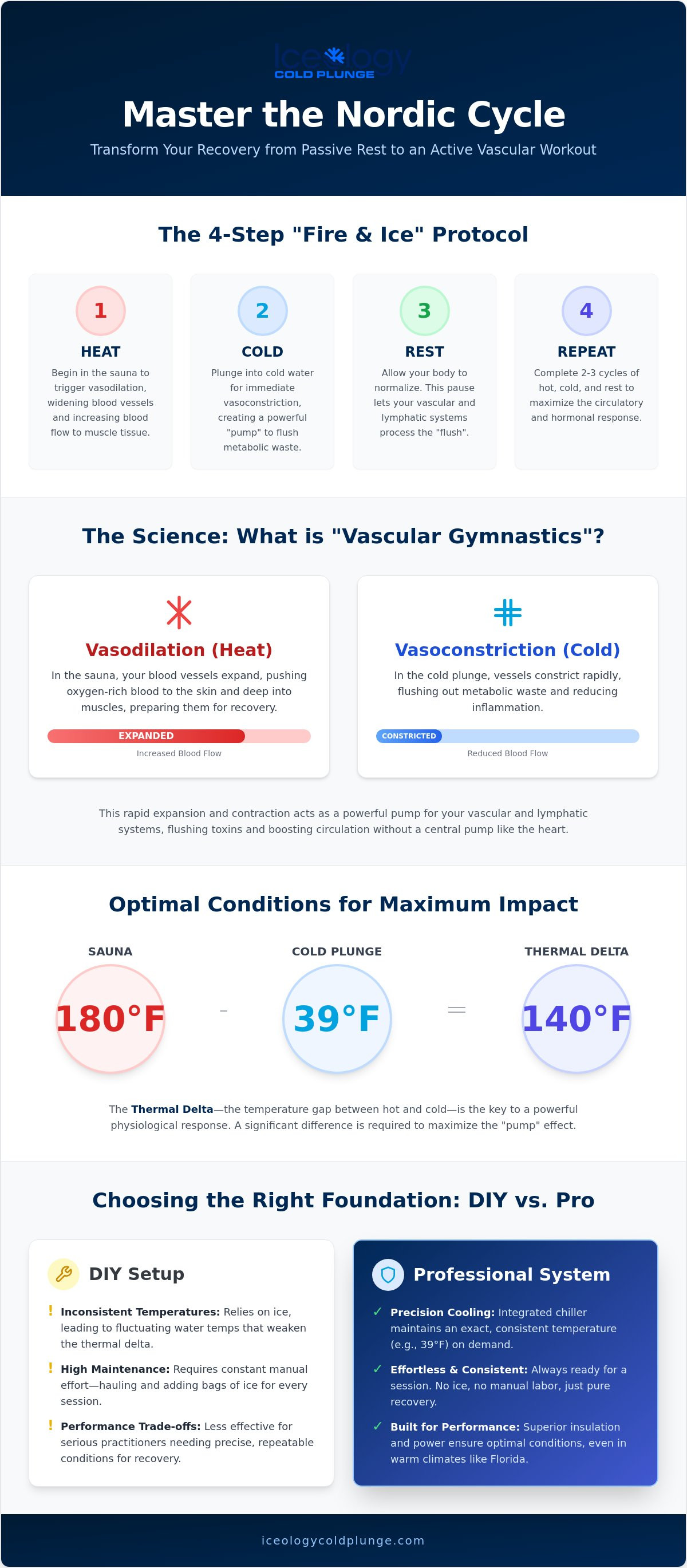
Starting with the sauna is non-negotiable for a true Nordic Cycle. The intense heat causes vasodilation, which is the widening of blood vessels. This process increases blood flow to the surface of the skin and deep into muscle tissue, which helps loosen tight fibers and prepares the body for the coming cold shock. Using the sauna first also acts as a psychological "warm-up." It's much easier to commit to a 39°F plunge when your core temperature is elevated and your nervous system is already in an aroused state. This sequence ensures that when you finally submerge, the vasoconstriction is immediate and profound, maximizing the "flush" of metabolic waste.
Defining the 'Thermal Delta' for Maximum Impact
The success of contrast therapy is measured by the intensity of the change. Most experts agree that a 140-degree difference between your environments is the "sweet spot" for optimal recovery results. Thermal delta is the temperature gap between the sauna and cold plunge tub. If your sauna is set to 180°F, your cold water needs to be consistently near 40°F to achieve the necessary physiological impact.
Precision is the difference between a relaxing soak and a professional recovery session. This is where the debate of DIY cold plunge vs buying becomes critical for serious practitioners. While a stock tank with ice might reach those numbers temporarily, premium tubs with integrated chillers ensure the cold side of the equation stays consistent for every round of your cycle. High-performance insulation and powerful chillers allow you to hit that 39°F floor without the fluctuating temperatures common in manual ice-based setups.
Biological Impact: What Happens During Hot and Cold Exposure?
Contrast therapy is a biological masterclass in hormesis. This concept describes how the body becomes more resilient when exposed to controlled, "good" stress. By moving between the intense heat of a sauna and the biting chill of a cold plunge, you aren't just changing your environment. You're forcing your cells to adapt to rapid transitions. This adaptive response strengthens your internal systems, making them more efficient at handling both physical and mental stressors in your daily life.
One of the most profound effects of this ritual is what experts call "vascular gymnastics." This is the rapid expansion and contraction of your blood vessels. Unlike the circulatory system, the lymphatic system doesn't have a central pump. It relies on muscle movement and pressure changes to move fluid. The intense vasoconstriction caused by the cold acts as a manual pump. It flushes out cellular debris and metabolic waste that accumulates after high-intensity training. This process clears the way for fresh, nutrient-dense blood to reach your tissues once you return to a resting state.
Vasodilation and Vasoconstriction: The Vascular Workout
During the heat phase, your blood vessels dilate to push heat toward the skin. When you submerge in 39°F water, those same vessels constrict instantly to pull blood back toward your vital organs. This constant motion is a workout for your cardiovascular system. The benefits of cold plunge extend far beyond simple muscle relief; they support long-term heart health by improving arterial elasticity. When weighing the choice of a DIY cold plunge vs buying a professional unit, immersion depth is a critical factor. Hard-sided tubs provide the necessary hydrostatic pressure and depth to ensure this vascular impact is felt across the entire body, rather than just the lower limbs.
Hormetic Stress and the Nervous System
The cold shock triggers the release of cold-shock proteins. These unique molecules act as biological "repair crews" that help maintain muscle mass and accelerate the mending of damaged fibers. Simultaneously, your brain releases a surge of norepinephrine and dopamine. This chemical cocktail is responsible for the intense "high" and sharpened focus that follows a session. It's an exercise in building mental toughness. By choosing to stay in the water despite the discomfort, you're training your autonomic nervous system to stay calm under pressure. This translates to better sleep quality as your body learns to transition more effectively from a state of high arousal to deep relaxation.
To ensure your home recovery setup can consistently trigger these powerful biological pathways, consider investing in professional cold tubs that maintain precise thermal control. The debate of DIY cold plunge vs buying often highlights that without a reliable chiller, it's difficult to reach the specific 39°F threshold required to unlock these hormonal and vascular rewards.
Protocols for Performance: How to Structure Your Contrast Sessions
The Nordic Cycle is a disciplined ritual that demands exactitude. It isn't a race to see how much heat or cold you can endure; it's a recalibration of your internal systems. To achieve the vascular and hormonal benefits discussed earlier, you must follow a structured sequence that allows your body to transition safely between thermal extremes. When evaluating a DIY cold plunge vs buying a precision-engineered unit, the ability to maintain these specific temperature windows across multiple rounds is the primary differentiator for serious practitioners.
A standard high-performance session follows a four-step progression designed to maximize metabolic impact. First, begin with the Heat Phase, spending 15 to 20 minutes in a traditional or infrared sauna to induce deep vasodilation. Second, move to the Transition, which involves a quick rinse to remove sweat and oils, ensuring your cold water remains pristine. Third is the Cold Phase, where you submerge for 2 to 5 minutes in water maintained between 39°F and 45°F. Finally, enter the Rest Phase for 10 minutes to allow your body to find room-temperature equilibrium. For optimal recovery results, repeat this entire cycle 2 to 3 times in a single session.
Tiered Protocols for Every Level
Your body's ability to handle thermal stress improves with consistency. Start at the level that matches your current resilience and progress only when the discomfort becomes manageable.
- Beginner: Focus on one round only. Spend 10 minutes in the heat followed by exactly 1 minute in the cold to prime your nervous system.
- Intermediate: Complete two full rounds. Increase your sauna time to 15 minutes and your cold immersion to 3 minutes.
- Advanced: Execute three full rounds. Push for 20 minutes of heat and 5 minutes of cold to achieve maximum cellular resilience.
Common Mistakes and Safety Precautions
Safety is the foundation of any high-level recovery routine. If you're a beginner, don't plunge alone. The initial cold shock can be intense, and having a partner nearby ensures a safe exit if you feel lightheaded. You must also be aware of "afterdrop," a phenomenon where your core temperature continues to fall even after you've left the water. To manage this, avoid hot showers immediately after your final cold round; instead, let your body warm up naturally through light movement or a warm robe. Finally, prioritize hydration. The combination of high-heat sweating and cold-induced diuresis can quickly deplete your fluids, so drink mineral-rich water before and after your session. When comparing a DIY cold plunge vs buying a professional system, remember that integrated safety features and reliable temperature floors are essential for preventing the risks associated with inconsistent cooling.
Designing Your Recovery Oasis: Setup Considerations for Florida Homes
Creating a recovery sanctuary in Florida presents a unique set of engineering challenges. The ambient temperature in cities like Miami, Tampa, or Orlando often exceeds 90°F, creating a relentless heat load on any cooling equipment. When you place a 180°F sauna in close proximity to your cold source, that thermal pressure intensifies. This environment is where the debate over a DIY cold plunge vs buying becomes a matter of long-term functionality. Without a dedicated cooling system, you'll find yourself trapped in a cycle of purchasing hundreds of pounds of ice just to reach a baseline temperature. For a consistent Nordic Cycle in the Sunshine State, a cold plunge tub with chiller is a functional necessity rather than a luxury.
Logistically, a hard-sided tub offers the durability required for permanent outdoor installations. Florida's high humidity and intense UV exposure can quickly degrade inferior materials. A professional, American-made unit provides a stable foundation that can withstand the elements while maintaining the aesthetic of a high-end home spa. Precision is paramount. You need a setup that is ready when you are, not one that requires hours of preparation and manual cooling.
The Critical Role of Polyurethane Insulation
In the humid Florida air, poorly insulated tubs suffer from "sweating," which is the heavy condensation that forms on the exterior of the unit. This moisture can lead to deck rot or mold issues in your recovery area. High-quality polyurethane foam insulation acts as a thermal barrier, preventing this condensation and significantly reducing electricity costs by keeping the cold in. Superior insulation maintains a consistent 39°F even when the tub is placed in direct sunlight. This efficiency ensures your chiller doesn't have to run constantly to combat the external heat, extending the life of your equipment.
Indoor vs. Outdoor: Proximity and Ventilation
The ideal distance between your sauna and cold plunge is roughly five to ten steps. This allows for a seamless transition that keeps your heart rate elevated and your nervous system engaged without allowing your core temperature to drop too far during the walk. If you choose an indoor setup, ventilation is your primary concern. Chillers move heat away from the water and into the surrounding air; without proper airflow, the room will quickly overheat, forcing the chiller to work harder. For those looking to elevate their daily routine with a setup that lasts, browse our American-made cold plunge tubs designed to handle high-ambient temperatures with ease.
Whether you are designing a backyard retreat in a coastal Miami home or a garage gym in Orlando, the materials you choose will dictate your success. The DIY cold plunge vs buying decision often comes down to whether you want to manage a project or manage your recovery. Investing in a professional system allows you to focus entirely on the physiological results of the Nordic Cycle, knowing your hardware is engineered for the specific demands of the Florida climate.
DIY Cold Plunge vs. Buying: Choosing the Right Foundation for Contrast Therapy
The decision between a DIY cold plunge vs buying a professional system ultimately determines the sustainability of your recovery habit. While the appeal of a self-built project is clear, the technical demands of contrast therapy often exceed the capabilities of a standard stock tank or converted freezer. To maintain the 140-degree thermal delta required for the Nordic Cycle, your equipment must be as resilient as the athlete using it. A high-performance recovery station isn't just a tub of water; it's a precision-engineered tool designed to hold a specific biological baseline regardless of the external environment.
DIY setups often struggle with the heat generated by a nearby sauna. Without professional-grade insulation and a dedicated chiller, the water temperature can climb rapidly, stripping the "cold" from your cold plunge. Investing in a cold plunge tub made in USA ensures you have a foundation built for longevity and thermal efficiency. These hard-sided units are designed to reach and hold 39°F consistently, removing the logistical headache of hauling hundreds of pounds of ice for every session. When your hardware is reliable, your commitment to the ritual remains unbroken.
American Craftsmanship Meets Thermal Efficiency
Iceology focuses on the intersection of functional engineering and user experience. Our built-in chiller systems are integrated directly into the hard-sided frame, providing a sleek footprint that fits seamlessly into your home recovery oasis. Unlike inflatable alternatives that can puncture or lose their shape over time, hard-sided construction remains the gold standard for professional environments. This durability is essential for managing the hydrostatic pressure of full-body immersion. By customizing your cold plunge tub setup for daily use, you ensure that high-level filtration and cooling are always working in the background. Crystal-clear water and exact temperatures shouldn't require your constant attention.
Investing in a Lifetime of Wellness
When you analyze the long-term ROI of a DIY cold plunge vs buying, the professional route often proves more economical for the daily user. The ongoing cost of ice for a manual bath can reach thousands of dollars annually, not to mention the time lost in preparation. A dedicated recovery station acts as "performance insurance" for your body and mind. It provides a reliable sanctuary where you can master the Nordic Cycle and build the mental resilience necessary for peak performance. Choosing the right Iceology model is the final step in taking full control of your physical state. It’s an investment in a tool that works as hard as you do, providing the precision cooling and durability required to sustain your wellness journey for a lifetime.
Elevate Your Performance with Precision Recovery
Contrast therapy is far more than a wellness trend; it's a disciplined approach to biological optimization. By mastering the Nordic Cycle, you've learned how to leverage the "fire" of the sauna and the "ice" of the plunge to flush metabolic waste and sharpen your mental edge. We've explored how the choice of a DIY cold plunge vs buying a professional system impacts your ability to hit that critical 39°F threshold consistently. While a manual setup might get you started, a dedicated recovery station ensures that your thermal delta remains wide enough to trigger meaningful physiological change.
Our units are proudly Made in the USA and engineered with premium hard-sided insulation to withstand the most demanding environments. This high-level construction allows our integrated chillers to reach 39°F and stay there, even when placed next to a high-heat sauna. Build your ultimate recovery oasis with an Iceology Cold Plunge and take full control of your physical and mental state. Your path to peak resilience starts with the right foundation. We're here to help you turn your recovery routine into a sustainable, life-changing practice.
Frequently Asked Questions
Is it better to cold plunge before or after the sauna?
You should always start with the sauna. Beginning with heat induces deep vasodilation and elevates your core temperature, which prepares your vascular system for the intense contraction of the cold. Plunging after the sauna maximizes the "vascular gymnastics" effect, ensuring a more powerful circulatory flush and a more profound hormonal response once you submerge.
How many rounds of sauna and cold plunge should I do?
Complete two to three full rounds for the best metabolic and recovery results. This frequency allows your body to cycle through thermal stress enough times to trigger significant cellular adaptation without overtaxing your nervous system. Beginners should start with a single round and gradually increase their volume as their thermal resilience improves over several weeks of practice.
What is the best temperature for a cold plunge when doing contrast therapy?
The optimal temperature range is between 39°F and 45°F. Maintaining this precise window is a primary factor in the DIY cold plunge vs buying debate, as professional chillers provide the consistency needed for high-level results. This specific range ensures the thermal delta is wide enough to trigger the release of norepinephrine and cold-shock proteins effectively.
Can I do contrast therapy every day?
Daily contrast therapy is safe and beneficial for most healthy individuals once they have adapted to the ritual. Many athletes use daily sessions to manage inflammation and maintain mental clarity. If you feel excessively fatigued or notice a decrease in sleep quality, reduce your frequency to three times per week until your autonomic nervous system recalibrates to the stress.
How long should I stay in the cold plunge after a sauna session?
Aim for a duration of two to five minutes in the cold water. This timeframe is sufficient to achieve full-body vasoconstriction and lower your skin temperature to the required threshold. Staying longer than five minutes doesn't necessarily increase the recovery benefits and can increase the risk of afterdrop, where your core temperature continues to fall after you exit the tub.
What are the risks of combining extreme heat and cold?
The primary risks include lightheadedness, cold shock, and potential cardiovascular strain. Rapidly changing your body temperature puts a temporary load on your heart, so individuals with pre-existing heart conditions or high blood pressure must consult a physician first. Always ensure you are well-hydrated and never plunge alone if you are new to extreme thermal transitions.
Do I need a special type of sauna to do the Nordic Cycle?
Both traditional steam saunas and infrared saunas are effective for the Nordic Cycle. The most important factor is reaching a temperature high enough to create a significant thermal gap with your cold plunge. While traditional saunas offer higher ambient heat, infrared saunas provide deep tissue penetration; both will successfully prime your body for the subsequent cold immersion phase.
How much does a cold plunge tub cost to run alongside a sauna?
A cold plunge with an integrated chiller typically costs between $25 and $60 per month in electricity. When evaluating a DIY cold plunge vs buying, consider that using ice for three sessions a week can cost between $1,560 and $2,340 annually. Professional units are significantly more cost-effective over time because their high-quality insulation and efficient chillers maintain temperatures without constant manual intervention.