
Tracking Wellness Progress With a Cold Plunge: A Practical Guide
What if a longer cold plunge isn’t the clearest sign that your routine is progressing? When tracking wellness progress with a cold plunge, it’s tempting to focus on minutes or water temperature alone. Those details describe the conditions of a session, not your full personal response.
You don’t need a dashboard full of wearable metrics to make useful observations. A simple, repeatable log can help you note how you feel before and after each session, record consistent details, and compare patterns over time without treating them as medical conclusions. The goal is clarity, not more data.
This guide explains how to choose a small set of relevant measures, keep session notes consistent, and use your observations to make informed decisions about your routine. Holding conditions steady can make comparisons more meaningful. Iceology Cold Plunge tubs have built-in chillers capable of cooling water to 39°F, supporting consistent session conditions without measuring wellness progress for you.
Key Takeaways
- Start with a compact session record: date, water temperature, duration, and a brief note about how you felt.
- Separate immediate observations from slower trends, such as changes in sleep or resting heart rate.
- Choose paper, a spreadsheet, an app, or a wearable based on how much setup and data you want to manage.
- Make tracking wellness progress with a cold plunge more useful by keeping session conditions consistent, noting relevant context, and reviewing patterns before making gradual routine changes.
- A built-in chiller can help maintain repeatable water-temperature conditions; it doesn’t measure wellness progress.
Why Track Cold Plunge Wellness Progress Beyond Time and Temperature?
Duration and water temperature tell you what conditions you experienced. By themselves, they don’t show whether your cold plunge routine is helping you meet a personal goal. A longer session isn’t automatically progress, and one comfortable plunge can’t establish a lasting change.
Useful tracking puts session details in context. Record what you did alongside how the session felt and any relevant circumstances. Over time, this can help you notice recurring patterns without turning personal observations into a diagnosis or proof that cold exposure caused a change. For an overview of cold-water immersion, its uses, and the mixed evidence around its effects, see this introduction to the ice bath.
What counts as progress in a cold plunge routine?
Start with markers you can observe directly: whether you follow your intended routine, how manageable the session feels, and your immediate response. These describe consistency, comfort, and experience. They aren’t the same as medical or performance outcomes, and changes in mood, tolerance, or perceived recovery won’t happen for everyone.
Use your early entries as a personal baseline. Comparing later sessions with that baseline is more informative than judging progress from one isolated plunge or against someone else’s experience. Look for patterns, not a universal score.
Why time and temperature need context
The same duration and water temperature can feel different from one session to another. Sleep, stress, recent activity, and expectations may all shape your experience. Note relevant context briefly rather than assuming that a change in how you feel came from the plunge itself.
For example, if a session feels harder after a poor night’s sleep, that entry doesn’t prove your tolerance has declined. It gives you a detail to consider when comparing similar sessions. Likewise, a more comfortable plunge doesn’t establish a specific wellness benefit. Keeping conditions and notes as consistent as practical makes comparisons clearer, but it can’t isolate cause and effect.
Takeaway: Make tracking wellness progress with a cold plunge a simple practice of pairing session details with your personal response and context. Use the log to guide thoughtful routine decisions, not to make medical conclusions. For a closer look at the evidence behind potential benefits, consult the existing guide to cold plunge benefits.
Which Cold Plunge Metrics Should You Track First?
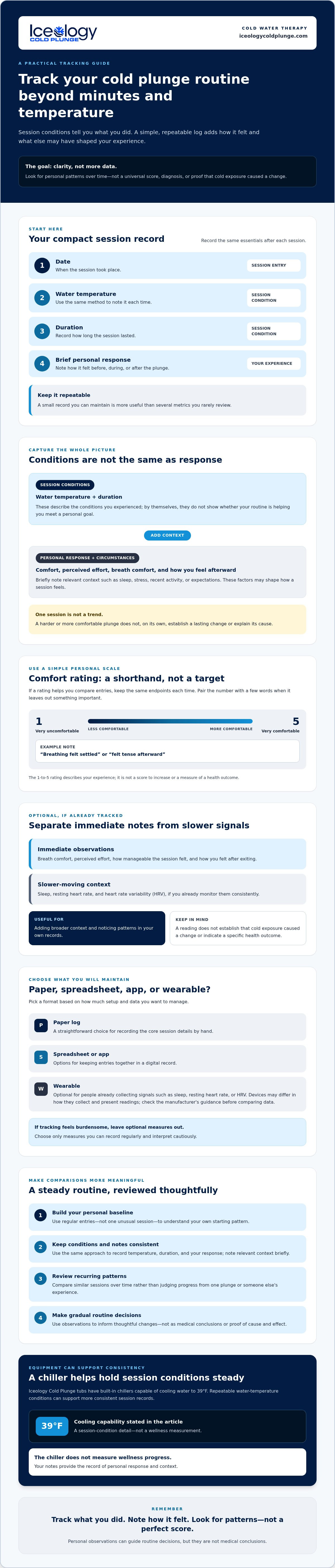
Keep your starting set small enough to record after every session. Begin with the date, water temperature, session duration, and a brief note about your response. These details create a usable record without requiring an app, wearable, or complex scoring system.
A baseline is a record of your typical personal conditions that gives you a fair point of comparison for later trends. Build it from regular entries rather than relying on one unusual session. There’s no universal temperature, duration, or response score that proves progress. The purpose is to compare your own sessions consistently.
Session details and immediate responses
Use the same method to note temperature and duration each time. Add a quick check-in on breath comfort, perceived effort, and how you feel after exiting. A simple rating scale can make notes easier to compare. For example, rate overall comfort from 1, “very uncomfortable,” to 5, “very comfortable,” and keep the same endpoints each time. Treat the number as shorthand for your experience, not a target to increase.
Pair the rating with a few words when a number misses something important, such as “breathing felt settled” or “felt tense afterward.” This small amount of detail can make your log more useful than adding several metrics you rarely review.
Longer-term signals and wearable data
Sleep, resting heart rate, and heart rate variability (HRV) may offer broader context if you already track them consistently. They’re slower-moving observations, not direct cold plunge scores. A change in one reading doesn’t establish that cold exposure caused it or indicate a specific health outcome.
Wearables are optional. Devices can differ in how they collect and present readings, so check the manufacturer’s guidance before comparing data or interpreting a trend. If tracking several signals feels burdensome, leave them out. Choose only measures you can record regularly and understand cautiously.
- Core log: date, temperature, duration, and a brief personal response.
- Optional context: sleep, resting heart rate, or HRV, if you already monitor them.
If you’re setting up a routine and want more control over session temperature, explore Iceology Cold Plunge tubs. A consistent setup can support repeatable temperature notes, while your personal log remains the tool for recording how each session felt.
Cold Plunge Progress Tracking: Paper Log, App, or Wearable?
The best tracking tool is the one that fits naturally into your routine. A paper log, spreadsheet, app, or wearable can all help organize observations, but extra features don’t automatically make the information more meaningful. Choose the simplest method you’ll use consistently.
| Method | Setup effort | Repeatability | Privacy to consider | Useful output |
|---|---|---|---|---|
| Paper log or spreadsheet | Low | High with fixed columns | Depends on where you store it | Session notes and straightforward comparisons |
| Dedicated app | Varies by app | Can be high if logging is simple | Check what data the app collects and stores | Organized entries, and possibly reminders or visual summaries |
| Wearable | May require setup and device use | Depends on consistent use and measurement methods | Review the device’s data and sharing settings | Physiological readings alongside your own notes |
When a simple cold plunge log is enough
If you want to compare session conditions and how each plunge felt, a paper log or spreadsheet is a strong starting point. Use the same columns every time, such as Date, Water Temperature, Duration, Breath Comfort, Perceived Effort, After-Session Response, Context. A fixed format makes entries easier to scan later and helps prevent recording numbers you won’t use.
For tracking wellness progress with a cold plunge, consistency matters more than the format. A short handwritten note can be just as useful as a digital chart when it captures comparable details.
When an app or wearable may add value
An app may suit you if organizing entries, setting reminders, or viewing summaries helps you maintain the habit. Features vary, so check what a specific app offers before relying on it. A wearable may add readings such as heart rate, but their meaning depends on the device and its measurement guidance.
Neither charts nor automated insights can establish that a change in wellness was caused by plunging. Keep your own observations in view, and avoid treating a device reading as a standalone verdict.
If consistent session conditions are part of your plan, learn more about Iceology Cold Plunge tubs. Equipment can support a repeatable routine; your chosen log is still where you record personal responses.
How to Track Cold Plunge Progress Consistently Without Overreading Data
A useful log isn’t a verdict. It’s a structured way to notice what repeats, what varies, and what else was happening around a session. Keep recording brief, then review entries with curiosity rather than looking for proof that every change came from cold exposure.
- 1. Establish a baseline. Record your usual session conditions and immediate response before judging whether anything has changed. Let the baseline reflect your own routine, not an ideal or universal standard.
- 2. Log each session in the same format. Use the same fields and rating definitions each time, such as date, water temperature, duration, breath comfort, perceived effort, and how you felt afterward.
- 3. Add relevant context. Note factors that may shape your experience, including sleep, exercise, stress, or feeling unwell. Keep these as observations, not explanations or diagnoses.
- 4. Review for patterns. Compare entries with similar conditions and look for responses that recur across sessions. Avoid drawing a conclusion from one unusually easy or difficult plunge.
- 5. Adjust cautiously. If a pattern gives you a reason to reconsider your routine, make a measured change and continue recording. Don’t treat a plateau or fluctuation as automatic failure.
Build a repeatable cold plunge session record
Consistency makes comparisons more useful. If you use a comfort rating, keep the same scale and endpoint descriptions. If you write a short response instead, use a similar level of detail from entry to entry. Include context only when it seems relevant. A few clear notes are easier to sustain and interpret than a detailed journal that quickly becomes a burden.
Keep conditions as consistent as practical when comparing sessions. If water temperature or duration differs, record the difference rather than treating the entries as directly equivalent. A controlled setup, such as an Iceology Cold Plunge tub with a built-in chiller, can support repeatable temperature conditions, but it won’t measure your personal response.
Review patterns and respond carefully
Look for repeated observations, not just a striking entry or a chart that appears to move in one direction. Sleep, stress, exercise, and illness may coincide with changes in how a session feels, but a log can’t establish what caused them. A trend is an observation, not proof of cause and effect.
Use patterns as prompts to reflect, not as medical conclusions. If you have health concerns or experience unexpected symptoms, pause your interpretation of the data and seek professional medical guidance.
How Iceology Cold Plunge Equipment Can Support a Consistent Tracking Routine
Tracking wellness progress with a cold plunge depends on recording your experience, not on the tub interpreting it for you. Equipment can help make one part of your log more consistent: the session environment. When water temperature is easier to manage from session to session, your entries may be simpler to compare. That’s useful context, not evidence of a wellness outcome.
Separate equipment consistency from wellness outcomes
Iceology Cold Plunge makes hard-sided tubs with built-in chillers capable of cooling water to 39°F. The tubs are made in the USA, and the company emphasizes efficient insulation and expert craftsmanship in their design. These are product attributes, not promises about how a person will feel or what results they’ll experience.
A chiller supports temperature management; your log captures the rest. Record session conditions alongside your own observations, such as comfort or how you felt afterward. Even at the same water temperature, your response may vary. A tub doesn’t measure wellness progress, and no specific temperature or piece of equipment guarantees a particular result.
As you consider a setup, the existing cold plunge tub with chiller guide can help you understand how that equipment category fits into a routine. Check product information for confirmed specifications, then compare those details with the conditions you want to record.
Choose a next step that fits your routine
A hard-sided Cold Tub with a built-in chiller may be worth considering if managing water temperature matters to your routine. Think about whether that setup would make it easier to keep session conditions consistent and maintain a simple log. Choose equipment to support a practice you can sustain, not to add pressure to chase longer sessions or more data.
Keep the roles clear: equipment helps establish session conditions, while your notes help you review personal responses over time. Iceology Cold Plunge tubs can cool water to 39°F, but that capability doesn’t establish a target or show whether your wellness routine is working. For details about a specific tub, rely on its verified product information.
Explore the equipment at your own pace.
Make Your Cold Plunge Routine Easier to Learn From
Effective tracking doesn’t require a perfect score or a stack of wearable data. Start with consistent notes on session conditions and your immediate response, then add context such as sleep, stress, or exercise when it may help you interpret a change. Review patterns over time and treat them as observations, not proof that cold plunging caused a particular outcome.
Choose a simple log, spreadsheet, app, or wearable that you’ll actually use. The best system keeps your records clear without making the routine feel like a test. If consistent water temperature matters to your comparisons, Iceology Cold Plunge tubs are made in the USA and have built-in chillers capable of cooling water to 39°F. That can support repeatable session conditions, while your own notes remain the way to record personal responses.
Keep your approach steady, stay curious about what your log shows, and let your observations guide thoughtful next steps. Progress is personal, and a practical routine gives you a clearer way to understand yours.
Frequently Asked Questions
What should I track when starting a cold plunge routine?
Start with the date, water temperature, session duration, and a short note about how the session felt. You might describe breath comfort, perceived effort, or how you felt after exiting. Add relevant context, such as sleep or exercise, when it helps describe that day’s experience. For tracking wellness progress with a cold plunge, a small set of details you can record consistently is more useful than a long list of metrics you rarely review.
Is time in a cold plunge enough to measure progress?
No. Duration records how long you were immersed, but it doesn’t independently show a wellness outcome or prove that your routine is working. Water temperature describes another part of the session conditions, not your full response. Compare those details alongside personal observations and relevant context. A longer plunge isn’t automatically a sign of progress, so avoid using time alone as a score or universal benchmark.
Can a wearable track cold plunge wellness progress?
A wearable can record physiological readings, depending on the device and its features, but those readings are only one piece of context. They don’t directly measure overall wellness progress or establish that a change was caused by cold exposure. Check the device maker’s guidance to understand how readings are collected and displayed. Pair any data you choose to use with session notes, and interpret changes cautiously rather than relying on a single reading.
How often should I review my cold plunge log?
Choose a regular review cadence that feels manageable, and use it consistently. Reviewing after you’ve recorded several sessions can make it easier to notice recurring patterns than judging each entry on its own. Compare sessions with similar conditions where practical, and consider notes about sleep, activity, or stress. There’s no need to force a conclusion from every review. If the entries don’t show a clear pattern, continue recording without treating that as failure.
What happens if my heart rate or HRV changes after a cold plunge?
A change in heart rate or heart rate variability (HRV) is an observation, not proof of a cause or a wellness benefit. Readings may vary, and device methods differ, so check your device’s instructions before interpreting a trend. Note the reading with relevant session context rather than relying on it alone. If you have health concerns or experience unexpected symptoms, seek guidance from a qualified healthcare professional.
Do I need a cold plunge tracking app to monitor progress?
No. A paper log or spreadsheet can be enough to record session conditions and your personal response. An app may help organize entries or display them in a format you find useful, but its features and data practices vary. Choose a method you’ll use consistently and feel comfortable with. More charts or reminders won’t make a record more meaningful if the information isn’t relevant or interpreted with care.
Can an Iceology Cold Plunge track my wellness metrics?
No. Iceology Cold Plunge tubs don’t measure or track wellness metrics. They’re made in the USA and feature built-in chillers that can lower water temperature to 39°F, which can support consistent session conditions for your log. Record personal responses and any other measures yourself, using a paper log, spreadsheet, app, or separate wearable. Check verified product information for details about a specific tub’s features.