
5 factors for cold plunge timing, duration, and temperature
The most energizing cold plunge isn’t necessarily the coldest or longest. For many people, the best time of day to cold plunge for energy is in the morning, while an evening session may feel stimulating when you’re trying to wind down.
It’s natural to look for one ideal time, but your goal matters: a boost to start the day calls for a different routine than a plunge later on. This guide compares morning and evening sessions, explains Huberman’s timing recommendations, and considers how water temperature and plunge duration can shape the experience. You’ll find practical factors to weigh as you build a steady routine, including why a gradual approach can be more useful than chasing colder water or staying in longer.
Key Takeaways
- Morning plunges may suit an energy-focused routine, while evening sessions can feel stimulating and may affect sleep.
- Test a consistent plunge schedule for two weeks before deciding whether its timing works for you.
- Cold exposure can prompt changes in norepinephrine and dopamine, but the response depends on the session and person.
- Build tolerance gradually by adjusting plunge duration and water temperature instead of starting with the most intense exposure.
- Choose a cold tub with temperature control that supports a repeatable routine across changing seasons.
1. Is it better to cold plunge in the morning or at night?
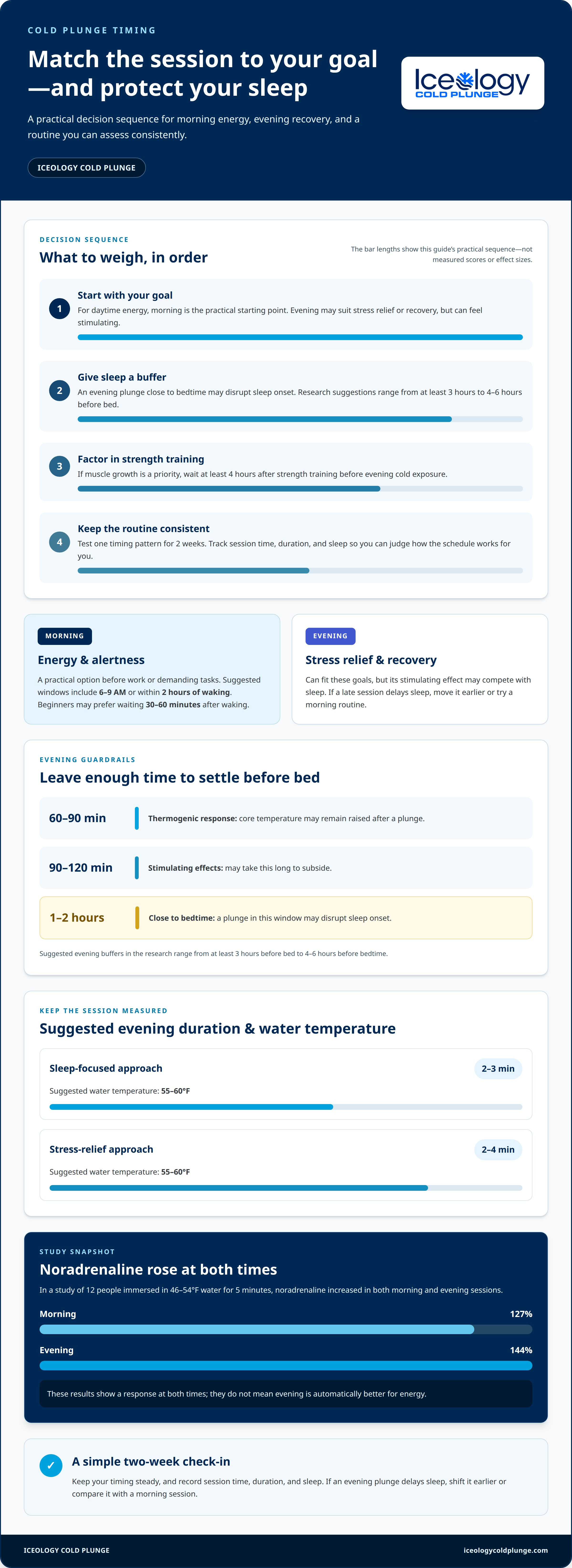
For an energy-focused routine, morning is the practical starting point. An evening plunge may fit stress relief or recovery, but its stimulating effect can compete with sleep. The best timing depends on what you want from the session and how close it is to bedtime. A regular morning session also makes it easier to notice how cold exposure affects your daytime routine.
Body temperature typically peaks in the late afternoon and reaches its lowest level in the early morning, with the low point around 4-6 AM. That daily rhythm doesn’t establish one ideal plunge time for everyone. In a study of 12 people immersed in 46 to 54°F water for five minutes, noradrenaline rose 127% in the morning and 144% in the evening. The results show that both times can produce a response, not that evening is automatically better for energy.
For sleep, leave a buffer between an evening plunge and bedtime. Suggested timing in the research ranges from at least three hours before bed to four to six hours before bedtime. Cold exposure can trigger a thermogenic response that raises core temperature for 60-90 minutes after a plunge, while the stimulating effects can take 90-120 minutes to subside. A plunge within 1 to 2 hours of bedtime may disrupt sleep onset, so an earlier session gives your body more time to settle.
Keep the evening session measured if sleep is a priority. A sleep-focused approach recommends 2 to 3 minutes in 55 to 60F water, rather than extending the plunge or choosing colder water. For stress relief, the suggested range is 2 to 4 minutes in 55 to 60F water. Four participants in a cold-shower trial reported insomnia that investigators linked to evening cold exposure, a reason to pay attention to how late sessions affect your own sleep pattern.
Exercise recovery adds another timing decision. A 2022 meta-analysis of 52 studies found cold water immersion improved muscle soreness and perceived recovery 24 hours after high-intensity exercise, compared with passive recovery. But if muscle growth is your goal, wait at least 4 hours after strength training before evening cold exposure. Cold plunging immediately after a strength session may not suit every training goal, so separate the session from lifting when building muscle is a priority.
Choose based on your goal: try morning sessions for daytime energy, or schedule evening sessions well before bed for stress relief or recovery. Track the session time, duration, and your sleep across two weeks. If a late plunge delays sleep, move it earlier or switch to morning. A consistent schedule makes comparison clearer than changing the timing every day.
2. What's the Huberman protocol for cold plunge timing?
Consistency matters more than chasing a supposedly perfect hour. Treat the routine associated with Andrew Huberman as a schedule to test, not a universal prescription for a specific time. Choose a time that fits your sleep, work, and exercise patterns, then keep it steady long enough to compare how you feel. A repeatable rhythm makes it easier to distinguish the effects of cold exposure from changes in your daily schedule.
Build the habit in stages. The guidance summarized for this topic suggests three to five sessions per week as a regular routine, and recommends trying one timing pattern for two weeks before adjusting it. Intermediate practice is described as morning sessions during weeks 5-12, but that schedule is not a reason to skip gradual adaptation. Start with a manageable routine and record the session time, water temperature, duration, and perceived energy afterward.
Is a cold shower as effective as a cold plunge for boosting energy? A cold shower provides cold exposure, but the information available here doesn’t establish that it produces the same energy response as immersion. Buijze’s cold-shower trial enrolled 3,018 Dutch adults who finished showers with 30, 60, or 90 seconds of cold water for 30 days; it compared shower durations, not showers with plunges.
Seasons can change the conditions around a session. Outdoor air, wind, and water without active temperature control may vary between summer and winter, making the same routine feel different throughout the year. Keep the timing consistent when possible, but note seasonal changes in how the water feels and how long you tolerate it comfortably. If winter conditions make your usual session feel substantially more intense, adjust your exposure rather than forcing the same duration.
Plan around your actual week. For example, someone with early work shifts might anchor sessions to a consistent point after waking, while a person who trains later could choose a separate recovery window. When a schedule change is necessary, the guidance suggests allowing about 5-7 days during the transition. That gives you a practical adjustment period before judging whether the new routine suits your energy and daily rhythm.
Use a simple log to assess how energized you feel, not just whether you completed a session. After each plunge, note whether you feel alert, steady, or unusually tired, then compare your observations across the two-week trial. Keep other habits as stable as practical, including exercise timing and bedtime. Changing your plunge schedule and training routine at once makes it harder to tell which change affected your experience.
Consistency across seasons doesn’t mean ignoring comfort. Cold water immersion should be a deliberate, repeatable practice, not a contest to tolerate harsher conditions. Use a steady schedule as your baseline, account for seasonal differences, and make one adjustment at a time. This approach gives you a clearer picture of how timing fits your energy needs.
3. Morning plunges for energy and alertness
For an energy-focused routine, the best time of day to cold plunge for energy is usually morning, before work or other demanding tasks. Suggested windows include 6 to 9 AM or within two hours of waking. Beginners may prefer waiting 30-60 minutes after waking before starting. These are practical scheduling options, not evidence that one exact time suits everyone.
How long should a beginner stay in a cold plunge for an energy boost? Start with 30 seconds to 2 minutes and focus on controlled exposure. A separate beginner progression suggests sessions of 1-2 minutes during weeks 1-4. Water temperature changes how intense that duration feels, so adjust one variable at a time rather than making the water colder while staying in longer.
What time of day is best for a cold plunge to boost energy? Try a consistent morning session, ideally within two hours of waking, then observe how it fits your day. Morning cortisol naturally peaks about 30-45 minutes after waking, but that timing doesn’t establish one universally optimal plunge window. Your wake time and personal preference can help shape a routine you can maintain.
Suggested morning sessions vary in duration. One first-thing protocol recommends 2-3 minutes, while another suggests 2 to 5 minutes in 50 to 59F water. These are distinct approaches, not a target everyone needs to reach. Begin with a manageable duration, record how you feel afterward, and make gradual adjustments instead of treating longer exposure as a guaranteed energy boost.
How soon after waking or exercising should you cold plunge? For morning energy, recommendations include 30-90 minutes after waking; a beginner window is 30-60 minutes. Exercise changes the timing: the guidance suggests cold-water immersion within 45 minutes after cardio for endurance recovery, but waiting 2-4 hours after training. For muscle growth after strength training, wait at least 4 hours.
A plunge before exercise may tighten muscles and affect movements that require flexibility or dynamic action. A brief 30 to 90 second exposure is suggested only for mental priming on a moderate day, not before maximal activity. For example, avoid placing it directly before demanding sprints if mobility and movement quality matter to your workout.
To judge the best time of day to cold plunge for energy, track session timing, duration, and afternoon energy over two weeks. Cain’s 2025 review included 11 randomized studies and 3,177 participants, but reported no results for alertness, focus, or concentration. Your notes can help you assess how morning exposure fits your routine without assuming every person responds alike.
4. Dopamine and norepinephrine responses
Cold immersion can trigger a fast stress response involving norepinephrine, also called noradrenaline. Reported norepinephrine levels can reach 2-3x baseline for 1-3 hours after exposure. This response helps explain why some people feel more activated after a plunge, but it doesn’t establish that every session produces the same energy or alertness. Water temperature, immersion duration, and the person’s response all matter.
How long do the energy and alertness effects of a cold plunge last? The reported norepinephrine response can last 1-3 hours, while a morning-plunge recommendation suggests focus may continue for 2-4 hours after a session. These are different reported effects, not a guarantee of sustained alertness; track your own response across sessions.
Dopamine is another part of the discussion. A reported morning response can reach 250% of baseline, but that figure shouldn’t be treated as a promised mood or performance outcome. Cold exposure is a physical stressor, and the sensation of alertness after immersion doesn’t measure dopamine directly. For a practical comparison, note your energy before plunging and later in the day, while keeping workout timing and session duration consistent.
What do studies say about cold-water immersion, energy, and time of day? In a study of 12 people immersed in 46 to 54°F water for five minutes, noradrenaline rose 127% in the morning and 144% in the evening. Another study of 24 lean young adults found cold-induced energy expenditure in men was 54% higher in the morning than the comparison baseline, versus 30% in the evening. These findings measure different responses, so neither proves one time produces the maximum energy for everyone.
Study conditions matter. The 530% noradrenaline increase reported by Šrámek followed one hour of head-out immersion in 57°F water, not a brief plunge. In a study of 17 men, a 10-minute immersion released noradrenaline, while a longer intermittent exposure released significantly more. Those protocols aren’t interchangeable with shorter sessions, and a larger measured response doesn’t automatically mean a better experience.
Cold shock also deserves attention. In a cold-water immersion study by Yankouskaya, heart rate rose 10.61 bpm within 30 seconds of entering the water. One immersion ended early after ectopic beats; the study’s ECG removal threshold was six or more ectopic beats per minute. Enter gradually, avoid treating discomfort as a challenge to overcome, and end the session if you feel unwell. A controlled response matters more than chasing a dramatic surge.
5. Cold plunge duration and water temperature
Duration and temperature work together: colder water can make the same number of minutes feel more intense. So the useful target isn’t the maximum time or lowest temperature. It’s a repeatable exposure that fits your experience and purpose. Cold water immersion is typically defined as submerging the body in water between 38-59°F (3-15°C), a broad range rather than one required setting.
For beginners, the suggested range is 55-65 °F during weeks 1-4, with sessions lasting 1-2 minutes. Another beginner recommendation starts with 30 seconds to 2 minutes, reflecting the value of a gradual entry. Start at the shorter end and avoid making the water colder and the session longer at the same time. Changing one variable makes it easier to tell what affects comfort and alertness.
As tolerance develops, the suggested ranges shift: intermediate practitioners use 45-55 °F during weeks 5-12, with sessions of 2-3 minutes. Advanced practice is listed as 35-45 °F after 12+ weeks, with sessions of 3-5 minutes. These are progression examples, not a reason to advance on a fixed calendar. Your ability to complete a controlled session matters more than reaching a colder tier.
Evidence on short exposures also argues against assuming that longer always means better. Buijze’s cold-shower trial enrolled 3,018 Dutch adults, who finished showers with 30, 60, or 90 seconds of cold water for 30 days. The largest cold-exposure trial found no difference in outcomes between those three shower doses (P=0.98). Showers aren’t the same as immersion, but the result offers no basis for treating extra seconds as an automatic advantage.
Match the session to the goal without chasing extremes. For stress relief, the suggested approach is 2 to 4 minutes in 55 to 60F water. For cardio recovery, the recommendation is 3 to 8 minutes in 50 to 59F water. These differing ranges show why duration and temperature should be chosen together: a setting intended for one purpose may not suit another, and alertness alone doesn’t show that a longer plunge is more effective.
Use a simple progression: choose a comfortable temperature, set a short duration, and repeat that combination before adjusting either variable. Sessions longer than 10 minutes are described as having diminishing returns, so extending a plunge isn’t a dependable shortcut to greater mental benefit. For evening cold exposure, also account for its stimulating effect and leave time before bed. A controlled, consistent dose gives you a clearer basis for evaluating your response.
Iceology Cold Plunge
Iceology Cold Plunge offers Cold Plunge Tubs, Ice Baths, Cold Tubs, and Accessories for people building a consistent cold-water routine. Its tubs have built-in chillers that can lower water temperature to as low as 39 °F, giving you control over a key part of your plunge setup. That can help you follow a repeatable temperature plan as you explore which timing and exposure feel right for your routine.
Iceology Cold Plunge makes hard-sided cold plunge tubs for home recovery and wellness routines. Choose equipment suited to your intended use, then use the timing and gradual progression discussed above to shape your sessions.
Contact Iceology Cold Plunge to discuss your cold-plunge setup.
Build a Routine That Fits Your Day
Finding the best time of day to cold plunge for energy starts with a routine you can maintain, not a perfect schedule on paper. Choose a time that supports your daily rhythm, then notice how it fits with sleep, exercise, and other commitments. A sustainable practice gives you room to adjust as your needs change.
As you plan your setup, consider how Iceology Cold Plunge’s Cold Plunge Tubs, Ice Baths, and Accessories can support a consistent practice at home. The right combination depends on how you want cold plunging to fit into your wellness routine. Focus on a setup that makes your chosen schedule practical to follow.
Take the next step at your own pace. Contact Iceology Cold Plunge to explore options for your cold-plunge routine.
Every steady practice starts with one intentional choice. Make yours a routine you can return to with confidence.
Frequently Asked Questions
Is it better to cold plunge in the morning or at night?
For daytime energy, morning is usually the more practical choice because its stimulating effect can carry into your active hours. An evening plunge may fit a recovery routine, but leave ample time before sleep and notice whether you feel more alert afterward. If an evening session makes it harder to wind down, for example, move it earlier or choose morning instead.
What's the Huberman protocol for cold plunge timing?
A practical approach is to choose a consistent time and routine rather than changing the schedule from session to session. The guidance discussed here suggests three to five sessions per week and testing one timing pattern for two weeks before adjusting it. Treat that as a structured experiment, not a requirement to plunge every morning: work shifts, training, and sleep can all shape a sustainable schedule.
How does a morning cold plunge affect alertness and energy levels?
A morning plunge can feel activating, which is why some people place it before work or focused tasks. That immediate sensation doesn’t prove that concentration improves for everyone. Cain’s 2025 review included 11 randomized studies and 3,177 participants, but reported no results for alertness, focus, or concentration. Use your own day as a guide: notice whether the session helps you feel ready or leaves you drained.
Does cold plunging in the afternoon or evening affect sleep?
It can, especially if a session leaves you feeling stimulated close to bedtime. Afternoon exposure gives that response more time to settle, while a late-evening plunge may make winding down harder. As a practical test, keep your usual bedtime steady and move the session earlier if sleep feels disrupted. Evening cold exposure suits some routines, but it isn’t automatically a sleep aid.
What water temperature is recommended for an energizing cold plunge?
For beginners, a suggested starting range is 55-65 °F during weeks 1-4. The feel of the water depends on both temperature and time immersed, so avoid making both more intense at once. For example, keep a manageable temperature while establishing a brief session, then adjust gradually as you learn your response. A colder setting isn’t automatically a better route to alertness.
What are the risks and contraindications of cold plunging?
Sudden immersion can trigger a strong cold-shock response, including an immediate change in heart rate. Yankouskaya’s cold-water immersion study documented this response during entry, underscoring why a plunge shouldn’t be treated as a test of willpower. Enter gradually, keep the session controlled, and leave the water if you feel unwell. People with health concerns should get individualized guidance before attempting cold exposure.