
Can I Put a Cold Plunge on a Deck? How to Check Safely
What if a deck that looks strong isn’t the safest place for a cold plunge? If you’re asking, “can I put a cold plunge on a deck,” the answer depends on the tub’s full operating load and the framing beneath the proposed location, not appearance alone. The water, tub, equipment, and person using it all contribute to the load.
Before bringing a cold tub home, confirm the exact model’s dimensions and filled operating weight, then consider the deck’s condition and how its framing carries the load. Iceology Cold Plunge tubs are hard-sided and include built-in chillers, but those product features don’t establish whether a particular deck is suitable.
This guide explains what information to gather and what to check about water, drainage, weather exposure, and access. It also covers when to ask a qualified professional for a structural assessment and how to compare a deck with a ground-level location.
Key Takeaways
- Whether you can put a cold plunge on a deck depends on the tub’s verified operating load and a qualified assessment of the deck’s framing, not how sturdy it looks.
- Build a preliminary operating-weight estimate using the selected model’s confirmed empty weight, water capacity, and operating components.
- Compare deck and ground-level locations for structure, access, drainage, equipment placement, and maintenance. Neither location is automatically suitable.
- Before installation, check manufacturer guidance for placement, support, clearance, and electrical setup, and plan for water management and safe access.
- Consider Iceology Cold Plunge options after establishing structural suitability independently, then confirm the exact specifications for the selected tub.
Can I Put a Cold Plunge on a Deck? Start With the Safety Question
A cold plunge may be placed on a deck only after the tub’s full operating load and the deck’s capacity at the proposed location have been verified. A deck’s appearance doesn’t reveal the strength or condition of its framing, connections, and supports. If you’re asking, “can I put a cold plunge on a deck,” looks alone can’t provide a safe yes or no.
Start by identifying the complete operating load: the tub, water, chiller and other equipment, accessories, and the person or people using it. Gather confirmed weights and dimensions for the exact model rather than relying on a generic estimate. A qualified professional can use those details to assess how the load relates to the deck’s framing and support points. The basic distinctions between structural loads also explain why total weight is only part of the assessment.
Why a filled cold plunge creates a different load than an empty tub
Water adds weight, so an empty-tub figure isn’t enough to evaluate an installation. Confirm the model’s water capacity and whether the manufacturer specifies a normal fill level. For capacity measured in U.S. gallons, estimate water weight by multiplying the confirmed gallons by approximately 8.34 pounds per gallon. Add the verified tub, chiller, accessories, and user weights. Don’t infer water volume from the tub’s exterior dimensions.
Why deck condition and framing matter
Suitability depends on the parts carrying the load: the framing, support points, connections, and their condition, as well as the tub’s location on the deck. A professional needs to assess the proposed placement, not just the deck’s overall size. Visible damage, soft or deteriorated areas, or noticeable movement are reasons to pause and get a qualified assessment. An online article can help you gather information, but it can’t certify an individual deck as safe.
Pause before placing or filling the tub. Confirm the selected model’s empty weight, water capacity, dimensions, and full operating weight. Give those details, along with information about your deck, to a qualified professional. Iceology Cold Plunge tubs have built-in chillers, but product features don’t establish deck suitability. Until the tub specifications and structure have been assessed, treat the location as unverified.
How to Estimate a Cold Plunge’s Full Operating Load
Build a preliminary load estimate from documented figures, not assumptions:
- Identify the exact tub model and configuration.
- Confirm its empty weight and dimensions.
- Verify the intended water volume or manufacturer-stated capacity.
- Add the weight of any chiller, plumbing, accessories, and users not already included in the listed operating weight.
For water measured in U.S. gallons, multiply the verified volume by approximately 8.34 pounds per gallon. For example, multiply the documented fill volume by 8.34 to estimate the water’s weight. Don’t use exterior dimensions to guess capacity, and don’t count supplied equipment twice if the manufacturer’s operating-weight figure already includes it.
An estimated load is not proof that a deck can support it. Your calculations organize the information, but a qualified professional must assess the deck and proposed location. Code references, such as the deck provisions in the International Residential Code (IRC), can provide context. Check which requirements apply locally.
Which product details should you confirm first?
Ask the manufacturer for written specifications for the exact model, including dimensions, empty weight, maximum water capacity, and full operating weight, if provided. Clarify whether listed weights include the chiller, plumbing, or other supplied components. Before choosing a location, also request written instructions for outdoor placement, support, and required clearance. These details give your assessor a clearer picture of the proposed installation.
How do load location and support points affect the assessment?
A plunge rests on a defined footprint, so its weight is applied to a particular part of the deck rather than distributed evenly across the entire surface. A qualified professional should review the framing and support points beneath the intended position using the verified tub information. For broader planning, see this cold plunge tub setup guide.
Your role is to collect accurate product details and identify the intended location. The professional’s role is to determine whether the deck can support the proposed load there. If you’re comparing models, you can review Iceology Cold Plunge tubs and confirm model-specific specifications before making placement decisions.
Deck vs. Ground-Level Placement: Which Cold Plunge Setup Makes Sense?
Choosing between a deck and a ground-level location is a site-specific decision, not a way to skip structural checks. A deck may offer convenient access to the home, while a ground-level spot may simplify some installation and maintenance tasks. Neither is automatically suitable. Compare both locations with the tub’s documentation, the surface condition, and qualified advice before deciding.
| Consideration | Deck placement | Ground-level placement |
|---|---|---|
| Structural verification | Have a qualified professional assess the framing and proposed tub location. | Check that the surface and supporting ground are suitable for the product and its operating load. |
| Access | Consider stairs, doorways, and how users will reach the tub safely. | Check the route to the location and whether the setup is convenient to reach. |
| Drainage | Plan how water from filling, draining, or routine use will be managed. | Consider where water will flow and whether it could affect the surrounding area. |
| Equipment placement | Confirm the deck can accommodate the tub and required equipment clearances. | Confirm there’s room for the tub and equipment in line with manufacturer instructions. |
| Maintenance access | Make sure the tub and equipment remain accessible for upkeep. | Allow access for routine checks and maintenance without obstructing the surrounding space. |
When might a deck location be worth assessing?
A deck may appeal if it’s close to the home or convenient for your routine. Those advantages don’t show that the structure can support the tub. Consider user access, water management, and the space needed around the tub and its equipment. Confirm the manufacturer’s outdoor placement, support, and clearance instructions, then have the proposed position assessed.
What should you compare with a ground-level location?
Look for a surface that’s stable, level, accessible, and appropriate for the specific product, but don’t assume ground-level placement is automatically safe. Check drainage, maintenance access, and the route for moving the tub into position. Surface preparation and manufacturer requirements still apply. As you compare models and home layouts, consult this premium cold plunge selection guide.
If you’re still asking, “can I put a cold plunge on a deck,” compare the deck and ground-level options using the same verified product details. The right choice depends on the specific site, manufacturer documentation, and qualified professional guidance, not convenience alone.
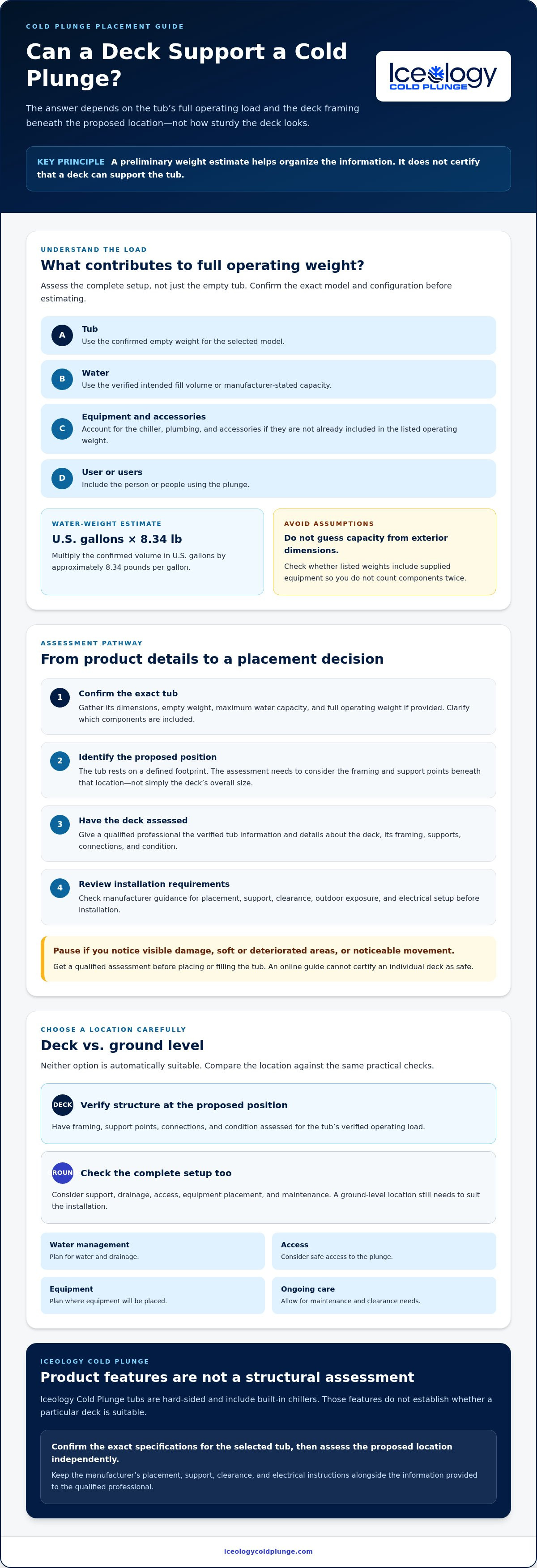
What to Check Before Installing a Cold Plunge on a Deck
Before deciding, “can I put a cold plunge on a deck,” treat installation as a pause-and-verify process, not a DIY load test. Use this checklist to gather information and identify open questions. It doesn’t replace structural approval.
- Confirm the tub details: Record the exact model, dimensions, empty weight, water capacity, and full operating weight. Check which equipment and accessories are included in the stated weight.
- Get a deck assessment: Ask a qualified structural professional to evaluate the framing, condition, and proposed tub location.
- Read the manufacturer’s instructions: Confirm requirements for outdoor placement, support, equipment clearance, and electrical setup. Ask the manufacturer to clarify anything missing or unclear.
- Plan access and water management: Consider the route for bringing the tub into position, safe user access, drainage during filling or maintenance, and room to reach the tub and equipment.
- Review weather exposure and electrical needs: Check whether exposure to the elements affects the tub, chiller, connections, or placement instructions. Have electrical planning reviewed by a qualified professional as appropriate.
Stop if the deck’s condition is uncertain, product specifications are incomplete, or the structural professional raises concerns. Don’t place or fill the tub while key questions remain unresolved.
Which professionals and documents can help answer the question?
Give the qualified structural professional the tub documentation and deck plans, if available. Share details of visible repairs, alterations, or damage, and identify the exact proposed location. Ask the manufacturer for written guidance on product support and placement. These materials help the professional assess your setup rather than rely on a general estimate.
How should water, weather, and equipment access factor in?
Don’t assume the deck has suitable drainage. Plan where water will go during filling, draining, and maintenance, and consider whether it could affect the deck or nearby areas. Check manufacturer guidance for outdoor exposure, and leave enough room to set up, clean, service, and move equipment as needed. Electrical arrangements should follow product instructions and be reviewed by someone qualified to assess the setup.
Homeowner check: Gather verified product information, review instructions, and plan access, water management, and electrical arrangements. Professional sign-off: Have a qualified structural professional assess the deck’s capacity for the proposed tub location. A checklist can prepare you for that review, but it can’t establish that the deck is safe.
Choosing an Iceology Cold Plunge After Your Deck Is Assessed
Research the product after establishing structural suitability, not before. If you’re still asking, “can I put a cold plunge on a deck,” general product information can’t answer that for your home. The deck’s capacity and proposed location need an independent assessment using verified tub specifications.
Iceology Cold Plunge designs and manufactures hard-sided tubs in the United States with built-in chillers that can lower water temperature to 39°F. That cooling capability describes the product, not its weight or support requirements, and it doesn’t indicate whether a deck can carry the operating load.
Which Iceology details should you verify before choosing a location?
Ask for documentation for the exact model you’re considering. Confirm its dimensions and filled operating weight, along with the support conditions required for placement. Check the manufacturer’s outdoor installation instructions, service clearances, and electrical guidance. If the listed specifications don’t clarify which equipment is included in the operating weight, request clarification before sharing the figures with a structural professional.
Don’t assume one model’s specifications apply to another, or that general brand information confirms a particular location is suitable. Consider product details and site conditions together.
What should your next step be?
Gather the model-specific documents and arrange for a qualified professional to assess the intended location. If the deck is approved for the proposed setup, compare it with your practical needs, including safe access, room for equipment, water management, and ongoing maintenance. If the assessment identifies concerns, pause and discuss alternatives rather than relying on a different product’s weight or an informal estimate.
Once you have the required details, review the options and confirm the specifications for the model that fits your plans. The sequence matters: verify the product information, assess the location, then choose.
Make Your Cold Plunge Plan a Safe One
The answer to “can I put a cold plunge on a deck” depends on two verified details: the tub’s full operating load and the deck’s capacity at the intended location. Confirm the exact model’s dimensions, filled weight, and placement instructions, then have a qualified professional assess the structure. A ground-level alternative may be worth comparing, but it also needs to meet the product’s support and placement requirements.
After the location is assessed, you can choose a tub with greater confidence. Iceology Cold Plunge makes hard-sided tubs in the United States with built-in chillers that can lower water temperature to 39°F. Confirm the specifications for your selected model before making deck placement plans.
Explore Iceology Cold Plunge tubs
Gather the product details, get the location assessed, and review the tubs and accessories that fit your plans.
Frequently Asked Questions
Can I put a cold plunge on a deck?
Possibly, but first confirm the tub’s full operating load and have a qualified professional assess the deck at the proposed location. The load includes water, the tub, equipment, accessories, and users. A deck that looks sturdy isn’t proof of its capacity. If you’re asking “can I put a cold plunge on a deck,” gather the exact model’s specifications and have the structure assessed before installation.
How much does a filled cold plunge weigh?
There isn’t one weight that applies to every filled cold plunge. Check the exact model’s empty weight and confirmed water capacity, then add the weight of equipment, accessories, and users if they aren’t included in the manufacturer’s operating-weight figure. For water measured in U.S. gallons, estimate its weight by multiplying the verified volume by approximately 8.34 pounds per gallon. Ask the manufacturer to clarify what its listed figures include.
How do I know if my deck can support a cold plunge?
Have a qualified structural professional assess the deck’s framing, condition, support points, and proposed tub location using verified product specifications. Provide the tub’s dimensions, filled operating weight, and manufacturer placement instructions. Visible damage or movement is a reason to pause, but an inspection by appearance alone can’t establish capacity. Don’t install or fill the tub until the professional has reviewed the specific setup and addressed any concerns.
Should I put a cold plunge on a deck or on the ground?
Compare both locations with the tub’s requirements and your home’s conditions. A deck needs a qualified assessment of its framing and capacity. A ground-level location still needs a stable, level, suitable surface, plus practical access, drainage, and room for equipment and maintenance. Consider how the tub will be moved into place and how water will be managed. Neither option is automatically safe or suitable.
Can a second-story deck hold a cold plunge?
You can’t determine that safely from the deck’s level or appearance alone. A qualified professional needs to assess the structure and proposed placement using the selected tub’s verified operating load and support requirements. Share deck plans if available, along with information about repairs or alterations. Until the assessment confirms the specific installation is suitable, don’t place or fill the plunge there.
What information should I give a contractor before installing a cold plunge?
Provide the exact tub model, dimensions, empty weight, water capacity, and confirmed filled operating weight. Clarify whether that figure includes the chiller, plumbing, and other supplied components. Share manufacturer instructions for support, outdoor placement, clearance, and electrical setup. Include deck plans if available, the intended tub location, and details of visible damage, repairs, or alterations. This information helps the professional assess the actual setup rather than a general estimate.
Does a cold plunge chiller affect where I can place the tub?
Yes. The chiller and its connections may affect equipment placement, clearance, electrical planning, and maintenance access. Check the selected model’s manufacturer instructions for outdoor exposure, electrical setup, and required service space. Confirm whether the chiller’s weight is included in the tub’s operating-weight figure. Iceology Cold Plunge tubs have built-in chillers that can lower water temperature to 39°F, but that capability doesn’t determine whether a deck is suitable.