
Cold Plunge for Lymphatic Drainage: How Lymph Moves Through Your Body
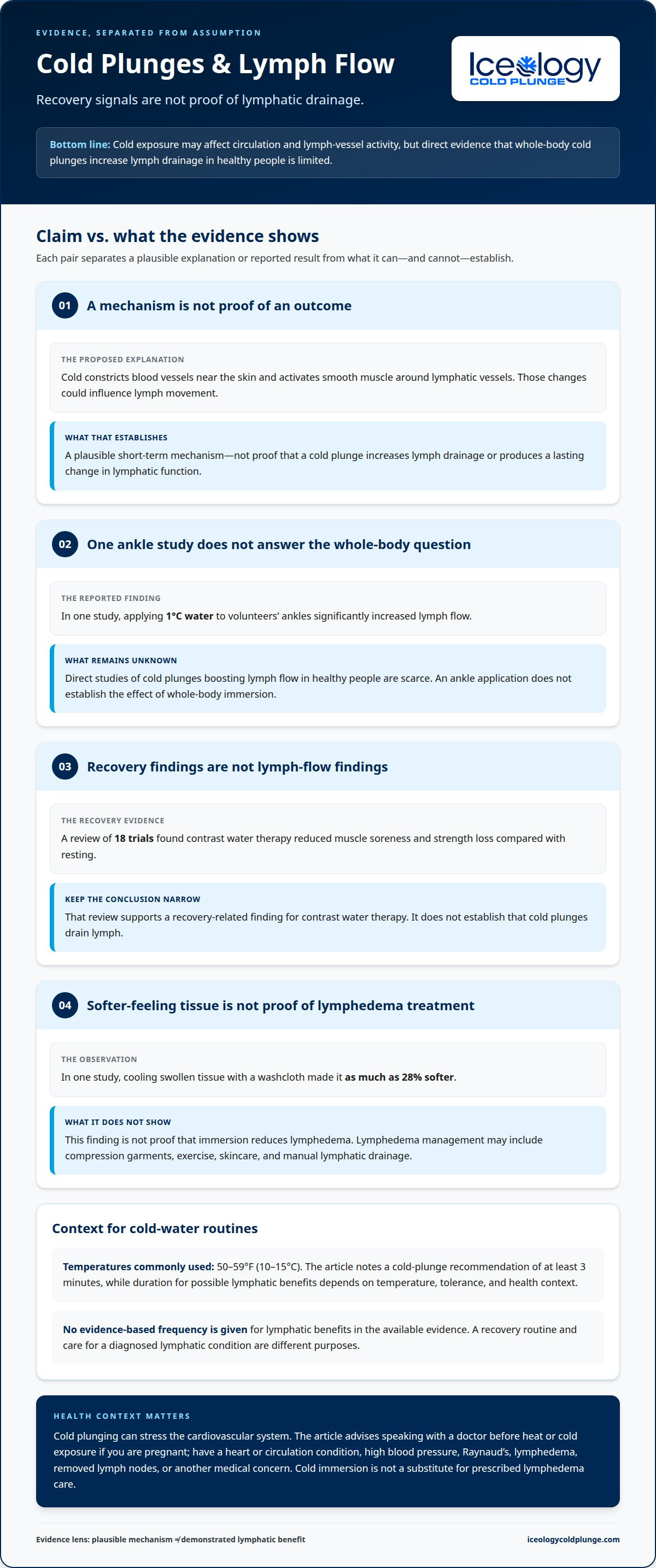
Cold plunges may be better understood as a recovery tool than as a proven way to “drain” lymph. Evidence for a cold plunge for lymphatic drainage in healthy people is limited: direct studies are scarce, although one study found that applying 1 °C water to volunteers’ ankles significantly increased lymph flow.
It makes sense to connect cold water with circulation and recovery, especially when muscles feel sore after hard training. A review of 18 trials found that contrast water therapy reduced muscle soreness and strength loss compared with resting, but that doesn’t establish a lymph-drainage effect from cold plunges.
This article explains how lymph moves through the body, what cold exposure may do to lymph flow and nervous system activity, and how it relates to post-exercise recovery. You’ll learn to distinguish plausible mechanisms from what the evidence actually shows.
Key Takeaways
- Understand how lymph nodes filter fluid and how the lymphatic system supports immune function and nutrient absorption.
- See how lymph moves toward the heart, guided by vessel contractions, one-way valves, and nearby muscle activity.
- Learn why cold exposure’s effects on the nervous system and blood vessels don’t automatically prove increased lymph drainage.
- Separate potential post-exercise recovery benefits from claims about lymph flow, and consider how your health context affects cold exposure.
What Is Your Lymphatic System and What Does It Do?
Your lymphatic system collects excess fluid from tissues and returns it to the bloodstream. About three liters of plasma move through body tissues each day before the lymphatic system captures them. Lymph nodes filter this fluid, trapping pathogens, foreign particles, and abnormal cells. The body contains an average of 500-700 lymph nodes. The system also absorbs fats and fat-soluble vitamins from the digestive system, linking fluid balance with cellular nourishment and immune defense.
Blood pressure moves blood through arteries and capillaries, while blood vessels deliver oxygen and nutrients to tissues. About 20 liters of plasma flow through arteries and capillaries each day. Some fluid leaves small vessels and enters surrounding tissue; lymphatic vessels collect the excess and return it toward the heart. This circulation is different from blood flow: the heart pumps blood, while lymph relies on vessel pumping and nearby tissue movement. A working muscle, for example, can compress lymph vessels as it contracts.
Cold-water immersion causes blood vessels near the skin to constrict, changing local blood flow. One proposed effect is that this pressure change may encourage lymph movement through vessels. But a cold plunge for lymphatic drainage isn’t established by that mechanism alone: direct studies of cold plunges boosting lymph flow in healthy people are scarce. A study applying water at 1 °C to volunteers’ ankles significantly increased lymph flow, but that finding does not establish the effect of whole-body immersion.
In the United States, buying a cold-plunge tub is an equipment purchase, while attending a session is a facility expense. These are different cost categories, so there is no single price that covers both. The practical question is whether you want a tub for repeated use at home or occasional access to a facility. The distinction, rather than a specific dollar amount, is what matters here.
Cold may temporarily change how swollen tissue feels, but that isn’t the same as treating lymphedema. In one study, cooling swollen tissue with a washcloth made it as much as 28% softer. Lymphedema can follow surgery, radiation therapy, infection, trauma, or genetic factors. Management may include compression garments, exercise, skincare, and manual lymphatic drainage. The evidence on a cooled area therefore shouldn’t be treated as proof that immersion reduces lymphedema.
Commonly used ice-bath temperatures are 50 to 59°F (10 to 15°C). A cold-plunge recommendation gives at least 3 minutes, but duration for possible lymphatic benefits depends on temperature, tolerance, and health context. No frequency can be prescribed for lymphatic benefits from the available evidence. The practical distinction is between using cold for a familiar recovery routine and treating a diagnosed lymphatic condition, which requires a care plan.
Cold plunging can stress the cardiovascular system as blood vessels constrict and circulation shifts. If you’re pregnant or have a heart or circulation condition, high blood pressure, Raynaud’s, or another medical concern, speak with a doctor before heat or cold exposure. The same applies if you have lymphedema, removed lymph nodes, or another lymphatic condition. After surgery involving lymph nodes, follow that guidance: cold immersion is not a substitute for prescribed lymphedema care.
Cold exposure and autonomic nervous system activation
The autonomic nervous system regulates functions such as heart rate and blood vessel tone without conscious effort. Cold water activates its sympathetic response, the branch involved in rapid alerting, preparing the body for a sudden temperature challenge. It also contracts smooth muscle around lymphatic vessels. This offers a plausible way cold exposure could influence lymph flow, but a proposed mechanism does not establish a health outcome. The nervous system response and a lymphatic effect are related, not interchangeable.
During immersion, the body responds to cold as a physical stressor. Blood vessels narrow near the skin, while smooth muscles around lymphatic vessels contract. These contractions may affect how lymph moves through the vessels, depending on the cold stimulus and the body’s response. It’s important to distinguish this short-term activation from a lasting change in lymphatic function. Feeling alert after cold water, for example, does not show that lymph has drained more effectively.
One study found that an hour of immersion in 57°F water raised noradrenaline by 530% and dopamine by 250%. These chemical changes help explain why some people describe the benefits of cold as an immediate lift in alertness or mood. They don’t establish that cold exposure improves immune function or treats lymphatic conditions. Noradrenaline is part of the body’s stress response; its increase is evidence of a response to immersion, not proof of a specific recovery result.
A separate observation helps show that temperature and duration both matter: participants felt more active, alert, and attentive after five minutes of immersion at 68°F. That response differs from the findings after an hour at 57°F. The two exposures cannot be treated as equivalent. A longer or colder session isn’t automatically more useful, because the body’s response changes with the conditions. For practical interpretation, distinguish a temporary change in attention from changes to lymph flow or longer-term health.
The immune system also connects to lymphatic activity. Lymphocytes are white blood cells, and regular cold-water exposure has been reported to stimulate their production. That observation doesn’t mean cold immersion prevents illness or guarantees stronger immune defenses. The immune system involves multiple processes, while a measured change in one cell type is only one piece. If you’re exploring a consistent routine, consider how cold-water immersion options fit your goals, rather than treating a brief nervous system response as a measure of lymphatic benefit.
Cold-water immersion and post-exercise recovery
After hard exercise, recovery can involve soreness, temporary strength loss, and changes in tissue inflammation. Cold-water immersion is studied as one recovery approach, but these outcomes are distinct. A review found that contrast water therapy reduced muscle soreness and strength loss compared with resting. That finding concerns post-exercise measures; it does not establish that cold water increases lymph flow or treats swelling. Keeping the outcomes separate helps you judge what immersion may contribute to a training routine.
Cold water constricts blood vessels, and immersion can reduce the release of inflammatory mediators. This offers a physiological explanation for interest in cold exposure after strenuous activity, but it does not mean less inflammation is always better for every training goal. Soreness, swelling, and strength are separate measures. A runner who feels less sore after a session, for example, has not necessarily regained strength or changed lymphatic function. Focus on the recovery measure that matters for your next workout.
Contrast water therapy alternates warm and cold exposure; cold-water immersion uses cold water alone. The methods are not interchangeable. The review finding concerns contrast therapy compared with resting, and does not show that every cold plunge produces the same result. To evaluate recovery, track a practical outcome, such as perceived muscle soreness or your ability to complete planned training. That gives you a clearer measure than a general feeling of refreshment.
Swelling after exercise also needs careful interpretation. Cold exposure can constrict blood vessels, but a change in visible swelling does not prove that lymph vessels are clearing fluid more effectively. After weight training, muscle tenderness, local swelling, and limited movement can occur together, yet each reflects a different aspect of recovery. Changes in swelling or how an area feels do not by themselves show that lymph flow has improved. This distinction matters especially if swelling persists or you have a diagnosed lymphatic condition.
For an athlete choosing a recovery method, match the method to the goal. Contrast water therapy has evidence for soreness and strength loss versus resting, while direct conclusions about lymphatic drainage require different evidence. Cold-water immersion can be one part of a structured recovery routine, not a substitute for training adjustments or care for ongoing symptoms. If you’re exploring cold water therapy, treat the experience as a recovery practice and assess it against a clear training outcome.
How lymph moves through the body
Lymph travels in one direction, from body tissues toward the heart. Along the way, lymphatic vessels carry fluid through lymph nodes, then return it to the bloodstream through the subclavian vein in the upper chest. This is the lymphatic system’s transport route: it collects fluid outside blood vessels, filters it, and returns it to circulation rather than leaving it in tissues.
Fluid is called lymph after it enters lymphatic vessels. Before then, plasma leaves tiny blood vessels and moves through surrounding tissues, delivering materials and exchanging fluid. Lymphatic capillaries collect excess fluid and particles from these spaces. As lymph travels onward, it carries cellular debris and immune cells. This return pathway is separate from arteries and veins, and it has no central, heart-like pump driving every movement.
Instead, lymph moves through the pumping action of the vessels and the compression of nearby tissue. For example, a walking step contracts leg muscles and compresses surrounding vessels. Breathing also changes pressure in the chest, helping fluid move toward the upper body. These everyday movements contribute to lymph transport. Long periods without movement reduce one source of mechanical assistance, while routine muscle activity provides repeated pulses.
One-way valves inside lymphatic vessels help keep fluid moving forward. When a vessel segment fills, its walls contract and push lymph past a valve. The valve closes behind the fluid, limiting backward movement. This sequence repeats along the route, much like a series of short forward pushes rather than one powerful pump. Lymph typically flows at 10-12 bpm, a slower pace than blood circulation through the heart-driven system.
Lymph nodes sit along this route and act as checkpoints. As lymph passes through a node, immune cells can encounter pathogens, foreign particles, and abnormal cells carried in the fluid. The nodes filter and help destroy these materials. For example, fluid draining from an arm passes through nearby nodes before returning to the bloodstream. This filtering role connects lymph movement to immune surveillance, not simply the movement of water between tissues.
Cold-water immersion is sometimes discussed as a way to influence lymph movement, but it does not replace the system’s normal route, valves, or tissue-driven pumping. Lymph still travels toward the heart and returns through the subclavian vein. Movement also contributes in its own way: walking, bending the knees, and using the arm muscles compress nearby tissues. Understanding this pathway helps distinguish normal transport from claims that a cold session directly “flushes” lymph.
What is the evidence for cold-water immersion and lymph flow?
The evidence supports a careful distinction between a biological response and a proven therapy. In one study, applying water at 1 °C to volunteers’ ankles significantly increased lymph flow. That finding is relevant because it measured lymph movement directly. But cooling the ankles is not the same exposure as immersing the whole body in a cold plunge. The result doesn’t establish that whole-body immersion produces the same change, or that any change leads to a meaningful health benefit.
Study design matters. An ankle-cooling experiment examines a localized area, while a cold plunge exposes a much larger portion of the body. Temperature, the area exposed, and the outcome measured all affect what a study can show. A change in local lymph flow, for example, is not the same as reduced limb swelling, improved lymphedema, or better immune function. Each is a separate outcome that requires direct evidence.
Other circulation findings don’t fill that gap. In a study of 20 adults, contrast therapy using infrared heat and cold produced bigger changes in forearm blood flow than classic hot and cold water baths. The measured outcome was forearm blood flow, not lymph flow. Blood and lymph circulate through connected but distinct pathways. A change in blood flow therefore offers context about the body’s response to temperature, not proof that cold immersion increases lymph transport.
Mechanisms can explain why researchers investigate this question. Cold exposure constricts blood vessels, and sympathetic activation can contract smooth muscle around lymphatic vessels. These responses offer a plausible pathway for altered lymph movement, but a plausible pathway is not a measured outcome. For anyone considering cold immersion, the distinction is straightforward: a temperature response does not demonstrate lymphatic drainage, and a change in lymph flow alone would not prove treatment of a condition.
Direct studies of cold plunges boosting lymph flow in healthy people are scarce. That evidence gap means claims should stay specific. The ankle study supports a finding about localized cooling; the 20-adult study concerns blood flow during contrast therapy. Neither establishes a general lymphatic benefit from whole-body cold immersion. If you’re weighing a cold plunge for lymphatic drainage, look for evidence that measures lymph flow under the same type of exposure and in the population relevant to your situation.
Iceology Cold Plunge: Cold Plunge Tubs
Iceology Cold Plunge offers Cold Plunge Tubs for people building a consistent cold-water routine at home. Their tubs are made in the USA and have built-in chillers that can lower water temperature to as low as 39 °F. That temperature control supports a repeatable immersion experience, but it doesn’t establish cold plunging as a treatment for lymphatic conditions. The evidence discussed above is limited, so use a tub for cold-water practice rather than as a substitute for medical care or a prescribed lymphedema plan.
If a dedicated tub fits your recovery routine, explore Iceology Cold Plunge’s options and decide whether one suits your space and goals.
Make Your Next Recovery Choice With Purpose
Let your goal guide your next step. If you’re considering a cold plunge for lymphatic drainage, use the evidence to set realistic expectations, not to replace care for a diagnosed condition. Start by deciding whether you want a structured cold-water practice, post-exercise recovery, or a consistent wellness ritual. Then consider how it fits your training and daily life.
Iceology Cold Plunge offers cold-plunge tubs, accessories, and ice baths for people establishing a cold-water routine at home. Choose an option that suits your space and how you plan to use cold-water immersion. Keep your purpose clear, and value a consistent practice over chasing an unproven outcome.
A thoughtful approach can turn cold exposure into a more intentional part of recovery. Take the next step with confidence.
Frequently Asked Questions
What Is Lymphatic Drainage?
Lymphatic drainage is the movement of excess tissue fluid through lymphatic vessels and nodes, then back into the bloodstream. The process also transports immune cells and material collected from tissues. In the digestive system, lymphatic vessels absorb fats and fat-soluble vitamins. The term can also describe manual lymphatic drainage, a hands-on technique used as part of some lymphedema management plans.
What Is Lymphatic Circulation?
Lymphatic circulation is the route lymph takes through the body, distinct from heart-driven blood circulation. Lymph travels through vessels and nodes toward the chest, where it returns to the bloodstream. One-way valves help keep it moving forward. Nearby muscle movement can compress vessels and assist transport, while lymph nodes filter the fluid along its route.
What Happens When Lymph Flow Slows?
When lymph flow is impaired, fluid can accumulate in tissues and contribute to swelling. Lymphedema may be associated with factors such as surgery, radiation therapy, infection, trauma, or genetics. A swollen limb alone does not identify the cause. Depending on the condition and care plan, management may involve compression garments, exercise, skincare, or manual lymphatic drainage.
What Treatments Target the Lymph?
Lymphedema management can include manual lymphatic drainage, compression garments, exercise, and skincare. These approaches address different parts of care: manual techniques support fluid movement, compression helps manage swelling, and exercise engages surrounding muscles. For example, a care plan may combine movement with compression rather than relying on one method alone. Cold immersion isn’t a replacement for these established management approaches.
Does cold plunging improve lymphatic drainage?
Current evidence does not establish that cold plunging improves lymphatic drainage in healthy people. Cold can affect blood vessels and may influence lymphatic vessel activity, but a proposed mechanism is not proof of a measurable benefit. Direct research on cold plunges and lymph flow is scarce. Treat claims that cold plunging improves lymphatic drainage as unproven, not as evidence that it treats swelling or lymphedema.
How does the lymphatic system move fluid through the body?
The lymphatic system moves fluid through vessel contractions and pressure from nearby tissues. One-way valves help prevent backward flow as lymph travels toward the chest. Muscle movement offers a practical example: when you walk, contracting leg muscles compress nearby lymphatic vessels. Lymph passes through nodes on its journey, then returns to the bloodstream through a vein in the upper chest.
How often should you cold plunge for possible lymphatic benefits?
No frequency has been established for possible lymphatic benefits; direct studies of cold plunges boosting lymph flow in healthy people are scarce.