
Cold Plunge Tub 39 Degrees: The Definitive Guide to the Advanced Recovery Threshold
Most recovery enthusiasts believe any cold water provides the same benefit, but the true physiological shift occurs when you cross the threshold into the high thirties. If you’ve spent time in a standard tank, you know the frustration of watching a chiller struggle to stay below 45 degrees or seeing your energy bill climb due to poor insulation. It’s difficult to focus on mental discipline when your equipment can’t maintain the precise environment you need for results. Finding a reliable cold plunge tub 39 degrees shouldn't be a gamble; it's a requirement for those who value their time and their health.
We understand that you’re looking for more than just a quick dip. You want to maximize metabolic activation and crush inflammation in a fraction of the time required at higher temperatures. This guide explores why 39 degrees is the elite standard for advanced cold therapy and the specific engineering required to reach it. We'll break down the science of thermal management and show you how to identify a USA-made tub that delivers professional-grade performance every single session. Get ready to transform your recovery routine into a streamlined, high-performance practice.
Key Takeaways
- Learn how the 39-degree threshold triggers a massive surge in norepinephrine to optimize your mood and focus.
- Understand the specific engineering hurdles that prevent standard units from reaching elite temperatures and how to overcome them.
- Discover why a cold plunge tub 39 degrees allows you to achieve deeper tissue penetration in less time than traditional 50-degree dips.
- Master the advanced safety protocols and breathwork techniques necessary to manage the intense physiological challenge of sub-40-degree water.
- Identify the structural benefits of hard-sided, American-made construction for ensuring long-term thermal precision and reliability.
The Science of 39 Degrees: Why This is the Recovery Gold Standard
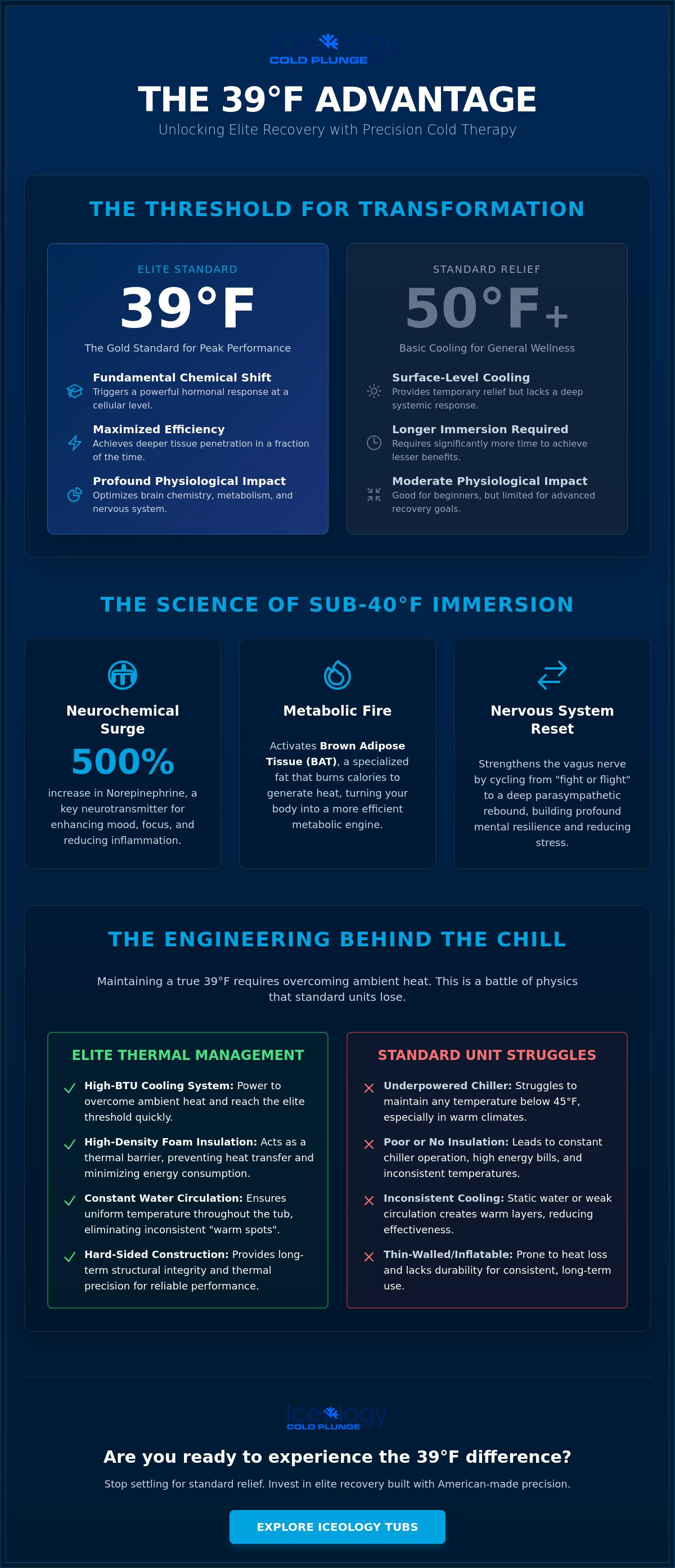
The 39-degree threshold represents the apex of cold therapy. While a 50-degree dip provides relief, 39 degrees is where the body undergoes a fundamental chemical shift. It's the point of maximum physiological challenge. At this temperature, your system isn't just cooling down; it's being forced to adapt at a cellular level. This intensity is what makes a cold plunge tub 39 degrees the gold standard for elite performers and longevity seekers alike. It requires precision engineering to maintain, but the biological rewards are unmatched.
One of the most profound effects of this extreme cold is the massive surge in norepinephrine. Studies have shown that immersion in sub-40-degree water can increase this neurotransmitter by up to 500%. Norepinephrine acts as both a hormone and a chemical messenger, playing a critical role in focus, mood regulation, and the reduction of systemic inflammation. By triggering such a powerful response, you aren't just recovering your muscles; you're optimizing your brain chemistry. Understanding The Science of Cold Water Immersion reveals that this rapid vasoconstriction also acts as a pump for the lymphatic system, flushing out metabolic waste with incredible efficiency. This process forces blood toward your internal organs, protecting your core while oxygenating your most vital systems.
Metabolic Fire: 39°F and Brown Fat Activation
Stepping into 39-degree water forces your body to defend its core temperature through non-shivering thermogenesis. Thermogenesis is the process of heat production in organisms. Unlike shivering, which uses muscle friction, this process activates brown adipose tissue (BAT). Brown fat is a specialized type of fat that burns calories to generate heat. Frequent exposure to these elite temperatures helps recruit more BAT over time, turning your body into a more efficient metabolic engine. This doesn't just help with calorie burn during the plunge; it creates a long-term shift in how your body manages energy and insulin sensitivity. It's a functional way to upgrade your metabolism through disciplined practice.
The Nervous System Reset
The initial shock of 39-degree water is an intense sympathetic nervous system event. Your "fight or flight" response is fully engaged. However, the true value lies in the parasympathetic "rebound" that follows. Once you exit the tub, your body shifts into a state of profound relaxation. This cycle strengthens the vagus nerve, which is the primary component of the parasympathetic system. Improved vagal tone is linked to better heart rate variability and reduced stress levels. Beyond the physical, there's a psychological victory here. Conquering the 39-degree water every morning builds a level of mental resilience that makes everyday stressors feel manageable. You've already faced the hardest part of your day; everything else is easy by comparison.
Achieving and Maintaining 39°F: The Engineering Behind the Chill
Reaching a true 39-degree set point is significantly harder than hitting 50 degrees. Most standard units on the market struggle to break the 45-degree barrier because they lack the thermal management required to fight ambient heat. It's a constant battle of physics. Heat from the surrounding air is perpetually trying to warm your water. Without a high-BTU (British Thermal Unit) cooling system, your chiller will run indefinitely without ever reaching the elite threshold. A cold plunge tub 39 degrees requires a synergy of power and protection that entry-level models simply can't provide.
The distinction between a traditional ice bath and a precision cold plunge becomes clear at these temperatures. An ice bath relies on the melting of ice, which leads to inconsistent cooling and "warm spots" around the body. In contrast, a professional-grade system uses constant circulation to ensure every inch of water remains at the target temperature. Scientific reviews on the Physiological Effects of Cold Therapy emphasize that these stable, low temperatures are necessary to trigger the specific hormonal responses discussed in the previous section. If your equipment can't hold the line, you're leaving results on the table.
The Power of Polyurethane Foam Insulation
Insulation is the unsung hero of thermal management. High-density, closed-cell polyurethane foam acts as a barrier that prevents thermal bridging, which is the transfer of heat through the tub's walls. While thin-walled inflatable options have almost no R-value, premium hard-sided tubs utilize thick insulation to lock the cold in. This engineering choice makes the system incredibly energy efficient. Your chiller doesn't have to work 24/7 to maintain a cold plunge tub 39 degrees; it simply kicks on for short bursts to counteract minor fluctuations. It saves money. It also extends the lifespan of your cooling unit by reducing mechanical strain.
Precision Chiller Systems
A powerful chiller is useless if the water isn't moving correctly. Integrated filtration systems are vital because they maintain water density and ensure debris doesn't slow down the cooling process. Digital thermostats must be accurate to within a fraction of a degree to keep you in the advanced recovery zone safely. When you invest in premium cold plunge tubs, you're paying for this level of technical reliability. If you're ready to stop guessing and start measuring your progress, it's time to explore engineered recovery solutions that hit the mark every time.
39°F vs. 50°F: Comparing Physiological Impact and Efficiency
Choosing between 39°F and 50°F isn't just about how much you're willing to suffer. It's a strategic decision based on your recovery goals and your schedule. While 50°F is often cited as the entry point for therapeutic benefits, the physiological impact of 39°F is exponentially more intense. This extreme temperature acts as a potent hormetic stressor, forcing the body to adapt to a much higher level of environmental pressure. If you're looking for the maximum return on your time, a cold plunge tub 39 degrees is the superior choice for efficiency.
The primary difference lies in the depth of thermal penetration. Colder water creates a steeper temperature gradient between your skin and your internal tissues. This allows the cooling effect to reach deeper muscle layers much faster than it would in a 50-degree tank. For athletes dealing with deep-seated inflammation or those looking to trigger a rapid systemic reset, the intensity of the high thirties provides a level of penetration that warmer water simply can't match in a single session. Consider your specific goals when choosing your range:
- For Fat Loss: 39°F triggers significantly higher brown fat activation through non-shivering thermogenesis.
- For Muscle Soreness: 50°F is often sufficient for reducing delayed onset muscle soreness (DOMS) without the extreme shock.
- For Mental Resilience: 39°F provides a much higher psychological challenge, building superior discipline.
- For Systemic Inflammation: The lower temperature provides faster vasoconstriction and lymphatic drainage.
Efficiency for the Busy Professional
Time is the most valuable asset for any high-performer. Utilizing the "Minimum Effective Dose" allows you to reap the rewards of cold therapy without spending half your morning in the water. Research suggests that while a 50-degree plunge requires up to ten minutes of immersion to reach therapeutic core cooling, a cold plunge tub 39 degrees achieves comparable physiological markers in just two to three minutes. This massive reduction in time makes the practice sustainable for a daily routine. You get the same surge in focus and metabolic activation while spending significantly less time in the tub. If you're ready to upgrade your morning protocol, choosing a tub designed for these elite temperatures is the first step toward a more disciplined life.
When to Choose 50°F Over 39°F
There are specific scenarios where the milder 50-degree range is actually preferable. Beginners should always start here to acclimate their cardiovascular system to the cold shock reflex. Jumping straight into 39 degrees without prior experience can over-stress the nervous system rather than strengthening it. Additionally, on days when your central nervous system is already taxed from a heavy lifting session or high stress, 50°F serves as a gentler tool for active recovery. You can also integrate these temperatures into contrast therapy with cold plunge, where the focus is on blood flow rather than extreme cold shock. Balancing these intensities ensures you don't burn out your resilience while still making consistent progress toward your recovery goals.
The 39-Degree Protocol: How to Safely Master Advanced Cold Exposure
Mastering a cold plunge tub 39 degrees is a journey of precision, not a test of bravado. You don't start at the elite threshold on your first day. It's about acclimating your nervous system to handle intense environmental stress without triggering a panic response. Safety at this level requires 100% mental presence. When the water hits 39 degrees, the margin for error narrows, and your ability to control your physiology becomes your greatest asset. It's a sobering experience that demands respect for the process.
The first hurdle is the cold shock reflex. Your body's natural instinct is to gasp and hyperventilate. To counter this, focus on a long, controlled exhale before you even touch the water. Deep, rhythmic breathing signals to your brain that you aren't in danger, allowing the parasympathetic nervous system to take over. Once you're submerged, keep your breath steady and your mind focused on the present moment. If you start to feel lightheaded or lose the ability to control your breath, it's time to exit. Listening to your bio-feedback is the difference between a successful session and an unsafe one.
Post-plunge safety is just as critical as the immersion itself. You must be aware of the "afterdrop," a phenomenon where your core temperature continues to fall even after you've left the water. This happens as cold blood from your extremities begins to circulate back to your heart. To manage this safely, avoid taking a hot shower immediately. Instead, use light, functional movement like the "horse stance" or gentle air squats to generate internal heat naturally. This allows your body to regain its thermal balance at a sustainable pace.
A Sample Progression to 39°F
Success in elite cold therapy is built on a foundation of gradual descent. Rushing into the high thirties can overwhelm your system and discourage long-term consistency. Follow this structured approach to reach your goal:
- Week 1: 50°F for 2 minutes. Focus on steadying your breath and staying calm.
- Week 2: 45°F for 2 minutes. Notice the increased intensity and the faster "sobering" effect.
- Week 3: 42°F for 2 minutes. Begin practicing your post-plunge movement routine.
- Week 4: 39°F for 1-2 minutes. This is the elite threshold where maximum benefits occur.
Optimizing Your Environment
Your equipment plays a vital role in maintaining this elite protocol. A cold plunge tub 39 degrees requires an airtight environment to prevent thermal loss. High-quality, insulated lids and covers are essential for maintaining the 39-degree seal, ensuring your chiller doesn't have to fight ambient air temperatures between sessions. Additionally, consider the placement of your tub. Keeping it in a shaded or temperature-controlled area reduces the workload on your cooling system. If you're ready to commit to a professional-grade recovery routine, it's time to browse high-performance cold plunge tubs designed to hold the line at any temperature.
Why Iceology is Built for the 39-Degree Challenge
Reaching the elite recovery standards discussed in this guide requires a specialized tool designed for the task. It's one thing to understand the science; it's another to have the hardware that can actually deliver it. A cold plunge tub 39 degrees acts as a catalyst for your transformation, but only if it can maintain that temperature reliably. Iceology is engineered specifically to meet this challenge. While flexible, thin-walled alternatives struggle with thermal gain and structural fatigue, our hard-sided construction provides the rigid stability needed for professional-grade thermal management.
Quality is found in the durability of the materials. Cheaper materials often "sweat" or flex, leading to a loss of insulation efficiency over time. Our tubs are built to remain a lifetime recovery tool, utilizing construction methods that prioritize longevity and user comfort. This isn't a temporary solution; it's a permanent fixture in your wellness routine. By choosing a premium build, you ensure that your equipment is ready to perform every time you're ready to plunge, regardless of the external environment.
American-Made Precision
The superiority of our design begins with our manufacturing roots. Choosing cold plunge tubs made in USA ensures that every unit is built with precision and accountability. Domestic production allows for significantly tighter tolerances in the insulation and assembly phases. This ensures your tub remains efficient whether it's sitting on a sun-drenched patio or in a climate-controlled home gym. Our commitment to American craftsmanship means you're investing in a product built for longevity, where every weld and seal is inspected to meet the highest performance standards.
The Iceology Chiller Advantage
Our integrated chiller systems are the heart of the Iceology experience. Most entry-level chillers lose efficiency as the water temperature drops below 45 degrees, but our units are calibrated for the heavy lifting of sub-40-degree cooling. This creates a seamless, "set and forget" experience for the user. You don't need to monitor gauges or add bags of ice to reach the target; the system holds the elite threshold for you automatically. This reliability allows you to focus entirely on the mental discipline and breathwork required for the plunge. If you're ready to master your recovery and unlock your peak potential, it's time to experience the power of 39 degrees with Iceology.
Master Your Recovery Threshold
Crossing the threshold into sub-40-degree water is a commitment to elite performance and disciplined recovery. You've discovered that the 39-degree mark isn't just a number; it's a physiological catalyst that maximizes metabolic fire and sharpens mental resilience. Reaching this target consistently requires a system built specifically for the challenge. Standard tubs often falter under the pressure of thermal gain, but precision engineering ensures your environment remains stable and effective every single morning.
Investing in a cold plunge tub 39 degrees means choosing equipment that matches your personal dedication to health. With USA-made hard-sided durability and premium polyurethane foam insulation, Iceology provides the structural integrity needed for professional thermal management. Our integrated high-performance chillers handle the heavy lifting so you can focus entirely on your breath and your results. It's time to stop settling for lukewarm recovery and start demanding more from your tools. You've mastered the science; now it's time to master the experience.
Upgrade to an Iceology Cold Plunge Tub and Master 39 Degrees. Take control of your physical state and unlock the transformative power of elite cold therapy today.
Frequently Asked Questions
Is it safe to cold plunge at 39 degrees every day?
Daily immersion at 39 degrees is safe for healthy, acclimated individuals who listen to their body's feedback. Frequent use can build profound mental resilience and maintain consistent metabolic benefits. However, if you feel chronically fatigued or notice signs of over-stressing your nervous system, it is wise to take a rest day or use a warmer setting. Always consult a physician before starting an advanced protocol to ensure it aligns with your cardiovascular health.
How long does it take for a chiller to reach 39 degrees?
Cooling time depends on the starting water temperature and the power of your specific chiller unit. A high-performance chiller can typically lower water temperature by several degrees per hour under optimal conditions. Starting from a standard tap temperature, it may take several hours to reach the elite 39-degree threshold. Once reached, a well-insulated tub will hold that temperature with minimal energy consumption, ensuring it is ready for your next session.
What is the difference between a 39-degree plunge and an ice bath?
Consistency and precision are the primary differences between these two methods. In a traditional ice bath, the temperature fluctuates as ice melts, often creating "thermal layers" where the water near your skin warms up. A cold plunge tub 39 degrees uses a chiller and circulation pump to ensure the water stays at a precise, uniform temperature. This constant movement breaks the thermal layer, providing a much more intense and effective cooling experience than stagnant ice water.
Can I reach 39 degrees in an inflatable cold plunge?
Reaching and maintaining 39 degrees in an inflatable tub is extremely difficult due to poor insulation. Inflatables lack the high R-value of hard-sided, foam-insulated tubs, meaning they lose cold to the environment almost as fast as the chiller can produce it. While some high-end portable chillers can get close, the energy cost is significantly higher. The unit will struggle to maintain that elite temperature in warmer climates without the protection of rigid, closed-cell foam.
Do I need special electrical outlets for a 39-degree cold plunge tub?
Most professional cold plunge systems are designed to run on a dedicated 110V/15A or 20A circuit with a GFCI-protected outlet. Because the chiller pulls significant power to maintain a cold plunge tub 39 degrees, you should ensure the circuit isn't shared with other high-draw appliances. Using a dedicated line prevents tripping the breaker and ensures your cooling system operates at peak efficiency. Always check your local electrical codes before installing a permanent recovery station.
How much does it cost in electricity to keep a tub at 39 degrees?
Operating costs are surprisingly low when using a tub with high-density polyurethane foam insulation. Because the insulation locks in the cold, the chiller only runs for short periods to maintain the set point. Most users find the monthly energy consumption comparable to running a standard household refrigerator. Your actual cost will depend on local utility rates and ambient air temperature, but a well-engineered hard-sided tub remains the most energy-efficient option for sub-40-degree cooling.
What should I do if I feel too cold after a 39-degree plunge?
Focus on active rewarming through functional movement rather than seeking external heat sources. Practice gentle air squats or the "horse stance" to generate internal body heat through muscle activation. Avoid jumping into a hot shower immediately. This can lead to a rapid drop in blood pressure or an intensified "afterdrop" effect as cold blood returns to your core. Allow your body to regain its thermal balance naturally over 10 to 20 minutes.
How does 39-degree water affect muscle growth vs. recovery?
Cold therapy is an elite tool for recovery but requires strategic timing if your primary goal is muscle hypertrophy. Immersion in 39-degree water immediately following a strength session can blunt the inflammatory response necessary for muscle adaptation. To maximize both gains and recovery, wait at least four to six hours after lifting before plunging. Alternatively, use the tub on active recovery days to refresh the nervous system without interfering with your body's natural growth signaling.