
Cold Plunge Tub for Improving Discipline: Build a Consistent Practice
What if a cold plunge isn’t a shortcut to discipline, but a cue to practice it? A cold plunge tub for improving discipline can create a clear, repeatable moment to follow through, even when motivation is low. But choosing to face discomfort doesn’t automatically make you disciplined. The value comes from returning to a manageable routine, not from making every session a test of willpower.
If routines tend to fade once the initial enthusiasm passes, it’s reasonable to wonder whether cold exposure builds discipline or simply feels uncomfortable. This article explains what a plunge can and can’t do, and how to shape the habit so it fits real life rather than becoming an all-or-nothing challenge. You’ll also learn what to consider in a dedicated cold tub, from preparation to space requirements, so you can decide whether it would make your chosen routine easier to repeat. The goal isn’t to prove how tough you are. It’s to build a steady practice you can sustain.
Key Takeaways
- A cold plunge tub for improving discipline can serve as a cue for deliberate practice, but discomfort alone doesn’t create dependable follow-through.
- Approach each session as a series of choices, using attention to your breathing and present sensations as a practice rather than a promised treatment.
- Build consistency with a simple framework: choose a cue, prepare your space, follow a realistic plan, and reflect on how it went.
- Prioritize a routine that feels sustainable and personally suitable instead of chasing colder water, longer exposure, or dramatic challenges.
- A dedicated setup can reduce preparation friction. Iceology Cold Plunge’s Grizzly 450 pairs a hard-sided tub with a built-in Active Aqua chiller, so no ice is required.
Can a Cold Plunge Tub Help Improve Discipline?
A deliberate cold-plunge practice may give you a place to practice discipline, but a plunge isn’t a shortcut to it. Here, discipline means following a chosen action when motivation or comfort is low. The useful question isn’t how cold you can go or how long you can stay in. It’s whether you can make a considered choice, carry it out in a measured way, and return to the practice without turning it into a test of toughness.
A cold plunge can provide a setting to practice follow-through, but it can’t guarantee discipline or lasting change.
That distinction matters when considering a cold plunge tub for improving discipline. The tub is part of the setting; your chosen behavior is the practice. A session may feel challenging, but intensity alone doesn’t show that a routine is sustainable. Look instead at decisions you can repeat: preparing when you planned to, paying attention to your response, and adjusting the routine when it no longer fits.
What does discipline mean in a cold-plunge routine?
Make the commitment specific and manageable. For example, decide ahead of time whether a plunge fits your routine, then follow the plan you chose rather than renegotiating it in the moment. The decision to begin is separate from the physical sensation of cold water. Discipline is the act of honoring a thoughtful commitment, not pretending the sensation is easy or forcing yourself to ignore your limits.
One session can be a meaningful choice, but it can’t prove that your personality has changed or that a lasting habit is in place. A routine takes repeated choices over time, and those choices may need adjustment as your schedule, comfort, or circumstances change. Keeping the commitment realistic gives you a clearer way to evaluate consistency than judging yourself by a single intense experience.
Why controlled discomfort can feel like practice
Choosing an activity that feels challenging, while keeping it intentional and manageable, creates a clear moment to follow through. You might notice the urge to rush or abandon your plan, then bring your attention back to the next deliberate step. That moment can be useful practice in awareness and choice. It isn’t evidence of a proven neurological transformation, and it doesn’t mean you must push through every discomfort.
Cold-water immersion is discussed in broader contexts, including sports recovery. The Ice bath (cold-water immersion) overview offers background on the practice. For discipline, keep the focus on your own behavior: did you make a considered plan, stay attentive, and act within the boundaries you set? The answer may vary from one person to another and from one session to the next.
Cold exposure also isn’t a substitute for broader physical or mental-health support. If the practice doesn’t suit you, choosing another manageable commitment can still provide a way to work on follow-through. The goal is not to prove toughness in cold water; it’s to make deliberate choices that remain appropriate for you.
How Cold Water Immersion Relates to Focus, Choice, and Follow-Through
A cold-water session can be viewed as a sequence of choices: decide whether to practice, prepare, enter, notice your response, and complete the commitment you set. Each stage gives you a chance to act intentionally instead of letting the moment decide for you. Any discipline-related value lies in that process, not in assuming the water itself will improve your concentration or self-control.
During a session, you might notice your breathing, the sensation of cold, or the impulse to rush. Returning your attention to what you’re experiencing can make the practice more deliberate. It isn’t a treatment, a proven focus technique, or a promise that you’ll feel calm. Your experience may vary from one session to another.
The role of intention and attention
Intention gives the activity a purpose beyond seeking a powerful sensation. Before you begin, decide what follow-through means for that session, such as preparing as planned and staying attentive to your own response. You could notice a thought like “I want to stop” without treating it as an order or as a challenge to overcome. Then make a considered choice about what comes next.
This kind of attention can be a personal practice, not proof of brain rewiring. Any sense of alertness immediately after cold exposure is also different from durable improvements in concentration during work, study, or daily tasks. Feeling energized may be part of your experience, but it doesn’t establish that your capacity for focus or self-control has changed over time.
What the evidence can and cannot establish
Cold exposure is studied in several contexts, but evidence about its broader effects doesn’t automatically answer whether it builds lasting discipline. A person may feel more alert during or after a plunge; that subjective response is not the same as a demonstrated, lasting change in concentration or follow-through. And even if someone reports that a regular routine helps them feel more consistent, that report alone can’t show that cold exposure caused the change.
A routine may offer a practical place to rehearse follow-through, but that plausible habit-building mechanism isn’t a proven clinical claim about lasting discipline. To make sense of your own experience, separate what happened in the session from what you hope it will change. Did you carry out the plan you chose? Did attention to the moment feel useful? Those observations can guide your next decision without turning one session into evidence of a permanent result.
If a dedicated cold-water setup is part of the practice you’re considering, explore Iceology Cold Plunge tubs. A hard-sided cold tub with a built-in chiller can remove the need to prepare ice, while the intention and choices behind a routine remain yours.
Cold Plunging and Discipline: Motivation, Myths, and Realistic Expectations
Discomfort alone doesn’t create dependable discipline. A cold plunge may feel demanding, but enduring a difficult sensation is not the same as building a habit you can rely on. The useful measure is whether the practice is intentional and repeatable, not whether you can make it colder, longer, or more dramatic.
That distinction keeps a cold plunge tub for improving discipline in perspective. A routine may give you one regular opportunity to act on a plan, but it won’t automatically carry over to other parts of life. Showing up for a plunge doesn’t, by itself, make it easier to finish a work task, keep a sleep schedule, or follow through on a separate goal. Those habits still take their own choices and effort.
Does doing something difficult automatically build discipline?
No. Difficulty can make a moment feel significant, but it doesn’t guarantee meaningful commitment or lasting behavior change. Consistency depends on choices you can repeat, not on escalating the challenge. If you pause, adjust your approach, or decide cold exposure isn’t right for you, that isn’t a character flaw. A considered boundary can be more useful than pushing for an impressive story.
Chasing colder water, longer exposure, or dramatic challenges can shift attention away from the quality of the routine. Instead of asking, “How much can I endure?” consider whether your plan fits your life and whether you can return to it without relying on a surge of motivation. A modest practice you can approach deliberately may be more sustainable than an extreme one you feel pressure to top.
Keep expectations specific. You might find that preparing for a planned session gives structure to part of your day, or that completing a chosen commitment feels satisfying. Someone else may not experience those effects. Neither response proves that cold plunging has created a general ability to persist through every challenge.
How to interpret claims about discipline and focus
Personal testimonials can describe genuine experiences, such as feeling energized or proud after a session. But an individual account can’t establish cause and effect: it doesn’t show that cold exposure produced a lasting change in focus or discipline. Temporary alertness is a momentary feeling, not proof of improved concentration over time.
The broader science of cold water immersion therapy offers context for understanding what researchers study, but claims about recovery or short-term responses shouldn’t be treated as evidence that a plunge builds dependable self-control. Ask what was measured, for how long, and whether the finding directly concerns discipline. If it doesn’t, keep the conclusion narrow.
Think of the practice as one possible setting for working on follow-through, not a shortcut that replaces other effort. If you want to strengthen a separate routine, define that routine on its own terms and make a plan for it. A plunge may fit alongside that work, but carryover is something to observe, not assume. The grounded expectation is simple: the experience may be useful to you, but it can’t promise a universal benefit or transform every habit.
Build a Cold-Plunge Routine That Makes Follow-Through Easier
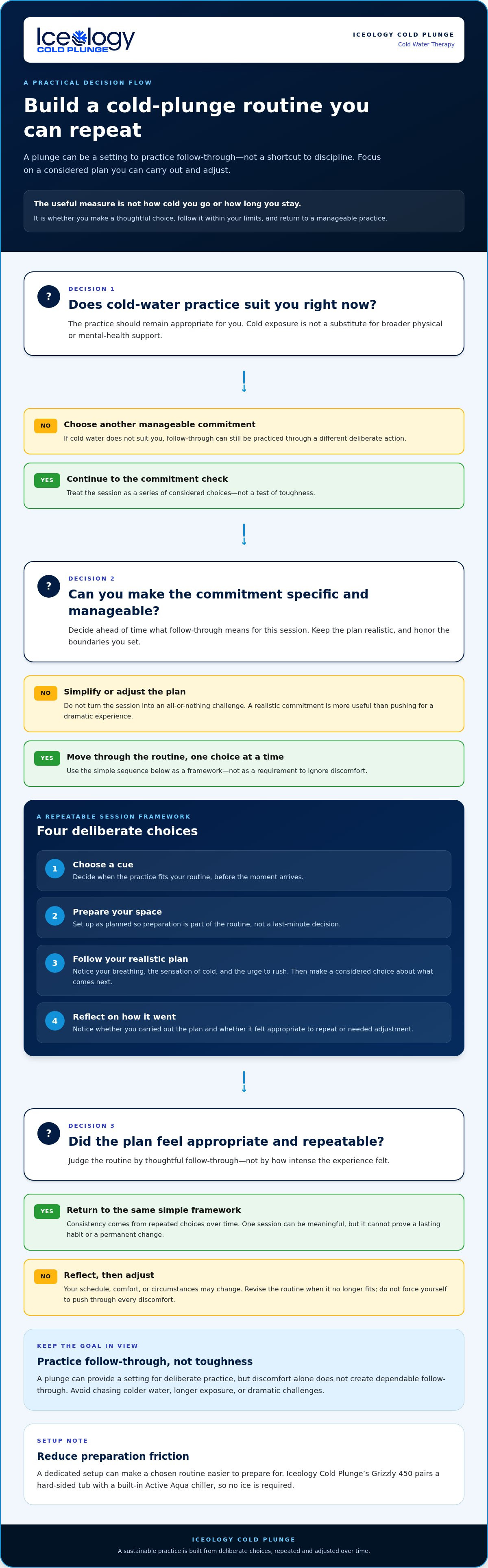
A routine is easier to return to when fewer decisions stand between you and the practice. Build it around a clear cue, a prepared space, a realistic plan, and a brief reflection afterward. These steps help make a cold plunge tub for improving discipline part of an intentional routine, without making intensity the measure of success. For broader setup guidance, a beginner’s guide to starting a cold-plunge journey can help you consider the practical basics as you shape your approach.
Choose a cue and reduce decision friction
Start with a point in your day you can recognize, such as after an existing activity or at a time that generally suits your schedule. The cue doesn’t need to be ambitious. Its purpose is to remind you to make a deliberate choice rather than wait for motivation to appear. Prepare the space and any items you need ahead of time, so the routine doesn’t begin with a string of avoidable decisions.
Keep the commitment flexible enough to fit real life. If your schedule or circumstances change, adjust the plan instead of treating a missed or modified session as failure. A sustainable routine is one you can revisit, not a rule that requires you to ignore what’s appropriate for you.
Use this four-step framework to give the practice a simple structure:
- Choose a cue. Tie the practice to a clear point in your day or an existing routine.
- Prepare the space. Set up what you need in advance to make getting started more straightforward.
- Follow a realistic plan. Decide what a manageable session means for you, without making colder water or longer exposure the goal.
- Reflect afterward. Note whether you followed your plan and what made that easier or harder.
Reflect on follow-through without chasing intensity
A short note can make reflection useful without turning it into a scorecard. Record whether you followed the plan you chose, what helped you begin, and whether anything made the routine difficult to sustain. Look for practical adjustments, such as choosing a more reliable cue or simplifying preparation. The point is to learn from the experience, not to judge yourself by how much discomfort you endured.
Some days may call for a change or a break. Treat that as information, not a failure of discipline. If the routine no longer feels suitable, reconsider it rather than escalating the challenge to prove commitment. Consistency is about returning to a practice that fits, not keeping every session identical.
Explore Iceology Cold Plunge tubs as you consider what kind of setup could support a routine you can return to. The Grizzly 450 has a built-in Active Aqua chiller, so the water cools without ice. Its two-inch pressure-injected polyurethane foam insulation helps keep the water cold longer and reduce energy use.
How Iceology Cold Plunge Can Support a More Consistent Practice
A dedicated cold-plunge setup can make the choice to practice easier to act on, but it can’t make that choice for you. The useful question is whether having a tub at home fits your space, schedule, and expectations well enough to support a routine you want to maintain. Consider the practical commitment as carefully as the personal one. A setup should suit your life, not create pressure to plunge simply because it’s there.
Features that can reduce preparation friction
Think about the steps that tend to interrupt your plans. Is it finding a suitable time, preparing your space, or making several decisions before you begin? A dedicated tub can give the practice a consistent place, while a built-in chiller can remove the need to source and add ice. The benefit depends on your circumstances: equipment can make access more straightforward, but it can’t remove every obstacle or establish a habit on your behalf.
Iceology Cold Plunge sells hard-sided cold plunge tubs, including the Grizzly 450 with a built-in Active Aqua chiller and Ozone Sanitation System. The chiller can bring water to 39°F, with its operating range regulating between 39°F and 41°F. Continuous circulation and filtration, together with the built-in ozone system, support water care, so include routine maintenance in your planning rather than assuming a dedicated tub is maintenance-free.
Before choosing a dedicated setup, check whether the footprint suits the space you have available. The Grizzly 450 requires a total space of 77 by 50 inches, including clearance at the back. Also account for the filled weight, approximately 855 to 900 pounds, and its standard 110-volt power requirements. These practical details can help you assess whether the tub fits your home and ordinary routine, rather than an idealized plan.
Choose consistency over an all-or-nothing challenge
A dedicated tub is a practical resource, not a measure of commitment. You don’t have to justify the setup by plunging every day or turning each session into a personal test. Let your intended use guide your decision, and leave room to adapt your routine when life changes. A sustainable approach gives you options; it doesn’t demand that every plan stay fixed.
If you’re weighing whether a dedicated tub belongs in your practice, compare the day-to-day setup with the habit you want to build. Consider whether the tub’s footprint, built-in cooling, and maintenance needs fit your space and schedule. Choose based on what feels workable for you, then let your own choices shape the habit over time.
Make Your Next Choice a Sustainable One
Discipline doesn’t have to look dramatic. It can begin with choosing a manageable practice, making room for it in your day, and deciding what feels appropriate as your routine evolves. A cold plunge tub for improving discipline may support that intention by making a chosen practice easier to access, but consistency comes from the choices you make over time, not from the tub itself.
Before you begin, consider what you want the practice to add to your routine and what would make it realistic to return to. Let your plan serve your well-being, not become another standard you feel pressured to meet. If a dedicated setup fits the way you want to practice, explore Iceology Cold Plunge as a possible next step.
Start with a thoughtful choice, then give yourself room to build steadily. Small, intentional steps can be a strong foundation for a practice that feels like your own.
Frequently Asked Questions
Can a cold plunge tub improve self-discipline?
It may be one context for practicing personal commitments, but whether it improves your self-discipline is individual. To assess its value, define what you’d count as a meaningful change outside the tub, such as completing a planned task or keeping an appointment. Compare your behavior over time rather than relying on a strong impression after one session. That gives you a more useful basis for deciding whether the practice belongs in your routine.
How does cold plunging help build discipline?
Cold plunging doesn’t have a proven, automatic effect on discipline. If you find the practice useful, consider what part of it supports you: planning ahead, creating a distinct pause in your day, or noticing how you respond to an uncomfortable sensation. Those are different experiences, so name the one that matters to you. That makes it easier to assess the practice without treating the cold itself as a measure of personal strength.
Does cold plunging improve focus and motivation?
Some people may feel more alert after cold exposure, but that feeling doesn’t establish that focus or motivation improves over time. If you want to evaluate your response, note a concrete task you planned to do afterward and whether you completed it. Keep other influences in mind, such as sleep, workload, and stress. This won’t prove the plunge caused a change, but it can help you distinguish a passing sensation from a pattern.
Do I need to cold plunge every day to build discipline?
No fixed daily schedule is required. A useful cadence is one that doesn’t compete with your other priorities or turn missed sessions into a source of pressure. Look at your calendar and identify a frequency that leaves room for work, rest, and unexpected changes. If your plans shift, reassess the schedule instead of trying to make up sessions. Your routine should be workable, not another obligation that strains your day.
Can a cold plunge make me more disciplined in other parts of life?
There’s no guarantee that a cold-plunge routine will change how you handle unrelated responsibilities. For a separate goal, make that goal specific on its own: decide what action counts as completion and what reminder will bring it to mind. For example, finishing a short administrative task after breakfast is easier to assess than a broad aim to “be more productive.” Evaluate each habit by its own results.
Does a cold plunge tub need ice for a consistent routine?
Not necessarily. Whether you need ice depends on how the tub cools its water. The Iceology Cold Plunge Grizzly 450 uses a built-in Active Aqua chiller to cool water directly, so ice isn’t required. When choosing a setup, also consider water care and whether routine maintenance fits the time and effort you can regularly give. An ice-based approach, by comparison, adds ice preparation to the process.