
Cold Plunge Tub Models and Chiller Options in Coral Gables
A cold plunge’s defining feature isn’t the ice; it’s the cold water. A tub cold plunge is a basin designed for cold-water immersion, with options that use ice or an integrated chiller to cool the water. For anyone considering a cold plunge tub, the chiller matters: Iceology Cold Plunge tubs can lower water temperature to as low as 39 °F.
Choosing a cold plunge tub for sale is about more than reaching a target temperature. Consider the space available, how you’ll use the tub, and whether an indoor or outdoor setup suits your home. This guide explains the main tub types, what affects price, and how to plan for cooling, installation, and sizing. Use these practical considerations to compare options and choose a setup that fits your space and routine.
Key Takeaways
- Compare ice-based cooling with an integrated chiller to understand which setup best suits your preferred routine and temperature control.
- Plan the tub’s location around available floor space, access, and the practical needs of an indoor or outdoor installation.
- Use model dimensions and the space around the tub to narrow down a size that fits comfortably in your home.
- Factor the tub, chiller, installation needs, and site requirements into your overall purchasing decision.
- Keep cold-water sessions brief, and consult a medical professional before cold therapy if you have a cardiovascular condition.
Indoor and outdoor installation options
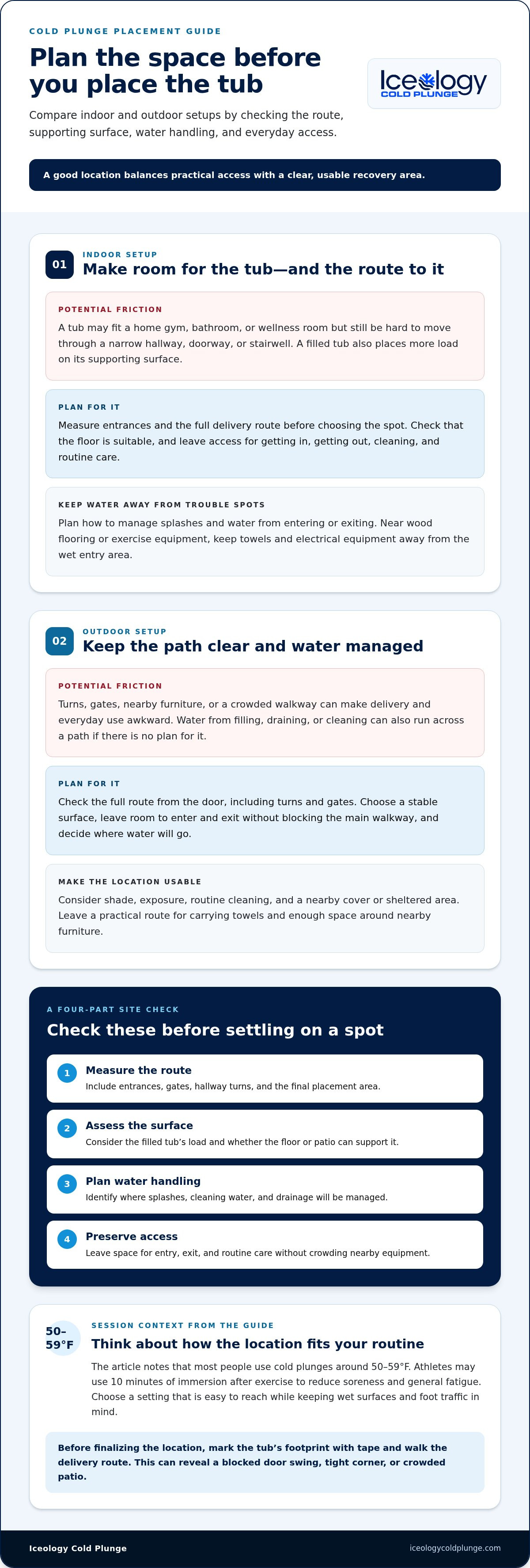
Placement affects access, setup, and how easily a cold plunge fits into your routine. Before choosing a location, compare an indoor room with an outdoor area by mapping the tub’s delivery route, surrounding space, and water-management plan.
Indoor Placement and Use
An indoor location can make a plunge part of a home gym, bathroom, or wellness room. Measure doorways and the route from the entrance before choosing a spot. A tub that fits the room may still be difficult to move through a narrow hallway or around a stairwell. Leave enough access around it for entry, cleaning, and routine care.
Assess the floor, nearby surfaces, and water handling. A filled tub places more load on its supporting surface than an empty one, so make sure the floor is suitable. Plan how to manage splashes and water from entering or exiting, especially near wood flooring or exercise equipment. In a gym, for example, keep towels and electrical equipment away from the wet entry area.
Outdoor Placement and Use
An outdoor setup may suit a patio or another accessible area beside the home. Check that the surface is stable and walk the full route from the door to the tub, including turns and gates. Leave room to enter and exit without blocking the main walkway. Account for nearby furniture and the path you’ll use to carry towels.
For an outdoor setup, consider shade, exposure, and routine cleaning. A nearby cover or sheltered area can help keep the space orderly between sessions. Plan where water will go during filling, draining, or cleaning instead of letting it run across a path. Choose a location convenient enough to use regularly.
Use this short planning sequence for either location:
- Measure the route: Include entrances, gates, hallway turns, and the final placement area.
- Assess the surface: Consider the filled tub’s load and whether the floor or patio can support it.
- Plan water handling: Identify where splashes, cleaning water, and drainage will be managed.
- Preserve access: Leave space for entry, exit, and routine care without crowding nearby equipment.
Location also shapes the experience. Most people use cold plunges around 50-59 degrees F, and athletes may use 10 minutes of immersion after exercise to reduce soreness and general fatigue. Those figures can help you picture how a session fits into an indoor recovery routine or an outdoor cooldown. Choose a setting where the tub is easy to reach, while keeping wet surfaces and foot traffic in mind.
Before settling on a location, mark the tub’s footprint with tape and walk the delivery route. This can reveal a blocked door swing, tight corner, or crowded patio before you finalize the setup. A good location balances practical access with a clear, usable recovery area.
Tub cold plunge models and prices
Cold plunge tubs mainly differ in how they cool and maintain the water. An ice-based setup relies on adding ice, while a tub with an integrated chiller uses equipment to cool the water. The difference affects your routine: one requires replenishing ice, while the other cools water without a fresh load of ice for each session.
Look beyond appearance when comparing models. Consider the cooling method, water capacity, how often you’ll use the tub, and the space required for the tub and its equipment. For regular use, an integrated chiller can keep the water cold between sessions without adding ice each time. For occasional use, an ice-based setup may be worth considering.
Prices depend on the model’s design and what the complete setup includes. A useful comparison accounts for the tub and its cooling method together, rather than treating the basin as the only purchase. Check whether the listed configuration includes the equipment needed for its cooling approach, and factor in practical needs such as delivery, placement, and ongoing operation. These considerations help explain why two tubs with similar appearances may represent different overall investments.
- Cooling approach: Compare ice-based cooling with an integrated chiller and consider the routine each requires.
- Capacity and footprint: Match the tub’s water capacity and physical size to your intended use and available space.
- Included components: Identify what comes with the tub and what the chosen cooling method needs.
- Use pattern: Consider whether the setup will support occasional sessions or a consistent recovery routine.
Consider how each model will fit its indoor or outdoor location. A chiller-based tub needs space for the tub and its equipment, while an ice-based setup requires a practical way to handle ice. The installation plan can affect how straightforward a model is to use. Before comparing configurations, note your available space, cooling preference, and intended routine.
Don’t treat a single advertised figure as the full cost of ownership. Compare each configuration on the same basis: tub, cooling method, included components, and any work needed to make the setup usable. This makes trade-offs clearer without assuming a lower initial price is the right fit for every routine.
Once you’ve identified the cooling approach that suits your routine, review cold plunge tub options alongside your space and setup priorities. A considered comparison begins with how you’ll use the tub, then weighs the model’s cooling method and overall configuration.
Choosing a tub size
Start with the tub’s outside dimensions, then compare them with the exact space available. Two models can look similar in product photos yet need different room around their sides and ends. Measurements also help you plan delivery access and the final placement. For Coral Gables homes, sketch the intended location and mark its length and width before deciding which size fits.
Standard compact cold plunge models typically measure around 67 inches long, 31.5 inches wide, and 24 inches high. Larger luxury models often measure about 76.75 inches long, 31.5 inches wide, and 28.75 inches high. Extended models offer more room to stretch out, while standard models share a more compact footprint. Compare those measurements with your available floor area, ceiling clearance, and route into the room.
Treat dimensions as the start of the installation plan, not the whole plan. Mark each model’s footprint on the floor with tape to spot tight corners or blocked pathways. Then measure doorways, turns, and gates along the delivery route. A tub that fits its final location still needs a workable path to get there.
Height deserves attention alongside length and width. Standard cold plunge heights sit around 24 inches, while larger units measure up to 28.75 inches high. Consider nearby ledges, shelves, windows, and ceiling features that could affect placement or access. Check how the tub’s position relates to the room’s doors and other equipment. For example, a marked footprint can show whether a cabinet door still opens fully.
Before selecting a cold plunge tub for sale in Coral Gables, work through these practical steps:
- Measure the proposed location: Record the usable length, width, and height, including nearby obstructions.
- Mark the footprint: Use tape to outline 67 by 31.5 inches for compact models, or up to 76.75 by 31.5 inches for larger Iceology Cold Plunge units.
- Check the route: Measure doors, hallway turns, and gates between delivery access and the tub’s final position.
- Review surrounding access: Check that entry points and nearby doors remain usable after placement.
Choose a model based on how you expect to use it, too. A compact footprint may suit a tighter room, while a longer model needs more floor space. When browsing an Iceology Cold Plunge, compare the stated dimensions with the location, delivery route, and usable space around the tub. That gives you a practical way to narrow your options without assuming the largest model is automatically the best fit.
Are permits or electrical requirements needed to install a cold plunge tub in Coral Gables?
Treat permits and electrical work as separate planning questions. The tub’s placement is different from changes to wiring, plumbing, or the supporting structure. Permit requirements depend on the work involved; electrical planning depends on the tub’s stated power needs and the home’s existing setup. Don’t assume every installation follows the same approval process.
Start by defining the full project scope. Note whether the tub will go in an existing indoor or outdoor space and whether you plan to change wiring, plumbing, or the structure. Placing a tub in a prepared area, for example, differs from adding an electrical connection or modifying a floor. A clear scope helps determine which permit requirements apply.
Begin electrical planning with the manufacturer’s installation information. Identify the tub’s power requirements, connection location, and the route from the power source to the proposed setup. An electrician can assess the existing circuit and planned equipment before installation. Don’t choose an extension cord or alter wiring by guesswork; follow the tub’s specifications and account for the home’s electrical conditions.
Use this preparation sequence before scheduling installation work:
- Gather the product documentation: Keep the installation instructions and electrical specifications together.
- Describe the site: Record whether the location is indoors or outdoors and note nearby power and water connections.
- List planned changes: Separate simple placement from new wiring, plumbing changes, or structural work.
- Resolve the permit path: Present the work description to Coral Gables building officials for a project-specific determination.
- Plan electrical work: Have an electrician assess the stated requirements against the home’s existing setup.
Keep the project details with your installation documents and update them if the plan changes. Moving a tub from a patio to a garage, for example, may affect the electrical layout and the work involved. A new location can change the connection route, while added plumbing or floor work changes the project scope. Revise the plan before work begins.
Electrical safety also depends on the wet setting. Include the planned connection and its route when mapping the tub’s location, then share the layout with an electrician. A convenient household outlet isn’t proof that it suits the equipment. A professional assessment can account for the tub’s stated requirements and the actual installation conditions.
Define the installation scope first, then plan permitting and electrical work around it. Placing a tub without building changes raises different questions from a project involving new wiring or plumbing. Product documentation, a clear description of the work, and an electrician’s assessment help turn those questions into practical installation decisions.
What are the health risks and safety precautions for using a cold plunge tub?
Cold-water immersion calls for a measured approach, not a test of endurance. Staying in cold water too long can cause hypothermia, so keep each session brief. Don’t extend a session to match someone else’s routine or prove you can tolerate the temperature. Put personal safety ahead of duration.
People with cardiovascular conditions should consult a medical professional before starting hot or cold therapies. Do this before using a cold plunge, even at home or if the routine seems manageable. Discuss the planned cold-water exposure and your relevant health history. A medical professional can help determine whether cold therapy is appropriate for you.
Use the tub’s temperature and your response as practical considerations, not reasons to push farther. Cold plunges are often used around 50-59 degrees F, but that range doesn’t establish a safe session length for every person. Keep sessions brief, and leave the water if you feel unwell. Never treat a published temperature or another person’s routine as a personal medical recommendation.
A simple safety sequence can make each session more deliberate:
- Before entering: Review the tub’s operating instructions and consider whether a medical discussion is needed.
- At entry: Move carefully, using a stable route into and out of the tub.
- During immersion: Keep the session brief and pay attention to how you feel.
- When finished: Exit promptly if you feel unwell, then allow yourself time to recover before resuming activity.
Plan the area around the tub, too. A clear path can help reduce slips during entry and exit, especially when the floor is wet. Keep towels within reach and move loose items that could obstruct your footing. In a home gym, leave a direct route between the tub and a dry area.
For athletes considering cold water after exercise, avoid turning a recovery routine into a prolonged immersion. A 10-minute session has been described for reducing soreness and general fatigue, but that example isn’t a universal prescription. The broader safety principle remains the same: keep sessions brief, and don’t use a set duration to override your body’s response or medical guidance.
Keep cold plunging controlled and intentional. If you have a cardiovascular condition, consult a medical professional before beginning. Keep sessions brief to help prevent hypothermia. These precautions provide a clear foundation for deciding whether cold-water immersion belongs in your routine.
Iceology Cold Plunge: Cold Plunge Tubs
Iceology Cold Plunge offers Cold Plunge Tubs for people seeking a dedicated cold-water setup at home. Its tubs are made in the USA and feature built-in chillers that can lower water temperature to as low as 39 °F. That integrated cooling can suit a routine where adding ice isn’t the preferred approach.
Use the decisions in this guide to narrow your fit: compare the installation location, measure the available space, and consider how you plan to use the tub. Iceology Cold Plunge also offers Accessories and Ice Baths, giving readers options to explore alongside their cold-water routine.
For a closer look at Cold Plunge Tubs and related options, contact Iceology Cold Plunge.
Make your next step a deliberate one
Choosing a cold plunge tub for sale in Coral Gables gives you the chance to shape a home recovery routine around your space and goals. Before deciding, consider what matters most in daily use: a dedicated place to reset, a setup that fits your home, or equipment that supports regular cold-water immersion. A clear priority makes comparing tubs easier.
Iceology Cold Plunge offers Cold Plunge Tubs, Accessories, and Ice Baths for people exploring ways to build a cold-water practice at home. Consider which option aligns with your routine, then take the next step at your own pace.
A practical setup can help turn an intention into a regular routine. Set clear goals, choose a tub that fits your space, and plan for safe, convenient use.
Frequently Asked Questions
What is a tub cold plunge?
A tub cold plunge is a purpose-built vessel for immersing the body in cold water. Some setups use ice, while others cool water with an integrated chiller. For a concrete product example, the Iceology Grizzly 450 holds 450 quarts, with a recommended fill line of 90-95 gallons. That capacity can help you assess how much water the tub requires for your intended setup.
Who Should Use It and Why?
Cold plunges may interest athletes and people exploring recovery or wellness routines. Iceology describes its tubs as supporting circulation, reducing inflammation, and physical and mental performance. These aims aren’t a substitute for medical guidance. People with cardiovascular conditions should consult a medical professional before starting cold therapy, and anyone using a plunge should keep sessions brief to help reduce the risk of hypothermia.
Where can I buy a cold plunge tub near Coral Gables, Florida?
Iceology Cold Plunge sells tubs online to customers across the United States, so buyers can explore its offerings without relying on a nearby showroom. Its Grizzly 450 is a hard-sided tub with an integrated chiller. Review the product details and consider your intended placement before purchasing. For a home setup, measuring the route to the final location can help you prepare for delivery.
How much does a cold plunge tub cost, including delivery and installation in Coral Gables?
The total cost depends on the tub, delivery, and work required at the installation site. Compare the product and shipping charges separately from any electrical, plumbing, or placement work. Installation needs vary with the home and project scope. A setup requiring new wiring, for example, needs different planning from placing a tub in a prepared space.
What should I know about delivery, installation, and outdoor placement of a cold plunge tub in Coral Gables?
Before delivery, measure the full route from the access point to the chosen location, including gates and turns. Check the product instructions for setup requirements, and plan electrical work around the tub’s stated specifications. Choose a stable surface and decide how to manage water during use and cleaning.
What warranty, maintenance, and operating costs should I expect for a cold plunge tub?
The Plunge has a 1-year limited warranty. Plan for routine care and cleaning; ice-based setups require replenishing ice, while integrated chillers use equipment to cool the water.
What are the best cold plunge tubs for home use in South Florida's hot, humid climate?
Choose based on your available space, intended routine, and cooling preference. Ice-based tubs require adding ice, while an integrated chiller can lower water to 39°F; the Plunge measures 67 by 31.5 by 24 inches and holds 75 gallons.
How do popular cold plunge tubs compare on capacity, temperature range, filtration, and cooling speed?
The Plunge holds 75 gallons, and Iceology tubs with a chiller can cool water to as low as 39°F; most people use cold plunges around 50-59°F. The material gives no filtration or cooling-speed details.