
Cold Plunge Tub Tax Deductions for Business: What Qualifies
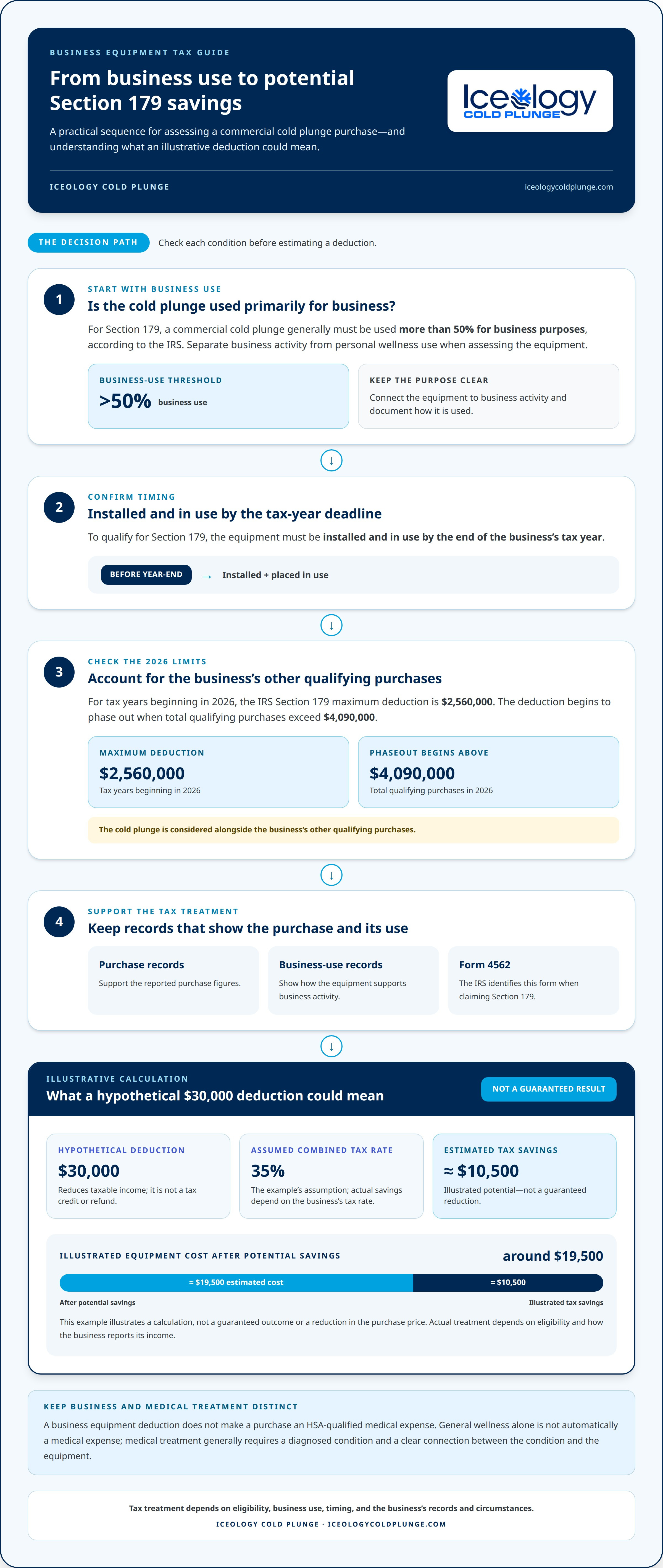
Can a commercial cold plunge qualify for a Section 179 deduction? It may qualify when it’s used more than 50 percent for business purposes, according to the Internal Revenue Service, and is installed and in use by the end of the business’s tax year. Whether cold plunge tub tax deductions for business use apply depends on the equipment’s business purpose, timing, and the tax treatment that fits the purchase.
It’s reasonable to want a clear answer before investing in recovery equipment. This guide explains which costs may qualify as business deductions, how Section 179 and bonus depreciation may apply, and why personal wellness use can change the tax picture. It also covers when medical expense rules may matter, including the distinction between general wellness and an expense tied to treating a diagnosed condition. With those factors in view, you can better understand the potential tax treatment and the records that help support it.
Key Takeaways
- A commercial cold plunge generally must be used more than 50 percent for business purposes to qualify for Section 179, according to the Internal Revenue Service.
- Medical expense rules focus on whether an expense treats or alleviates a diagnosed condition, rather than supporting general wellness alone.
- Separate the tub, components, and accessories in your records so their business purpose and tax treatment can be assessed clearly.
- The Internal Revenue Service states that 100 percent bonus depreciation has been restored for 2026 under the One Big Beautiful Bill Act.
- To assess whether the purchase is an ordinary and necessary business expense, connect it to your business activity and document how it is used.
Potential tax savings illustrated with a hypothetical example
Section 179 may reduce taxable business income when equipment meets the applicable requirements. A hypothetical calculation helps show how a recovery studio’s purchase could affect its tax bill. For businesses assessing cold plunge tub tax deductions for business use, the first question is whether the equipment supports business activity and qualifies for the chosen tax treatment.
Hypothetical Tax Savings Example
A hypothetical example estimates how a deduction could affect taxable income. If the purchase qualifies for the full deduction, the example treats $30,000 as a deduction, not as a tax credit or refund.
The distinction matters because a deduction reduces taxable income, while resulting tax savings depend on the business’s tax rate. The example assumes a combined tax rate of 35 percent. Actual treatment depends on eligibility and how the studio reports its income. This is one reason cold plunge tub tax deductions for business use should be evaluated against the business’s records and circumstances.
Illustrated Savings Potential
At a 35 percent combined tax rate, a $30,000 deduction could produce roughly $10,500 in tax savings. The example estimates an effective equipment cost of around $19,500 after potential savings. These figures illustrate a calculation, not a guaranteed outcome or reduction in the purchase price.
Business use is central. A commercial cold plunge generally must be used more than 50 percent for business purposes to qualify for Section 179, according to the Internal Revenue Service. A studio should distinguish commercial use from personal wellness use when estimating an eligible deduction.
Federal limits also matter. For tax years beginning in 2026, the Section 179 maximum deduction is $2,560,000, according to the Internal Revenue Service. For tax years beginning in 2026, the deduction begins to phase out when total qualifying purchases exceed $4,090,000, according to the Internal Revenue Service. The cold plunge is considered alongside the business’s other qualifying purchases.
Timing and documentation support a claim. The equipment must be installed and in use by the end of the business’s tax year to qualify for Section 179. The Internal Revenue Service identifies Form 4562 as a form to file when claiming Section 179 on a cold plunge. Purchase records and business-use documentation should support reported figures.
Keep business deductions distinct from medical-account spending. In the United States, an HSA accountholder who uses HSA funds for a nonqualified medical expense must report it as taxable on Form 8889, and the amount is subject to an additional 20% penalty tax, according to the Internal Revenue Service. A business equipment deduction doesn’t make a purchase an HSA-qualified medical expense simply because it supports wellness.
Reasonable costs and medically necessary features
A cold plunge tub bought for general recovery or mental wellness is not automatically a medical expense. To qualify as medical treatment, its primary purpose must be preventing or alleviating a physical or mental illness or disease, with a clear, direct connection between the diagnosed condition and the equipment.
That distinction matters for health care FSAs, HRAs, and HSAs. These accounts generally pay for medical expenses, while a cold plunge used for broad wellness needs special circumstances to qualify for tax-free reimbursement. A diagnosed condition and a clear connection between it and the expense may be needed to establish a medical purpose; self-diagnosis may not be enough. The diagnosing and treating provider typically documents the connection between the condition and the expense in a letter of medical necessity.
The circumstances behind the purchase matter. If someone would have bought the tub regardless of a medical condition, it does not meet the stated medical-purpose criteria. For example, a person who already planned to use cold immersion as part of a general recovery routine cannot make that purpose medical simply by later connecting it to a health concern. The purchase must be primarily intended to prevent or alleviate the diagnosed illness, not simply support wellness.
For preventive care, the connection to the condition should be specific and well documented. A general hope that cold exposure might support future health does not establish that relationship. Documentation should explain the condition, the intended medical purpose, and why the equipment is connected to treatment or prevention.
- Reasonable cost: The expense must be reasonable for the medical purpose. A more expensive configuration does not become medically necessary merely because it offers added convenience.
- Necessary features: Features unrelated to treating the condition aren’t considered medical. Separate the function required for treatment from optional wellness or comfort features when describing the expense.
- Account review: For an FSA or HRA, a third-party administrator and/or sponsoring employer reviews expenses. HSA accountholders are responsible for ensuring withdrawals cover qualified medical expenses.
Medical-purpose equipment can be used at home, at work, or in a vehicle, but location alone does not establish eligibility. The medical reason and supporting records remain central. A lifestyle spending account may cover broader, nonmedical wellness expenses, but those reimbursements are taxable. It is therefore distinct from tax-advantaged health accounts, even when both support a recovery or wellness program.
Tax treatment of tub components and accessories
Yes, installation, plumbing, electrical work, and maintenance costs can affect a business’s tax treatment, but they do not necessarily receive the same treatment as the tub. Separate each cost and document its purpose: work to prepare equipment for use differs from ongoing upkeep.
For a commercial installation, keep the tub invoice separate from contractor charges, plumbing materials, electrical work, and later service visits. This breakdown helps distinguish costs for acquiring and preparing the equipment from costs for maintaining it during operations. Tax treatment depends on the nature of each cost and the applicable deduction or depreciation method, not simply on whether it appears on the same project invoice.
Consider a recovery studio that buys a tub and pays a contractor to connect its water supply and power. The studio should retain the purchase record and the contractor’s itemized invoice, noting the work performed and the equipment it supports. If the invoice combines installation with unrelated facility upgrades, a clear allocation makes the business purpose of each charge easier to understand.
Accessories also need a functional explanation. A component required for the tub’s operation differs from an optional item added for convenience or general wellness. Record each item, its cost, when it was acquired, and how the business uses it. For example, an accessory dedicated to preparing the tub for customer use has a clearer business connection than one used for both personal and business activities.
- Installation: Keep contracts and invoices that describe setup work and identify the equipment being prepared.
- Plumbing and electrical: Preserve itemized records showing the specific connection or work completed, rather than grouping all facility work under one vague label.
- Maintenance: Record service dates, the work performed, and whether the charge concerns routine upkeep or a larger change to the equipment.
- Accessories: Note each item’s operational purpose and whether its use is business, personal, or shared.
For a residential setting, the same recordkeeping discipline helps separate business use from personal use. A tub installed at home does not make every associated cost a business expense. A written usage log, appointment records, or another consistent record can help explain the business connection and identify personal use.
State and federal tax treatment can differ, so organize records by cost type and tax year. Do not combine a maintenance visit with a capital improvement in your bookkeeping just because both relate to the same tub. A precise description gives your tax preparer the information needed to assess how each item should be reported and whether it should be treated separately or with the equipment.
Bonus depreciation
Bonus depreciation can let a business deduct eligible equipment costs sooner instead of recovering them over time. According to the Internal Revenue Service, 100 percent bonus depreciation has been restored for 2026 under the One Big Beautiful Bill Act. For a cold plunge purchase, the deduction still depends on the equipment qualifying under the applicable tax rules.
Timing can affect a business’s taxable income in the year it claims a deduction. A faster deduction may matter to a recovery studio making a substantial equipment investment, especially when weighing cash flow against future depreciation. It does not reduce the purchase price or create a tax credit. It changes when eligible costs reduce taxable income.
Section 179 and bonus depreciation are separate provisions, and the page’s stated ordering is to apply Section 179 first. Bonus depreciation may then apply to remaining eligible costs. This sequence means a business shouldn’t treat the two deductions as interchangeable or simply add their percentages together. The tax return must reflect the eligible cost and the method used for that cost.
For example, a business considering a cold plunge alongside other equipment should first identify the assets and their qualifying costs. It can then evaluate Section 179 treatment before considering bonus depreciation. This order helps reveal how each provision affects the deduction and avoids assuming that every dollar receives the same treatment. Purchase records, invoices, and placed-in-service details support that analysis.
- Separate the provisions: Model Section 179 first, then consider bonus depreciation for eligible remaining costs.
- Match records to assets: Keep the invoice and equipment description connected to the amount claimed.
- Consider the tax year: Organize purchases by the year the equipment is placed in service, rather than relying only on the payment date.
- Review business use: Keep records showing how the equipment supports business activity and distinguish that use from personal wellness use.
A 100 percent rate describes the potential deduction for qualifying property, not an automatic write-off for every purchase. Eligibility, business purpose, and the applicable tax year remain important. The Internal Revenue Service’s 2026 rule therefore does not remove the need to establish that a cold plunge is used in the business and reported under the correct provision.
Planning also means considering the broader return, not viewing one asset in isolation. A business adding several pieces of equipment should assess how Section 179 and bonus depreciation interact across those purchases. The deduction may affect taxable income differently from its effect on cash available for operations. A clear schedule of assets and costs gives the tax preparer a practical basis for reporting the claim.
For a wellness business, the practical next step is to coordinate the purchase records, business-use documentation, and depreciation method before filing. The 2026 bonus depreciation change creates an opportunity for eligible equipment, while accurate classification keeps the deduction tied to its proper tax treatment.
What IRS rules determine whether a cold plunge tub is an ordinary and necessary business expense?
The key issue is the tub’s connection to the business, not its wellness appeal alone. A recovery studio that uses it as part of a defined service has a clearer business rationale than an owner buying one mainly for personal recovery. The purpose, actual use, and way the business operates should align.
“Ordinary” and “necessary” are useful tests for examining that rationale. In practical terms, consider whether the equipment fits the kind of work the business does and supports that work. A studio offering recovery services, for example, can explain how the tub contributes to its customer experience. A company buying one for an owner’s private routine has a different business connection.
Build the explanation around the business model. A customer-facing recovery studio might connect the tub to its service menu, appointment records, operating procedures, and revenue activity. A workplace offering general wellness access to employees should describe that purpose accurately, rather than presenting it as treatment for a diagnosed condition. The stated purpose should match actual use.
Several records can help demonstrate that relationship:
- Business purpose: Describe how the equipment fits the company’s work and who uses it.
- Operating records: Keep relevant booking, customer-use, or workplace-program records that reflect actual activity.
- Ownership and payment: Retain purchase documents and identify whether the business or an individual acquired the equipment.
- Personal use: Record any personal access separately from business use, especially where the tub is located at an owner’s residence.
For example, a recovery studio can compare its stated service purpose with its actual appointment and usage records. If those records show the tub primarily supports the owner’s personal wellness, the business rationale is weaker than for documented commercial use. A written explanation alone cannot make a personal purchase business-related.
Keep the business-expense analysis separate from medical treatment. A wellness benefit for employees or customers does not automatically become a medical expense. Medical treatment involves a diagnosed physical or mental condition and a direct connection between that condition and the expense. The business rationale and the medical rationale answer different questions.
Keep the explanation consistent across purchase records, bookkeeping, and reported use. If the business describes the tub as essential to customer services, its operating records should reflect that role. If its actual use changes, update the records so the stated purpose remains accurate. This disciplined approach helps clarify whether the expense fits the business activity, rather than relying on a general claim about recovery or wellness.
Iceology Cold Plunge
Iceology Cold Plunge offers equipment options for businesses planning a recovery or wellness space. Once you understand how business purpose and actual use affect tax treatment, consider which setup fits your operation and keep your purchase records aligned with that decision.
Iceology Cold Plunge Tubs, Ice Baths, Cold Tubs, and Accessories support different cold-water immersion setups. A studio planning for customer use may have different equipment needs from a business creating a dedicated employee wellness area. Choosing with the intended use in mind can help you describe the equipment’s role in your business records. Tax eligibility depends on your circumstances and applicable rules, not the product alone.
For help choosing equipment for your business, explore Iceology Cold Plunge’s tubs and accessories.
Make Your Next Equipment Decision With Clarity
Planning cold plunge tub tax deductions for business use starts with a clear view of how the equipment will serve your operation. Before moving forward, align the intended business use with your purchasing plans and recordkeeping approach. This makes the equipment decision more deliberate, whether you are creating a recovery space for customers or supporting workplace wellness.
Iceology Cold Plunge offers Cold Plunge Tubs, Accessories, and Ice Baths for different business environments. Consider how the options fit your space and intended use, then keep the equipment’s business purpose in view as you plan. Tax treatment depends on your circumstances, so use this guide as a starting point for a discussion with your tax professional.
A well-planned recovery space begins with thoughtful choices. Move forward with a setup that fits your business and its goals.
Frequently Asked Questions
Can You Write Off a Commercial Cold Plunge With Section 179?
Yes, a commercial cold plunge may qualify for Section 179 when it meets the eligibility rules. The Internal Revenue Service states that business use must exceed 50 percent. The equipment must also be placed in service by the end of the business’s tax year. For a studio, records showing customer access and business operations help distinguish commercial use from an owner’s personal wellness use.
Does Financing Affect the Deduction?
Financing alone doesn’t prevent a commercial cold plunge from qualifying for Section 179. A financed purchase can qualify when the equipment is placed in service by the deadline and meets the other requirements. For example, a studio financing equipment should retain its purchase and financing records alongside documentation showing when the tub became operational and how the business uses it.
What Happens If the IRS Questions My Deduction?
If the Internal Revenue Service questions a deduction, the business needs records supporting its reported treatment. Keep the purchase invoice, payment or financing documents, installation records, placed-in-service date, and evidence of business use. For a recovery studio, customer bookings or operating records can help explain the tub’s role. Records should be consistent with the business purpose reported on the return.
What Is Section 179?
Section 179 is a federal tax provision that can allow a business to deduct the cost of qualifying equipment in the year it is placed in service, instead of recovering the cost through depreciation over time. The deduction has eligibility limits and may depend on business income and equipment use. A cold plunge is considered alongside the business’s other qualifying equipment purchases.
Can a business deduct the cost of a cold plunge tub under IRS rules?
A business can generally deduct the cost when the tub is an ordinary and necessary expense connected to its operations and meets applicable tax requirements. A recovery studio using it as part of customer services has a different business case from an owner buying one primarily for personal use. The business’s actual use and records should support the treatment claimed on its return.
Is a cold plunge tub deductible as business equipment or a capital asset?
A cold plunge bought for ongoing business use is generally treated as equipment or a capital asset, rather than an ordinary supply used up during operations. The business then considers depreciation rules or an available expensing provision. For example, a studio should record the tub as an asset and keep its purchase documents separate from recurring operating costs.
Can a gym, spa, wellness clinic, or physical therapy practice deduct a cold plunge tub?
A gym, spa, wellness clinic, or physical therapy practice may be able to deduct a tub when it supports the business’s actual services or operations. The business type alone does not establish eligibility. A gym should document how the tub fits its member offerings, while a clinic should distinguish general wellness use from equipment serving a specific business purpose.
How does Section 179 or bonus depreciation apply to a cold plunge tub?
Section 179 may allow an eligible business to deduct qualifying equipment costs, while bonus depreciation can provide another depreciation method. According to the Internal Revenue Service, 100 percent bonus depreciation has been restored for 2026 under the One Big Beautiful Bill Act. Section 179 is generally applied before bonus depreciation, so the business assesses the provisions in that order when reporting eligible costs.