
How a Cold Plunge Tub Works in a Community Center
A cold plunge tub for a community center needs more than cold water: the setup must circulate and filter water, support water treatment, and keep the tub cold. The facility also needs a suitable location, safe access, drainage, and room for equipment and cleaning. Planning these pieces together makes daily operation more practical.
Shared use changes the planning. Each person adds heat and contaminants to the water, and busy periods increase demand on the cooling system. The tub matters, but so do circulation, water care, safe access, and clear daily routines.
This guide explains how these components work together and what to plan for delivery, shelter, and facility space. You’ll learn how filtration and chilling support operation, why staff procedures matter, and how Iceology Cold Plunge’s tubs can fit into a community wellness environment.
Key Takeaways
- Plan water care as a combined routine: circulation, filtration, disinfection, testing, cleaning, and staff procedures all support shared use.
- Assess chiller performance around the tub’s volume, desired temperature, insulation, room conditions, and expected peak use, not horsepower alone.
- Make delivery and setup part of the facility plan by considering access routes, equipment placement, drainage, and service clearance.
- Map the space before installation, including safe entry and walking surfaces, electrical access, ventilation, and practical cleaning routines.
- Compare project costs by accounting for the tub and the facility work around it, such as electrical preparation, drainage, and installation needs.
Filtration, circulation, disinfection, and water testing
Useful safeguards include controlled entry, clear staff supervision, safe access, and documented routines for cleaning and water checks. The CDC’s Model Aquatic Health Code can inform planning for public aquatic environments. Local requirements may vary by facility type and location.
In a shared cold plunge, circulation and filtration do different jobs. A pump moves water through the system, and a filter captures suspended particles. Disinfection addresses microorganisms that mechanical filtration alone does not remove. Each user adds heat and contaminants, so peak use affects water care and cooling demand. A shared-use setup needs coordinated circulation, filtration, disinfection, testing, cleaning, and staff routines, not reliance on a single component.
Water testing helps staff track whether treatment is working as intended. CDC water-care guidance includes disinfectant levels and pH management, alongside practices to reduce the risk of recreational water illness. Testing and recording results give staff a consistent way to spot changes and follow facility procedures. Cleaning the tub and maintaining its treatment system are separate tasks, and both belong in the operating routine. Practical procedures should also assign responsibility for each check and explain how results are recorded.
Capacity shapes how the system handles shared use. A cold plunge capacity benchmark is around 105 gallons, but the useful size depends on the facility’s intended use and available space. A larger water volume can take more cooling effort, while frequent entry brings additional heat and contaminants into the water. The history of cold-water therapy reaches back further than modern wellness facilities: references to cold’s therapeutic effects appear in the oldest known medical text, circa 3500 BC. The Polar Bear Club has also demonstrated the social appeal of cold-water plunges since the early 1900s.
A cold plunge means immersion in water below 59°F. For beginners, a guide recommends starting at 55-60°F and staying in for one or two minutes, then adapting gradually. Cold-water exposure that lasts too long can lead to hypothermia. People with cardiovascular disease risk factors, such as high blood pressure, should check with a primary care provider or cardiologist before plunging. Temperature and exposure time both matter, so community procedures should give users clear limits and support a gradual approach.
These elements work as one operating system: filtration captures particles, circulation moves water, disinfection treats it, and testing guides staff routines. When planning a cold plunge tub for a community center, account for water capacity and expected use so water quality and temperature management fit into daily operations.
Chiller performance and temperature control
A chiller removes heat from circulating water and maintains the selected temperature between uses. For a community wellness space, performance depends on peak demand, insulation, circulation, and room conditions.
Sizing for Peak-Hour Demand
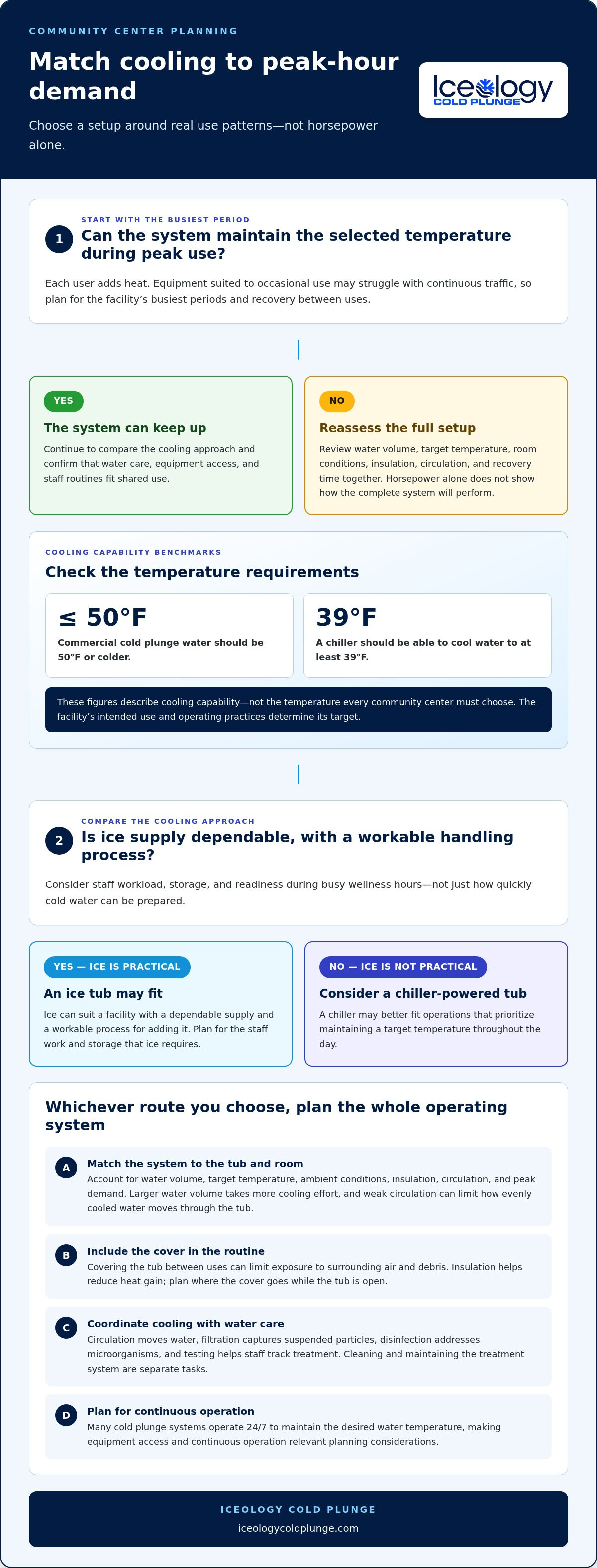
Plan for peak-hour demand by considering whether the chiller can maintain the target temperature during the facility’s busiest periods. Each user adds heat, so equipment suited to occasional use may struggle with continuous traffic. Factor in water volume, target temperature, ambient conditions, insulation, circulation, and recovery time. Horsepower alone does not show how the complete system will perform.
Commercial cold plunge water should be 50°F or colder, and a chiller should be able to cool water to at least 39°F. These figures describe cooling capability, not the temperature every community center must choose. The facility’s intended use and operating practices determine its target. A chiller that can reach the target and recover between busy periods supports steadier access for users seeking recovery through cold water immersion.
Consider the tub and chiller as a system. A larger water volume takes more cooling effort, while weak circulation can limit how evenly cooled water moves through the tub. Insulation affects how quickly heat enters the water, and peak use determines the demand the equipment must meet. Assessing these factors together is more useful than comparing horsepower figures alone.
Chiller Versus Ice Tub
A chiller-powered tub actively cools water; an ice tub relies on added ice. That difference matters because a chiller maintains water temperature, while an ice tub requires a regular supply of ice. Ice supply and handling can add work for staff and affect storage and readiness during busy wellness hours.
Ice can suit a facility with dependable supply and a workable process for adding it. A chiller may better fit operations that prioritize a maintained target temperature throughout the day. Either setup still needs water care and a plan for changing conditions after users enter. Compare the ongoing work each approach creates, not just how quickly cold water can be prepared.
A cover can also help manage temperature. Covering the tub between uses can limit exposure to surrounding air and debris, while insulation helps reduce heat gain. Keep cover handling practical for staff and users, and plan where it will go while the tub is open. A cover complements the chiller but does not replace equipment suited to expected use.
Many cold plunge systems operate 24/7 to maintain the desired water temperature, making continuous operation and equipment access relevant planning considerations. For a community center, cold water immersion planning starts with matching cooling capacity to use patterns, not selecting a chiller by one specification alone.
Delivery, setup, and warranty
Delivery planning connects the tub’s arrival with its final location. A clear route, prepared site, and assigned setup responsibilities can prevent avoidable delays.
Delivery and Installation
Plan how the unit will reach its operating location and how it will be set up. This matters in a community center because a tub can be difficult to reposition once the room is arranged. Map the route from the receiving area to the installation point, including doors, turns, thresholds, and stairs. Check the site’s electrical, drainage, and equipment-access needs before arranging the layout.
Before delivery, assign staff to coordinate building access and keep the route clear. Prepare the installation area before the tub arrives rather than using a corridor or public room for temporary storage. A filled tub places more load on its supporting surface than an empty one, so have the base and surrounding floor appropriately assessed. Include delivery, site preparation, electrical work, drainage, and installation labor in the project plan; requirements depend on the facility and scope.
After placement, setup includes connecting the system, filling it, and checking that circulation and temperature control work as intended. Staff can establish cleaning and operating procedures before users enter the area. Frequent use makes a clear handover especially important: employees need to know who maintains the unit, where its access panels are, and how to reach the equipment without disrupting nearby activities.
Warranty Coverage
Warranty coverage defines which components and problems qualify for repair or replacement, and for what period. That distinction matters because a tub, chiller, and other system components may have different terms. Some cold plunge models specify a 1-year warranty, while the phrase “lifetime warranty” needs a precise written definition before it can guide a facility’s decision.
For a lifetime warranty, identify what “lifetime” refers to and which parts it covers. The wording should clarify whether coverage applies to the original purchaser, the product’s usable life, or particular components. It should also explain exclusions, claim steps, and responsibilities for shipping or labor. Don’t assume that a lifetime term covers every part of a filled, frequently operated system.
Review warranty documents alongside the setup plan. Note any maintenance, cleaning, or installation conditions that affect coverage, and keep purchase records and service documentation together. Some models also specify a 30-day money-back guarantee, which is separate from warranty coverage and may have its own conditions. For a community center, clear records and staff ownership make it easier to follow the stated process if a covered issue arises.
Facility room layout, electrical access, ventilation, and drainage
A cold plunge area needs room for the tub, safe entry, equipment access, cleaning, and drainage. Plan these features together before choosing the tub’s location.
Assess demand by identifying expected users, busy periods, and staff capacity for cleaning and supervision. Consider how people with different mobility needs can reach, enter, and exit the tub. Written operating policies should cover access, user guidance, cleaning responsibilities, and routine checks.
Room layout affects user flow and maintenance. Leave enough clearance for staff to clean the tub and reach service points without moving equipment. Durable construction, insulation, easy-clean surfaces, safe entry, effective circulation, and efficient drainage all support practical facility operations. A non-slip approach and clear walking route also help reduce hazards around a wet plunge area.
Electrical and plumbing access need to match the installation. A facility planning guide identifies a dedicated 120V 15A GFCI-protected outlet as a common requirement for many high-quality tubs; this is a planning reference, not a universal rule. The guide recommends having a licensed electrician install a GFCI-protected circuit. Plan water supply, plumbing connections, drainage, and equipment clearance alongside electrical access, rather than treating them as separate tasks.
Ventilation and drainage matter because water can spill during entry, exit, and cleaning. Plan drainage around the tub’s location and the facility’s cleaning routine. Keep wet walkways clear and leave staff room to reach equipment for maintenance. A reinforced concrete pad is a recommended base for water-filled units; a properly engineered deck can also work. The supporting surface must suit the filled tub and its installation.
Permits and code compliance depend on the facility and location, so avoid assuming one national rule covers every community center. The Centers for Disease Control and Prevention’s Model Aquatic Health Code serves as a planning reference for public aquatic environments; local requirements may vary by location and facility type. Include the applicable review process in project planning.
Accessories can support daily cold therapy operations when they solve a practical need, such as covering the tub between sessions or helping staff with routine cleaning. Place them so they do not block entry, drainage, or equipment access. This keeps the space functional for users and staff.
For a workable program, connect demand, accessibility, and operating policies: estimate user flow, design clear routes, and assign staff responsibilities for cleaning and supervision. A room plan that accounts for plumbing, electrical access, ventilation, and drainage helps the facility support safe, consistent use.
How much does a commercial cold plunge tub cost, including installation?
A community center’s project budget includes more than the tub. Separate equipment, delivery, site preparation, installation, and ongoing operating needs to show decision-makers what shapes the total investment. A cold plunge tub for a community center may also require building work, depending on the facility and chosen setup.
Start by defining the equipment scope. A chiller-powered system includes the tub and cooling equipment; an ice-based setup also requires a dependable ice supply. Compare the options with the center’s operating schedule and staff workload in mind. The choice affects more than initial equipment spending: it also shapes routine water care, temperature control, and work between user sessions.
Build a project estimate with distinct cost categories:
- Equipment: the tub, chiller, and any selected accessories.
- Delivery: transport and the work needed to move equipment into its planned location.
- Site preparation: floor assessment, electrical access, plumbing, and drainage.
- Installation: labor and connections required to prepare the system for operation.
- Operations: water treatment, cleaning supplies, energy use, and staff time.
Costs depend on the facility. A room with suitable electrical access and drainage may need less preparation than one requiring new connections. Delivery also takes more coordination if the route includes tight turns or stairs. Treat these site conditions as part of the project scope, not as incidental details.
Compare proposals using the same assumptions. Ask for separate costs for equipment, delivery, installation, and building work. A line-item estimate makes it easier to see whether a proposal includes drainage or electrical preparation or covers only the tub. Record who handles each task, what the facility must prepare, and which system components are included.
Plan for operating expenses as well as setup. A chiller uses power, while an ice-based approach requires recurring ice supply and handling. Cleaning and water-treatment routines also take staff time and consumables. For a busy center, expected operating hours and user volume help distinguish recurring costs from one-time installation expenses.
Include warranty terms and maintenance access in the financial review. Coverage conditions, service procedures, and equipment access can affect future repair planning. A practical budget links the tub choice to delivery, building readiness, daily operation, and upkeep, helping the community center compare complete project scopes.
Iceology Cold Plunge: Cold Plunge Tubs
Iceology Cold Plunge offers Cold Plunge Tubs for facilities planning a dedicated cold-water recovery space. Its tubs are made in the USA and feature built-in chillers that can lower water temperature to as low as 39°F. This gives community center planners a defined cooling capability to consider alongside their expected use, room layout, and water-care plan.
Turn to Iceology Cold Plunge when you’re evaluating a tub for a planned wellness area and want to explore the available Cold Plunge Tub options. Consider how the system’s cooling capability fits your facility’s target temperature and operating needs, then align that choice with your installation plan.
For information about Cold Plunge Tubs, visit iceologycoldplunge.com.
Turn Your Plan Into a Thoughtful Next Step
Choosing a cold plunge tub for a community center can create a purposeful space for recovery and shared wellness. Before deciding, clarify who the space will serve, how it fits daily operations, and what kind of user experience you want to support. A clear plan makes it easier to choose equipment that suits the facility.
Iceology Cold Plunge offers Cold Plunge Tubs, Accessories, and Ice Baths for people considering cold-water recovery equipment. Explore those options in light of your center’s intended use, rather than treating the purchase as a standalone decision. The best next step is one that connects the equipment choice to the broader experience your facility wants to create.
Shape a setup that feels considered, practical, and welcoming. A well-planned recovery space can offer your community a new way to engage with wellness.
Move forward with clarity and build a space that supports your community’s goals.
Frequently Asked Questions
How Does It Work?
A cold plunge system cools and circulates water, then maintains the set temperature between uses. Water passes through filtration and treatment components before returning to the tub. For example, a user entering after exercise adds heat and contaminants, so circulation, treatment, and regular testing all support shared use. Staff routines complete the system by maintaining equipment and responding to water-quality readings.
What Sanitation and Room Requirements Should Buyers Plan For?
Plan for water treatment, testing, cleaning, drainage, safe entry, and equipment access. Assign staff responsibility for routine checks and make cleaning practical within the room’s layout. The CDC’s Model Aquatic Health Code can inform planning for public aquatic environments; local requirements vary by facility type and location. Review applicable facility requirements early so the operating plan and physical space are considered together.
What Are the Basics of Cold-Water Immersion?
Cold-water immersion involves entering cold water for a controlled exposure, with temperature and time both shaping the experience. Beginners should take a gradual approach rather than treating a longer session as a better one. Cold exposure can create strong physical stress, so users should follow clear facility guidance and exit if they feel unwell. People with cardiovascular risk factors, including high blood pressure, should consult a healthcare professional before plunging.
What Are the Benefits for Workout Recovery or Athletic Performance?
Cold-water immersion may reduce exercise-induced muscle damage, soreness, and inflammation after physically challenging activity, and may help restore next-day performance. It is not a fit for every training goal: regular immersion after resistance training may hinder long-term strength and muscle-growth improvements. Present cold exposure as one recovery option, not a guaranteed result, and let users consider how it fits their training priorities.
What Size and Capacity Cold Plunge Tub Is Suitable for a Community Center?
Choose capacity around the facility’s intended user flow, available room, and operating pattern. Iceology Cold Plunge’s Grizzly 450 holds 450 quarts, or approximately 112.5 gallons. That figure describes the model’s water capacity, not how many people should use it at once. Planners should also assess the filled unit’s weight, access route, and service clearance before selecting a location.
Which Cold Plunge Tubs Are Designed for High-Traffic Public or Commercial Use?
Look for systems designed for repeated shared use, with durable construction and components suited to frequent operation. Iceology Cold Plunge’s Grizzly 450 includes a built-in ozone generator and continuous circulation and filtration. Its filter is rated at 50 microns, and the system circulates and filters water at least five times per hour. These specifications describe the model; facility suitability also depends on operating demand and water-care procedures.
What Electrical, Plumbing, Drainage, and Ventilation Requirements Does a Community Center Cold Plunge Need?
Requirements depend on the selected tub and the building. The Grizzly 450 operates on standard 110 V, up to 7 A, with a dedicated breaker and GFCI recommended. Plan plumbing and drainage around the installation location, cleaning, and service access. Its chiller is approved for indoor use; outdoors, it needs protection from the elements. Don’t operate the chiller in below-freezing ambient temperatures.
What Are the Water Sanitation, Filtration, and Testing Requirements for Public Cold Plunge Tubs?
Plan water care as a staff-managed routine that combines filtration, circulation, disinfection, testing, and cleaning. The CDC provides guidance on disinfectant levels, pH management, and reducing recreational water illness risk. The Grizzly 450’s built-in ozone generator and 50-micron filter are system features, but they don’t replace facility water-care procedures. Testing and documenting results help staff track treatment conditions and follow applicable local requirements.