
The Cold Plunge vs. Iceology: Which Premium Recovery Tub Wins in 2026?
The most expensive cold plunge you'll ever buy is the one that sits unused because the water won't stay cold or the maintenance feels like a second job. When you're weighing the choice of the cold plunge vs iceology, it's easy to get caught up in sleek marketing and social media trends. For those living in high-heat environments like Florida, the real test isn't how a tub looks in a photo. It's how it performs when the ambient temperature climbs and your recovery depends on hitting a precise 39°F on demand.
You deserve a recovery tool that respects your time and supports your discipline. We know you're looking for a permanent fixture rather than a temporary gadget, which means prioritizing high-density insulation and industrial-grade chillers that won't quit. This definitive comparison explores the engineering, thermal efficiency, and long-term value of these two premium systems. We'll preview the sanitation tech and structural durability of both to ensure you choose a station that thrives for a decade, not just a season.
Key Takeaways
- Understand the critical role of high-density polyurethane insulation in maintaining 39°F water, especially when ambient temperatures rise.
- Compare the structural integrity of USA-made hard-sided tubs against mass-market acrylic options to ensure a decade of reliable use.
- Examine the specific engineering differences in the cold plunge vs iceology to determine which chiller system handles high-heat environments more efficiently.
- Learn how integrated ozone sanitation systems reduce maintenance time by keeping your water pristine without the constant need for manual ice.
- Discover the long-term cost benefits of investing in a thermally efficient station that prioritizes energy savings and component longevity.
The Evolution of Recovery: The Cold Plunge vs. Iceology in 2026
Recovery has moved beyond the occasional bag of ice dumped into a bathtub. Modern cold-water immersion is now a controlled, repeatable science. In 2026, the focus has shifted from merely getting wet to achieving thermal precision. This is where the debate of the cold plunge vs iceology begins. One side of the market is dominated by mass-produced retail models, while the other focuses on the meticulous engineering required for extreme climates. This evolution reflects a growing demand for recovery stations that function as permanent home fixtures rather than temporary fitness gadgets.
The current landscape splits into two distinct philosophies. On one side, you have the leading mass-market brands that prioritized accessibility and sleek aesthetics to bring cold therapy to the mainstream. These are reliable choices for casual users who value a standardized setup. On the other, boutique manufacturers like Iceology Cold Plunge lean into material science and industrial-grade components. As energy costs and durability become primary concerns for users, 2026 has become the year of thermal efficiency. Choosing between these options requires looking past the branding and into the technical specifications that define daily performance.
The Anatomy of a High-End Cold Plunge
A professional recovery station isn't just a tub. It's a closed-loop system consisting of a dedicated chiller, a sophisticated filtration circuit, and a high-density tub structure. While mass-produced retail models successfully simplified the user experience for homeowners, Iceology Cold Plunge differentiates itself through a "quality-first" mindset. By utilizing hard-sided construction and high-density polyurethane foam insulation, these tubs are built to withstand the elements. This distinction is vital for anyone placing their unit outdoors in hot climates where standard acrylic materials tend to degrade under relentless UV exposure.
Head-to-Head: Feature Comparison at a Glance
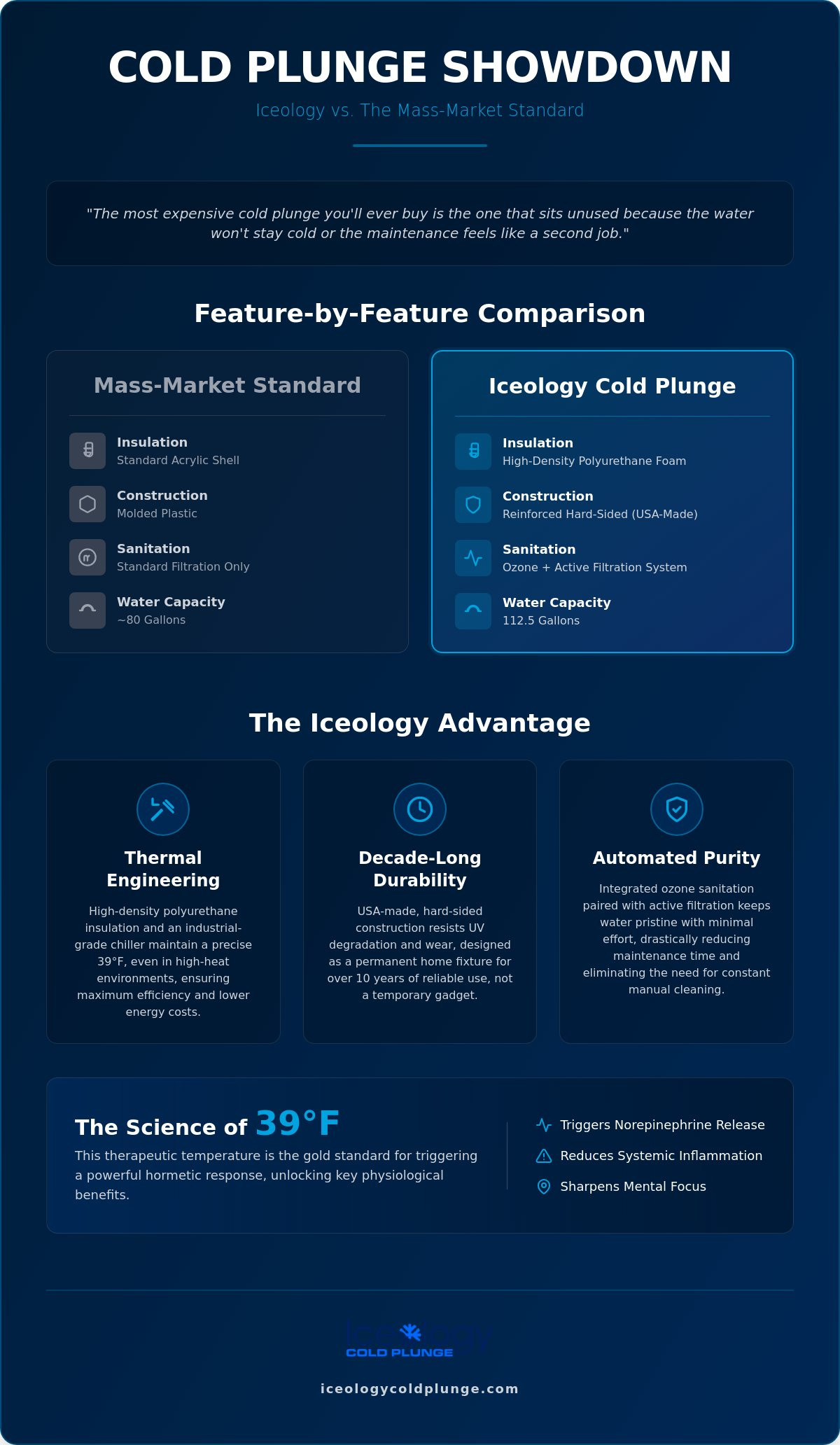
When comparing the cold plunge vs iceology, the technical details reveal the true long-term value. While both systems offer automated cooling, the way they maintain those temperatures differs significantly. The following table highlights the core engineering differences between the standard mass-market models and the precision-built Grizzly 450.
| Feature | Mass-Market Standard | Iceology Cold Plunge (Grizzly 450) |
|---|---|---|
| Target Temperature | Down to 39°F | Down to 39°F |
| Insulation Type | Acrylic Shell | High-Density Polyurethane Foam |
| Sanitation System | Standard Filtration | Ozone + Active Filtration |
| Construction | Molded Plastic | Hard-Sided / Reinforced |
| Water Capacity | ~80 Gallons | 112.5 Gallons |
The 39°F threshold is the professional standard for triggering a meaningful hormetic response. While most premium units can reach this temperature, the Grizzly 450 uses a 1/4 HP Active Aqua chiller paired with superior insulation to keep it there with less energy. For the casual apartment dweller, the compact footprint of a standard retail model might suffice. For the athlete or homeowner looking for a 10-year recovery tool, the USA-made craftsmanship of a hard-sided station provides a much stronger durability outlook.
Thermal Engineering: Reaching and Maintaining 39 Degrees
Achieving a deep chill requires more than just cold water; it requires thermal stability. When evaluating the cold plunge vs iceology, the most critical metric is how the system handles heat transfer during the first five minutes of immersion. Your body acts as a radiator. As soon as you submerge, your skin begins warming the surrounding water, creating a "thermal layer" that can insulate you from the cold and diminish the treatment's effectiveness. High-performance recovery stations solve this through superior flow rates, ensuring that freshly chilled water constantly breaks that barrier. This mechanical precision is what separates a professional tool from a simple tank of water.
Why 39°F is the Gold Standard for Recovery
Hormesis is the body’s positive adaptation to controlled cold stress. To trigger this response effectively, you need to hit the therapeutic window between 39°F and 50°F. This specific range is vital for norepinephrine release, a chemical that sharpens focus and reduces systemic inflammation. According to the science of cold water immersion, staying within these precise bounds ensures you are taxing the body enough to see results without causing unnecessary tissue stress. While many mass-market systems claim to reach these levels, maintaining them while a warm human body is actively heating the water is a different engineering challenge. Precision cooling ensures that every minute spent in the water is productive.
Chiller Efficiency in High-Heat Environments
Ambient temperature is the silent killer of chiller performance. In places like Florida, where 90°F humidity is the baseline, a chiller's BTU rating determines whether your water stays at 39°F or creeps toward 55°F. Many retail options utilize external add-on chillers that struggle against high-ambient heat because they lack the insulation to keep the cold in. Iceology Cold Plunge takes a different approach. By integrating a 1/4 HP Active Aqua chiller directly into a hard-sided, polyurethane-insulated structure, the system works less to achieve more. This thermal efficiency means the unit doesn't have to run 24/7 to fight the sun. It saves on electricity and preserves the life of the compressor.
Iceology Cold Plunge’s integrated chiller system provides a streamlined loop that minimizes the distance water travels. Every inch of external tubing is a point of thermal loss. By keeping the filtration and cooling components housed within the insulated frame, the system ensures that the energy you pay for actually goes into cooling the water, not the air around it. This is a significant point of differentiation in the cold plunge vs iceology debate. If you want a setup that thrives in the heat, you should explore high-performance cold tubs designed for durability. A powerful, integrated chiller might seem like a luxury until you're trying to reach 39 degrees in the middle of a July afternoon.
USA-Made Craftsmanship: Why Material Science Matters
Choosing a recovery station isn't just about the first splash; it's about the thousandth. When analyzing the cold plunge vs iceology, the most significant divergence lies in the material science behind the tub walls. Most mass-market units rely on a standard acrylic shell. While visually appealing, acrylic is essentially a thin plastic layer that requires external support to maintain its shape under the weight of water. In contrast, Iceology Cold Plunge utilizes a hard-sided construction method that treats the tub as a structural fixture. This isn't just about weight; it's about a 10-year durability outlook that ensures your investment doesn't warp or crack after a single summer. This distinction is a core part of the cold plunge vs iceology comparison, as the choice between a plastic shell and a reinforced structure determines your future maintenance costs.
Being made in the USA isn't just a slogan for Iceology Cold Plunge; it's a commitment to quality control. When manufacturing happens locally in Florida, every plumbing joint and electrical component is vetted to meet professional standards. Mass-produced imports often fail at the connection points because they use generic adhesives and thin-walled tubing that can't handle the vibration of a high-performance pump. By controlling the entire assembly process, Iceology Cold Plunge ensures that the tub you receive is built for high-performance use. This craftsmanship transforms the tub from a piece of gym equipment into a luxury furniture-grade fixture that enhances your home environment.
The Benefits of Polyurethane Foam Insulation
The true differentiator in longevity is the hidden layer of high-density polyurethane foam. This isn't just insulation; it's the structural backbone of the unit. By filling the wall cavities with this dense material, Iceology Cold Plunge creates a thermal barrier that virtually eliminates heat transfer from the environment. You can read more about how this engineering supports your health in our guide on The Value of an Insulated Cold Plunge Tub. The foam also reinforces the tub walls, preventing the flexing sensation often felt in thinner acrylic models when stepping in or out.
Durability for Outdoor and Indoor Plunging
If you plan on placing your tub on a patio or deck, UV resistance is non-negotiable. Many mass-produced tubs use materials that become brittle under relentless sun exposure, leading to micro-cracks that compromise the shell. Iceology Cold Plunge’s hard-sided construction is engineered to resist color fading and structural degradation. This is particularly important for users in coastal or high-heat areas where salt air and humidity accelerate wear on standard retail units. A tub built with high-grade material science won't just survive the elements; it will thrive in them for years to come.
The Ownership Experience: Maintenance and Sanitation
The "dirty reality" of manual ice baths often discourages people from a consistent recovery practice. Stagnant water in a stock tank becomes a breeding ground for bacteria within days, requiring frequent draining and scrubbing. When comparing the cold plunge vs iceology, the ownership experience is defined by how much time you spend in the water versus how much time you spend maintaining the equipment. Modern recovery stations utilize automated sanitation loops to keep water pristine for months rather than days. This shift transforms cold therapy from a high-friction task into a seamless, daily ritual that respects your time.
Clean Water Science: Ozone and Filtration
Keeping water crystal clear requires a two-pronged approach: physical filtration and biological sanitation. Ozone generators are the gold standard for biological control. Ozone molecules break down organic contaminants and bacteria on contact without the need for harsh pool chemicals that can irritate your skin. While both brands utilize ozone, the efficiency of the filtration loop remains a critical factor. A 20-micron filter is essential for trapping skin cells, hair, and environmental debris before they ever reach the chiller. This protects the mechanical components and ensures the water feels crisp every time you submerge. Additionally, the operational noise of the pump and chiller can impact your environment. Iceology’s integrated housing dampens vibration, often resulting in a quieter cycle compared to the external, exposed pumps found on some mass-market models.
Total Cost of Ownership in 2026
The sticker price of a tub is only one part of the financial equation. Long-term value is found in daily operational efficiency and component longevity. In high-humidity environments like Florida, non-insulated tubs sweat and lose cold air constantly. This forces the chiller to run overtime, which dramatically increases your monthly power bill. You can find a detailed breakdown of these variables in our guide on Cold Plunge Tub Electricity Cost. Beyond power, you must account for filter replacements. Standard 20-micron filters are affordable and widely available, typically requiring a quick change every 4 to 6 weeks depending on how many people are using the tub.
Ultimately, the goal is to minimize operational friction. If a system requires constant water changes or complex chemical balancing, you're less likely to use it during a busy week. A well-engineered station allows you to focus entirely on your mental and physical resilience rather than pool chemistry. If you're ready to upgrade your recovery setup with a low-maintenance, professional-grade system, you should order your premium cold tub today. Investing in superior sanitation and thermal efficiency pays dividends in both time saved and water quality preserved.
Choosing Your Path: Why Iceology is the Professional Choice
Deciding between the cold plunge vs iceology ultimately comes down to your personal intent and environment. If you are a casual user or an apartment dweller with limited space, a mass-market system like The Plunge offers a recognizable, standardized entry point. It serves those looking for a plug-and-play solution in climate-controlled indoor settings. However, for the dedicated athlete, the permanent homeowner, or the Southerner facing high-ambient temperatures, the requirements are different. You need a station that functions as a professional tool rather than a lifestyle accessory. Iceology is built for this "power user" who views cold therapy as a non-negotiable pillar of their daily discipline.
The value of local, Florida-based craftsmanship cannot be overstated for those in warm climates. Iceology understands the specific mechanical stress that 90-degree humidity puts on a chiller. By choosing a USA-made, hard-sided station, you gain access to expert support and engineering that prioritizes thermal efficiency over marketing volume. This quality-first mindset ensures that your recovery station remains a reliable partner for a decade of use. You aren't just buying a tub; you're investing in a piece of precision machinery that respects your commitment to peak performance.
Customization and Accessories
A premium recovery experience extends beyond the water temperature. Personalizing your station with the right additions ensures the system remains efficient and easy to use. An insulated hard cover is perhaps the most critical accessory. It acts as a thermal seal, preventing the sun from warming the water and keeping environmental debris out of your filtration loop. You can find a complete list of Must-Have Cold Plunge Tub Accessories to enhance your setup. From custom-fitted steps to specialized maintenance kits, these tools help maintain the sanctuary of your recovery space without added operational friction.
The Final Verdict on Your Recovery Investment
The era of the "Ice Run" is a relic of the past. You no longer have to settle for the inconsistent temperatures of a bag-ice setup or the degrading materials of a cheap import. When you evaluate the cold plunge vs iceology, the winner is the system that provides 39°F water on demand with the lowest energy draw and the highest structural integrity. It's about empowering your physical and mental state through a tool that is as disciplined as you are. Take the next step in your wellness journey and explore Iceology Cold Plunge Tubs to see how American engineering can elevate your recovery practice. Your body deserves a station built for longevity and precision.
Secure Your Peak Performance with Precision Engineering
The decision between the cold plunge vs iceology comes down to a choice between temporary convenience and long-term structural integrity. You've seen how high-density polyurethane foam insulation and industrial-grade chillers transform a simple tub into a professional recovery station. By prioritizing thermal efficiency and USA-made craftsmanship, you ensure that your water hits 39°F every time, regardless of the heat outside. This isn't just about a cold bath. It's about a 10-year investment in your physical and mental resilience. With local Florida support and a quality-first mindset, you can focus entirely on your results while the equipment handles the rest.
Your path to total-body optimization deserves a tool as dedicated as your routine. Don't settle for a system that struggles when the temperature rises or requires constant maintenance. Invest in American-Made Recovery: Shop Iceology Cold Plunge Tubs and experience the difference that professional engineering makes. It's time to take control of your recovery and elevate your daily practice to a new standard of excellence. You've done the work; now let the cold do its part.
Frequently Asked Questions
Is the Iceology cold plunge better for outdoor use than The Plunge?
Iceology is specifically engineered for durability in outdoor environments. Its hard-sided construction and high-density polyurethane foam insulation provide superior protection against the elements compared to standard acrylic shells. While many units degrade under direct sunlight or in high humidity, these tubs maintain their structural integrity and thermal efficiency. This makes them a more reliable choice for patios or decks where UV exposure is a constant factor.
How much does it cost to run a cold plunge tub per month in 2026?
Monthly operational costs depend heavily on the unit's insulation and your local climate. Thermally efficient tubs with high-density foam insulation require significantly less energy because the chiller doesn't run constantly to fight ambient heat. While non-insulated models may see higher spikes in power usage during summer months, a well-engineered station minimizes electricity draw. Choosing a system designed for high-ambient temperatures helps keep your ongoing investment manageable and predictable.
Can Iceology tubs really reach 39 degrees in hot weather?
Yes, Iceology tubs are designed to hit and maintain 39°F even in high-heat environments like Florida. This performance is achieved by pairing a powerful 1/4 HP Active Aqua chiller with superior polyurethane insulation that locks in the cold. In the debate of the cold plunge vs iceology, this thermal stability is a major differentiator. You can trust that your recovery session will remain at the precise temperature needed for a meaningful hormetic response.
What is the main difference between hard-sided and acrylic cold plunges?
The primary difference lies in structural integrity and thermal management. Acrylic cold plunges typically use a thin plastic shell supported by a frame, which can flex or crack over time. Hard-sided tubs utilize a reinforced, dense material that offers a 10-year durability outlook. This construction also allows for better integration of high-density foam, ensuring your water stays cold with less mechanical strain on the chiller system.
Do I need a special electrical outlet for an Iceology cold plunge?
Most Iceology models are designed to run on a standard 110V or 120V dedicated circuit. This "plug-and-plunge" capability makes installation straightforward for most homeowners without requiring expensive electrical upgrades. It's always best to ensure your outlet is GFCI protected for safety in wet environments. This simple setup allows you to focus on your recovery routine immediately after your station arrives and is filled with water.
How does the warranty for Iceology compare to other brands?
Iceology prioritizes long-term reliability through meticulous USA-based craftsmanship and local support. While many mass-market brands offer standard limited warranties, the advantage here is direct access to Florida-based experts who understand the engineering of your specific unit. This quality-first approach means components are vetted for longevity before they leave the factory. You're investing in a partner that values your results as much as the durability of the equipment.
Where are Iceology cold plunges manufactured?
Every Iceology cold plunge is manufactured in the United States, with headquarters based in Florida. This local production ensures strict quality control over every plumbing joint and electrical connection. In the comparison of the cold plunge vs iceology, domestic manufacturing provides a significant advantage in terms of shipping speed and component availability. It also means the engineering is specifically optimized for the high-ambient temperatures common in Southern climates.
Is ozone sanitation better than using chlorine in a cold plunge?
Ozone sanitation is widely considered superior because it breaks down bacteria and organic matter without the need for harsh chemicals. Unlike chlorine, ozone doesn't leave a residue or cause skin and eye irritation during your immersion. This automated system keeps your water pristine and crystal clear for months with minimal effort. It provides a more holistic and natural experience that aligns with the wellness goals of high-performance cold therapy.