
7 Common Mistakes Buying a Cold Plunge Tub in 2026 (And How to Avoid Them)
Relying on ice to cool your tub can cost you upwards of $2,800 a year, yet many people still treat their recovery setup like a simple outdoor cooler. When you overlook the complex engineering required for consistent thermal management, you fall into the trap of common mistakes buying a cold plunge tub that lead to noisy chillers and skyrocketing energy bills. It's frustrating to invest in your wellness only to end up with a lukewarm tub that struggles against the relentless Florida humidity.
You likely agree that your recovery time is too valuable to spend skimming dirty water or waiting hours for a temperature drop. We promise to help you discover the critical pitfalls that lead to buyer regret and show you how to select a high-performance cold plunge that lasts a lifetime. This guide previews the essential technical specs you need, from why high-density polyurethane foam is the gold standard for insulation to the importance of integrated sanitation systems that keep your water crystal clear and ready for a crisp 39°F soak 24/7.
Key Takeaways
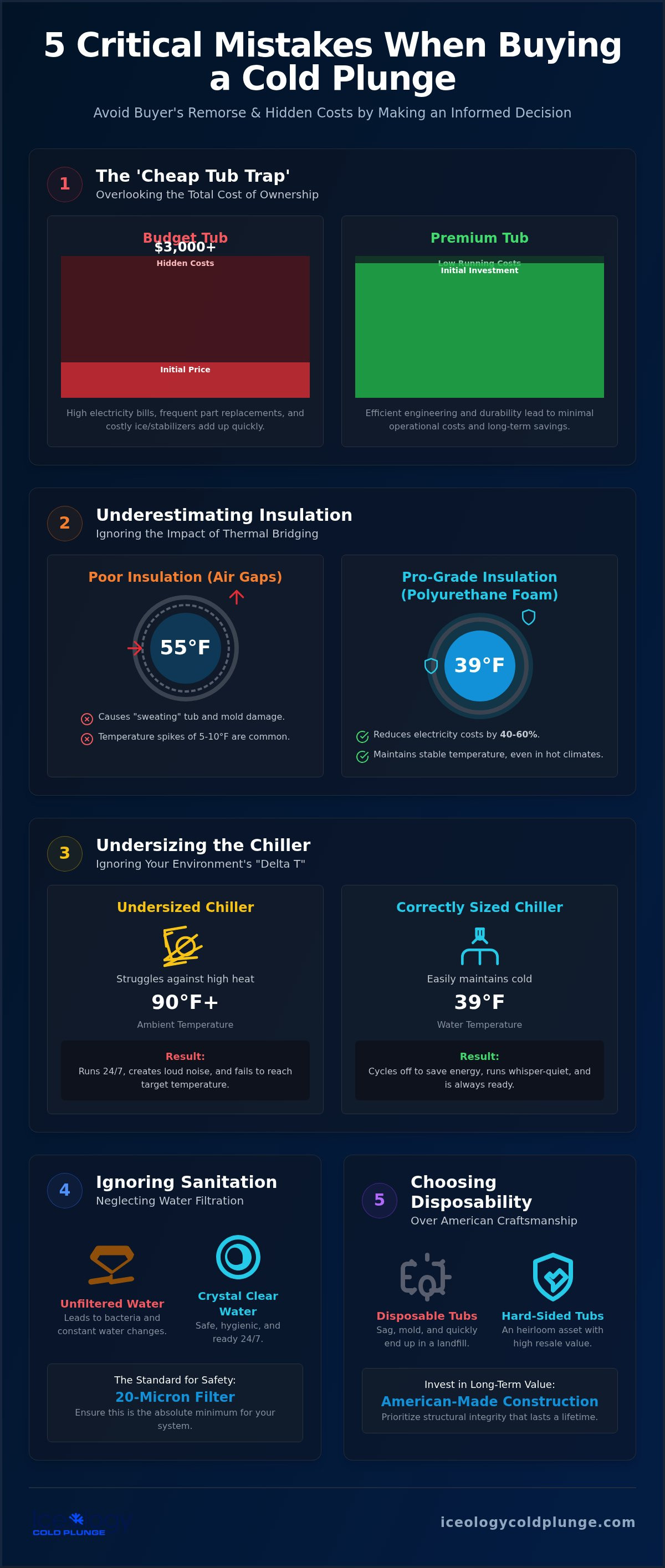
- Learn why the "cheap tub trap" often results in thousands of dollars in hidden energy and repair costs, proving that initial price is rarely the final cost.
- Understand how professional-grade insulation prevents thermal bridging and "sweating," protecting your home from moisture damage while maintaining consistent temperatures.
- Discover how to calculate the "Delta T" for your specific environment to ensure your chiller isn't undersized for the heat.
- Master the requirements for crystal-clear water by identifying why a 20-micron filter is the absolute minimum for a safe, hygienic plunge.
- Avoid the most common mistakes buying a cold plunge tub by prioritizing American-made, hard-sided construction over disposable alternatives that degrade over time.
Overlooking the "Total Cost of Ownership" in Budget Tubs
Sticker price is a deceptive metric. One of the most common mistakes buying a cold plunge tub is focusing solely on the initial transaction while ignoring the operational reality. A "budget" tub might save you $1,000 today, but it often triggers a cascade of hidden expenses that can exceed $3,000 within the first few years. This "Cheap Tub Trap" stems from high electricity draws, frequent part replacements, and the constant need for water stabilizers to combat poor filtration. When you buy cheap, you aren't just buying a tub; you're often buying a recurring monthly bill.
Durability isn't just a luxury feature. It's a fundamental performance metric. A tub that maintains its structural integrity allows the thermal management system to work at peak efficiency. When a tub begins to sag or leak, the chiller has to work harder to compensate for the lost thermal seal. Beyond the financial drain, consider the environmental impact. Short-lived, disposable wellness equipment often ends up in landfills because the components aren't designed for repair. True sustainability in recovery gear means buying a unit that lasts a lifetime.
The Electricity Drain of Poor Engineering
In high-heat regions like Miami or Naples, an inefficient chiller is a liability. It will run 24/7 to fight ambient temperatures, leading to staggering monthly utility bills. Premium units utilize high-efficiency compressors and high-density insulation to reach 39°F quickly and then cycle off. Cheap units often groan under the pressure of high humidity, running constantly without ever hitting the target temperature. This creates significant noise pollution. A loud, buzzing chiller ruins the mental clarity you seek during a morning plunge. High-quality engineering ensures the only thing you hear is the water.
Depreciation and Resale Value
Hard-sided tubs are built as heirloom assets. They maintain their structural integrity and aesthetic appeal for years, ensuring high resale value if you ever choose to move or upgrade. Many entry-level options suffer from structural sagging and mold issues within months of outdoor use. Sourcing parts for generic, overseas-manufactured units is a common frustration for budget buyers. When a proprietary pump fails, the entire unit often becomes a lawn ornament. Investing in premium cold plunge tubs ensures you are buying a permanent home asset. It's a commitment to long-term health supported by American craftsmanship that stands the test of time.
Failing to Prioritize Professional-Grade Insulation
Thermal bridging is a silent performance killer. It occurs when a conductive material allows heat to bypass your tub's insulation, effectively turning your cold plunge into a lukewarm bath. One of the primary common mistakes buying a cold plunge tub is assuming any thick wall provides protection. Without professional-grade insulation, your chiller works overtime, leading to the "Sweating Tub" problem. This condensation isn't just a nuisance. It can cause permanent floor damage and mold growth in indoor or garage setups. Allowing this to happen is one of the common mistakes buying a cold plunge tub that results in hidden home repair bills later. Professional-grade insulation ensures the exterior of the tub remains at ambient temperature, even when the water inside is a bone-chilling 39°F. This protects your property and ensures the unit remains a clean, dry addition to your wellness space.
Polyurethane Foam vs. Air Gaps
The science of closed-cell insulation is what separates high-performance insulated cold plunge tubs from budget alternatives. While many entry-level models rely on thin air gaps or basic expanded polystyrene, premium units use high-density polyurethane foam. This material provides a superior R-value, preventing the 5-10 degree temperature spikes that occur every few hours in poorly insulated units. Research indicates that high-density foam insulation can reduce electricity costs by 40-60% compared to poorly insulated models. Beyond thermal retention, this foam adds structural rigidity and dampens vibration. It makes your unit whisper-quiet. When engaging in cold therapy, understanding Cold Water Hazards and Safety is essential for peak performance and personal well-being.
Thermal Management in High-Heat Regions
For users in Naples, Tampa, or South Florida, insulation isn't optional. It's a requirement. The Florida sun is relentless, often heating garage temperatures to 90°F or higher. A tub with poor thermal integrity will struggle to maintain 39°F, forcing the compressor to run indefinitely. This leads to premature mechanical failure. You need a high-quality, insulated lid to prevent thermal escape from the top surface. A well-engineered lid creates a complete thermal seal, ensuring your water stays at the target temperature without wasting energy. If you're ready to invest in a system that masters the heat, explore our hard-sided cold tubs designed for extreme climates. They offer the thermal management necessary to keep your water icy, regardless of the ambient humidity.
Undersizing the Chiller for Your Environment
Horsepower is often a marketing distraction. One of the most frequent common mistakes buying a cold plunge tub is choosing a chiller based on water volume alone without accounting for ambient heat. This is the "Horsepower Myth"; a 1/2 HP motor might cool 100 gallons in a climate-controlled gym, but it will struggle in a 90°F garage. You must calculate your "Delta T," which is the difference between your target temperature and the highest ambient air temperature. If your Delta T is over 50 degrees, a small unit will run indefinitely. This constant strain leads to rapid compressor burnout and a tub that never actually gets cold. It's an expensive error that leaves you with a lukewarm investment.
Integrated chillers offer a distinct advantage over external "hang-on" units. Because they are built into the chassis, they maintain optimized flow rates without the friction loss found in long, external hoses. This engineering efficiency ensures the water moves quickly through the cooling heat exchanger. It prevents "hot spots" in the tub. When a chiller is properly sized for your specific environment, it reaches the set point and shuts off, preserving the life of the machine and lowering your utility costs. High-performance recovery requires hardware that can handle the local climate without breaking a sweat.
Reaching the "Magic" 39 Degrees
Budget chillers often bottom out at 45 or 50 degrees when the Florida humidity spikes. This is problematic because the most profound physiological benefits often occur at a 39-degree cold plunge. While you should be aware of the potential risks of cold plunging, such as cold shock or cardiovascular strain, having precise control over your temperature is the only way to manage those risks safely. Iceology engineering utilizes high-efficiency compressors that maintain these low temperatures even in the most demanding environments. You shouldn't have to settle for "cool" when you paid for "cold."
Cooling Speed and Recovery Time
Chiller efficiency isn't just about the first cooldown; it's about how fast the water recovers after a session. When you enter the water, your body heat naturally raises the temperature. A high-flow pump is essential to break the "thermal layer" that forms around your skin, ensuring you stay cold throughout the entire duration. A cold plunge that doesn’t need ice relies on this rapid recovery to stay available for back-to-back sessions or multiple family members. Precision cooling ensures your ritual remains consistent every single morning, regardless of how many people use the tub.
Ignoring Water Sanitation and Filtration Systems
Standing water is a biological time bomb. Even at 39°F, stagnant water allows for the development of biofilm, a slimy layer of bacteria that coats the interior surfaces of your tub. One of the most overlooked common mistakes buying a cold plunge tub is treating it like a standard bathtub that you drain after every use. Without active, continuous filtration, you encounter the "Swamp Effect." This leads to cloudy water and unpleasant odors that ruin the recovery experience. Failing to verify the filtration specs is among the most frequent common mistakes buying a cold plunge tub available, as it turns a wellness tool into a maintenance headache.
Micron ratings determine the visual clarity and safety of your water. A 20-micron filter is the industry baseline for residential units. It's fine enough to trap skin cells, hair, and small debris that larger filters miss. To go beyond mechanical filtration, premium systems utilize Ozone or UV-C sanitation. Ozone is a powerful oxidizer that destroys contaminants on contact, while UV-C light neutralizes the DNA of bacteria and viruses. Combining these technologies allows you to maintain pristine water with minimal chemical intervention, keeping the experience natural and skin-friendly. Don't forget to check the pump strainer and swap filter cartridges regularly; a clogged system forces the motor to work harder, leading to premature wear.
Integrated vs. External Filtration
External hoses are a liability. They create trip hazards, leak at the connection points, and clutter your space with unsightly hardware. Built-in systems facilitate better water circulation by pulling water from specific intake points and returning it through directional jets. This prevents "dead spots" where bacteria can congregate. Following simplified cold plunge maintenance tips ensures your system runs efficiently without becoming a part-time job. A clean system is a reliable system.
Water Care for High-Frequency Use
If multiple athletes or family members use the tub, the biological load increases significantly. Using non-chlorine oxidizers helps keep the water soft while breaking down organic matter. For a premium, hard-sided tub with advanced sanitation, you should aim for a full water change every three to four months. Monitoring the water's pH and alkalinity once a week is a simple habit that preserves the life of your chiller's internal heat exchanger. If you want a system that handles the heavy lifting of sanitation for you, explore our advanced cold tubs today.
Choosing Convenience Over American Craftsmanship
A cold plunge is a high-performance wellness appliance, not a disposable plastic box. Many people fall into the trap of choosing short-term convenience over heirloom quality. This is one of the most frequent common mistakes buying a cold plunge tub that leads to premature replacement. While a portable unit might seem appealing for a weekend trip, the structural sagging and risk of punctures often turn a one-time convenience into a long-term liability. Hard-sided tubs represent a commitment to durability. They are engineered to withstand the elements, maintaining their aesthetic and functional integrity for decades rather than months. When you prioritize craftsmanship, you're investing in a permanent recovery station that grows with your practice.
The risks associated with "disposable" culture go beyond simple leaks. Inflatable options frequently suffer from internal mold growth within their seams, which is nearly impossible to sanitize completely. Choosing cold plunge tubs made in the USA ensures that your equipment meets rigorous engineering standards. American-made units utilize premium materials like high-density polyurethane and marine-grade components. These materials don't just look better; they perform better. They provide the rigid foundation necessary for integrated chilling systems to operate without vibration or noise. Expert craftsmanship is the difference between a frustrating project and a seamless daily ritual.
Reliability and Local Support
Trying to source parts for a generic, overseas-manufactured unit is a logistical nightmare. When a proprietary seal or specialized pump fails, you are often left with a heavy, expensive lawn ornament. Local Florida customers in cities like Miami, Naples, and Tampa benefit significantly from a regional manufacturing presence. Having access to domestic parts and expert support provides peace of mind that an import simply cannot match. If a technical issue arises, you need a partner who understands the local climate and has the components on hand to fix it immediately. Reliability is a core component of peak performance.
Final Checklist: Before You Click "Buy"
Before finalizing your purchase, run through this technical checklist to avoid the most common mistakes buying a cold plunge tub. A 100-gallon tub filled with water and a user can weigh over 1,200 pounds. This is double the rated capacity of a standard residential floor, which is typically 40 pounds per square foot. Ensure your surface is reinforced and level. Your checklist should include:
- Electrical Safety: Verify that you have a dedicated GFCI outlet within reach of the unit.
- Drainage Access: Confirm you have a clear path for water changes to avoid flooding your garage or patio.
- Space Requirements: Measure your entryways and the final footprint, including clearance for the integrated chiller's airflow.
- Manufacturer Reputation: Look for real-world performance data in high-ambient temperatures, not just controlled lab settings.
You've done the research. Now, it's time to choose a system that won't let you down when the heat rises. Explore the Iceology range and avoid these common mistakes today by investing in a hard-sided, American-made recovery solution designed for life.
Elevate Your Recovery with Precision Engineering
Investing in your long-term physical and mental well-being requires more than just a container of cold water. It's a commitment to a disciplined practice that demands reliable hardware. By avoiding the common mistakes buying a cold plunge tub, such as undersizing your chiller or settling for inadequate insulation, you ensure your daily ritual remains a source of peak performance rather than a maintenance burden. Focus on the total cost of ownership and the science of thermal retention to protect your investment for years to come.
You deserve a system that reaches 39°F consistently, even in the most demanding climates. Our hard-sided tubs utilize premium polyurethane foam and integrated cooling technology to provide a seamless experience that lasts a lifetime. Experience the difference that Made in the USA craftsmanship makes in your recovery journey, where every detail is engineered for durability and user comfort.
Browse USA-Made Cold Plunge Tubs and secure a recovery station built for excellence. Your path to optimized health and mental clarity starts with the right equipment. Take control of your recovery today.
Frequently Asked Questions
Is a 1/4 HP chiller powerful enough for a cold plunge tub?
A 1/4 HP chiller is often insufficient for maintaining therapeutic temperatures in high-ambient environments. While it might work for small setups in climate-controlled rooms, users in Florida often find these units struggle to combat the external heat. Undersizing your cooling unit is one of the common mistakes buying a cold plunge tub that leads to constant operation and premature compressor failure. A 1/2 HP or 1 HP chiller is recommended for consistent 39°F performance.
Can I keep my cold plunge tub outside in Florida?
You can certainly maintain an outdoor setup in cities like Miami or Naples if the unit features professional-grade insulation. High-density polyurethane foam is essential to prevent the Florida sun from heating the water through the tub walls. You should also use an insulated lid to create a complete thermal seal. Hard-sided construction is necessary to resist the intense humidity and UV exposure that typically degrades lower-quality materials over time.
Do I really need a hard-sided tub or is an inflatable one okay?
Hard-sided tubs provide the structural integrity and thermal efficiency required for a permanent wellness station. Inflatable options often suffer from structural sagging, punctures, and internal mold growth within the seams. A hard-sided, American-made tub allows for integrated chilling systems and superior insulation that inflatables simply cannot match. Choosing a durable material ensures your investment remains a high-performance asset rather than a disposable item that requires frequent replacement and creates unnecessary waste.
How much does it cost to run a cold plunge tub monthly?
Monthly operating costs typically range from $15 to $80 depending on your local climate and the quality of your insulation. High-density foam can reduce electricity draws by 40% to 60% compared to poorly insulated models. In warmer regions like Orlando or Tampa, an efficient chiller that cycles off once it reaches the target temperature is the most effective way to keep utility bills manageable while maintaining a consistent 39°F environment for daily use.
How often do I need to change the water in a tub with a chiller?
With an advanced filtration system utilizing Ozone or UV-C sanitation, you only need to perform a full water change every three to four months. Active circulation prevents the "swamp effect" by keeping water moving through a 20-micron filter. Regularly checking your pump strainer and maintaining proper water chemistry will extend the time between changes. This ensures your water remains crystal clear and hygienic for your daily ritual with minimal maintenance required.
Is a DIY chest freezer cold plunge safe compared to a professional tub?
DIY chest freezer conversions present significant safety risks, particularly regarding electrical hazards and water sanitation. Freezers aren't designed to hold the weight of water or provide active filtration, often leading to structural failure and bacterial growth. Professional tubs are engineered with dedicated GFCI protection and integrated sanitation systems. Investing in a purpose-built unit ensures your recovery practice is safe, hygienic, and compliant with residential safety standards in your local area.
What is the ideal temperature for a cold plunge session?
The ideal temperature for therapeutic benefits generally falls between 50°F and 59°F for most users. Advanced practitioners often prefer reaching 39°F to maximize the metabolic and anti-inflammatory response. It's essential to listen to your body and start with shorter durations as you acclimate to the cold. Having a chiller that can precisely maintain these temperatures allows you to customize your experience based on your specific recovery goals and your personal tolerance levels.
Does a cold plunge tub require a dedicated electrical circuit?
A cold plunge tub should ideally be connected to a dedicated 15-amp or 20-amp circuit equipped with a GFCI outlet. This prevents the chiller from tripping breakers shared with other high-draw appliances and ensures maximum safety in a wet environment. Proper electrical planning is a critical step in a successful home installation. Always verify your local building codes in South Florida to ensure your setup meets all safety requirements for outdoor or garage placement.