
Cold Plunge Tub with Chiller: The Professional Guide to Premium Recovery 2026
How much time and money are you literally pouring down the drain every time you haul bags of ice to your backyard? Most dedicated athletes start their recovery journey with a basic tub and a goal, only to realize that maintaining a steady 39°F with melting ice is a losing battle. You want the mental clarity and physical recovery, not a second job as a sanitation worker or ice delivery driver. Investing in a high-quality cold plunge tub with chiller isn't just about luxury. It's about reclaiming your time and ensuring your recovery protocol delivers elite results every single morning.
You already know that consistency is the foundation of any successful wellness practice, yet stagnant water and fluctuating temperatures often stand in your way. This guide reveals how integrated chiller systems transform basic ice baths into professional-grade recovery stations for consistent, high-performance results. We will break down the engineering behind American-made thermal management, the reality of low-maintenance filtration, and why a dedicated cooling system is the only way to achieve true professional recovery in 2026.
Key Takeaways
- Learn how an integrated cooling and filtration system eliminates the logistical headache of manual ice replenishment for a truly hands-off recovery routine.
- Understand the technical advantages of a cold plunge tub with chiller, including how high-grade heat exchangers maintain a precise 39°F even during back-to-back sessions.
- Discover why American-made, hard-sided construction offers superior thermal mass and long-term durability compared to temporary inflatable alternatives.
- Gain expert strategies for optimizing chiller performance and protecting your equipment in demanding environments like high-humidity coastal climates.
- Master the transition from amateur ice baths to a professional recovery station designed to maximize mental clarity and physiological results through precision engineering.
Understanding the Cold Plunge Tub with Chiller Ecosystem
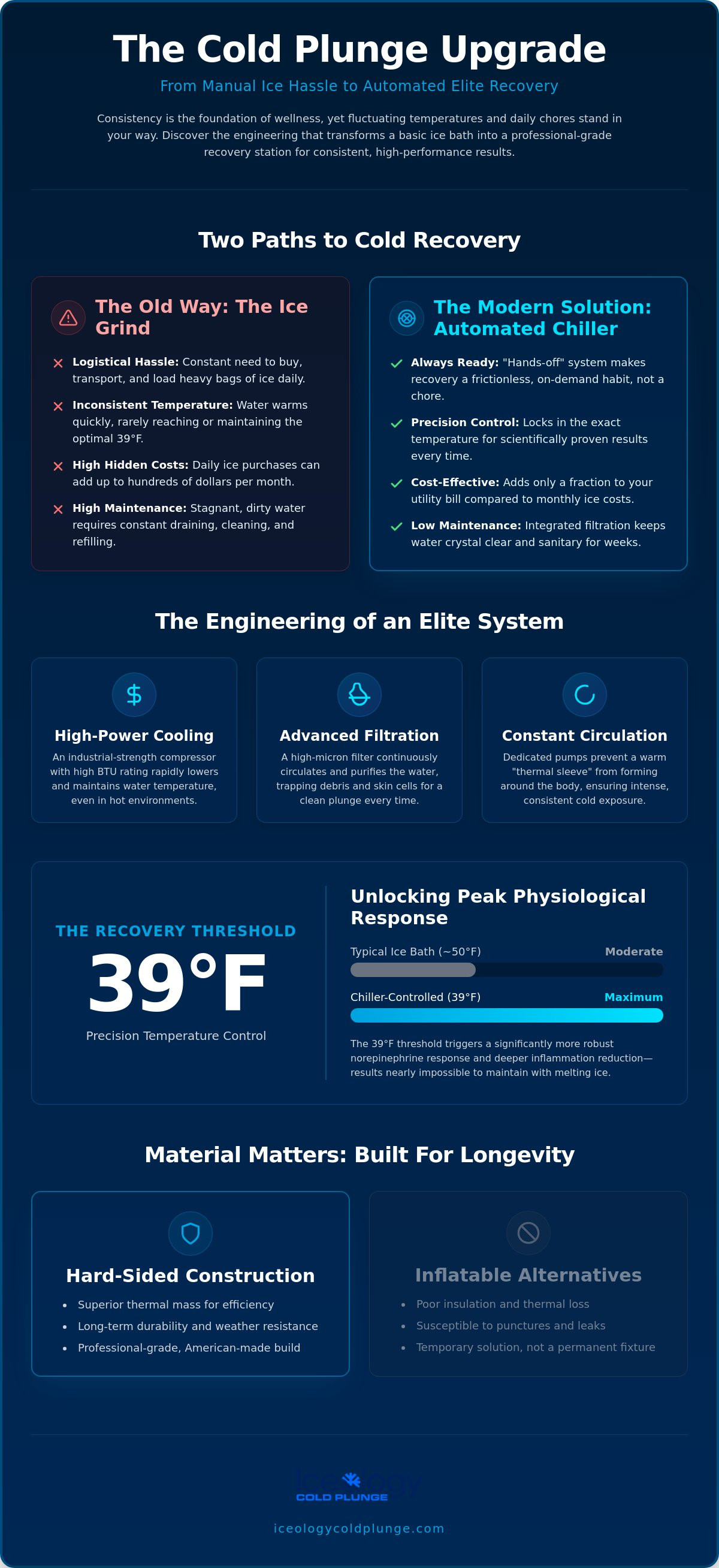
A professional recovery setup is far more than a container of cold water. It is a sophisticated, closed-loop ecosystem designed for thermal precision. Unlike a standard tub that relies on external cooling sources, a cold plunge tub with chiller integrates mechanical cooling, advanced filtration, and constant circulation into a single, seamless unit. This system provides a controlled environment for cold-water immersion, ensuring that the water is always clean, safe, and exactly the temperature you need it to be. When you remove the variability of melting ice, you gain the ability to master your recovery with scientific accuracy.
The transition from manual ice replenishment to an automated chiller system marks the difference between an amateur hobby and a professional discipline. Relying on ice bags creates a logistical burden that often leads to skipped sessions. You have to buy the ice, transport it, and wait for the water to reach a semi-cool state that rarely stays consistent. An integrated chiller replaces this friction with "always-ready" availability. It maintains a specific thermal mass, allowing you to step into the water at any moment and receive the exact physiological benefits you've planned for.
The Core Components of a Chilled System
The cooling unit is the heart of the machine. Its power is measured in BTU (British Thermal Units), which dictates how quickly the system can lower the water temperature. High BTU ratings are essential for rapid pull-down times, especially if the tub is located in a garage or outdoors where ambient heat is a factor. Complementing this is advanced filtration. Professional systems use high-micron filters to trap debris and skin cells, keeping the water crystal clear for weeks at a time. Finally, dedicated circulation pumps prevent thermal layering. Without constant movement, a warm "sleeve" of water forms around your body, insulating you from the cold. Continuous flow ensures every inch of your skin experiences the same intense, therapeutic temperature.
Chiller vs. Ice: A Practical Comparison
The true cost of ice is often hidden until you calculate a full year of use. Daily ice bags can cost hundreds of dollars per month, while a cold plunge tub with chiller typically adds only a fraction of that to your utility bill. Beyond the finances, the value of time is immeasurable. A chiller eliminates the 30-minute preparation window, turning recovery into a frictionless habit rather than a chore. Most importantly, precision control allows you to hit the cold plunge tub 39 degrees threshold. There is a profound physiological difference between 50°F water and 39°F water. The lower threshold triggers a significantly more robust norepinephrine response and deeper inflammation reduction, results that are nearly impossible to maintain consistently using loose ice.
The Engineering of Elite Cooling: Why Chillers Outperform Ice
Engineering precision defines the modern recovery experience. When you step into a cold plunge tub with chiller, you are interacting with a system designed to maintain thermal homeostasis against the heat of your own body. Physics dictates that a human body will quickly warm the surrounding water, creating a thermal bridge that reduces the effectiveness of the session. While ice eventually melts and loses its cooling capacity, a high-grade heat exchanger continuously pulls heat away from the water. This rapid temperature recovery ensures that the second minute of your plunge is just as potent as the first, providing the stability needed to unlock the mental health benefits associated with deep cold exposure.
The backbone of this performance is the compressor. Consumer-grade units often found in budget imports are prone to overheating when ambient temperatures rise. In contrast, industrial-strength compressors are built for 24/7 operation and high-demand environments. These units work in tandem with advanced thermal management to ensure the water stays at your target temperature without constant cycling. To see how these professional components come together in a finished design, you can explore our full range of premium cold tubs built for longevity.
The Role of Industrial Insulation
Precision cooling is only half of the equation; energy retention is the other. Utilizing a polyurethane foam cold plunge design is the industry standard for a reason. High-density foam acts as a thermal barrier, preventing a cold plunge tub with chiller from overworking when placed in a 90°F garage or on a humid patio. This insulation significantly reduces daily electricity consumption by maintaining the water's "cold soak" for hours after the chiller shuts off. Beyond efficiency, the foam provides essential structural rigidity, dampening vibration and ensuring the hard-sided tub remains a permanent fixture in your wellness space for years.
Filtration and Water Sanitization
Maintaining water quality is a technical challenge that ice-only tubs cannot solve. Professional chilled systems utilize a combination of Ozone and UV-C light integration to neutralize bacteria and pathogens without the heavy chemical smell of traditional pools. This is critical because chlorine is approximately three times less effective as a sanitizer in water below 60°F. Micron-rated filters complement this by removing physical particulates that could otherwise clog and damage the chiller's internal heat exchanger. This dual-stage approach extends the life of your water to three or even six months, replacing the daily "drain and refill" chore with a simple, automated maintenance schedule.
Hard-Sided Durability vs. Inflatable Alternatives
Choosing the right vessel for your recovery is a decision that impacts both your daily experience and your long-term budget. While the market is flooded with portable, inflatable options, these often function more like temporary camping equipment than professional recovery tools. A high-performance cold plunge tub with chiller requires a rigid, stable environment to operate at peak efficiency. Hard-sided tubs are designed as permanent wellness fixtures, offering the structural integrity needed to support heavy mechanical components and the weight of hundreds of gallons of water without bowing or leaking. For a luxury home or a professional training facility, the aesthetic of a sleek, furniture-grade station provides a sense of permanence that an air-filled plastic tub simply cannot match.
Environmental factors play a massive role in equipment longevity, particularly in demanding climates. Inflatables struggle significantly with "sweating" in high-humidity regions like South Florida. Because air is a poor insulator compared to dense foam, condensation builds up on the exterior walls, leading to puddling and potential mold issues on your flooring. A hard-sided unit eliminates this concern through superior thermal barriers. Furthermore, choosing a cold plunge tub made in USA ensures that every fitting, seal, and structural component meets rigorous domestic standards. This attention to detail in component sourcing prevents the premature degradation common in overseas imports, where thin PVC often cracks after just one season of UV exposure.
Thermal Integrity and Wall Construction
The thickness of your tub walls directly correlates to the lifespan of your cooling unit. Hard-sided tubs act as a true thermal barrier, whereas thin-walled air pockets allow heat to bleed into the water constantly. When your tub retains its cold, your cold plunge tub with chiller doesn't have to work as hard to maintain your set point. This reduced workload can add years of extra service to the compressor and motor. Beyond the mechanics, a rigid tub provides a safe, stable entry and exit point. This is crucial during "cold shock" when your motor skills might be slightly compromised by the intense temperature.
Long-Term ROI of Premium Materials
Investing in premium materials is a strategy for long-term value. Inflatable tubs are essentially disposable; they have a high failure rate and virtually zero resale value once the material begins to stretch or puncture. In contrast, a hard-sided station retains its value as a piece of high-end fitness equipment. Warranty considerations also favor domestic manufacturing, as getting replacement parts for a US-made system is a straightforward process compared to navigating overseas supply chains. For outdoor installations, professional-grade UV protection ensures the exterior remains pristine, resisting the fading and brittleness that plague cheaper alternatives.
Optimizing Performance in High-Heat Climates
Operating a cold plunge tub with chiller in Florida presents unique engineering challenges that standard equipment often fails to meet. The combination of intense solar radiation and pervasive humidity creates a "heat soak" effect that can force lower-quality chillers to run indefinitely. To maintain a consistent 39°F, you must account for the ambient environment. This starts with understanding that a chiller is essentially a heat pump; it extracts heat from the water and exhausts it into the surrounding air. If that exhaust air cannot dissipate, the unit will recycle its own heat, leading to mechanical strain and decreased efficiency. Proper ventilation isn't just a recommendation; it's a requirement for professional-grade results.
Strategic Placement in South Florida Homes
Strategic placement in South Florida homes is the first step toward peak performance. In cities like Miami and Naples, choosing a shaded area can reduce solar heat gain by as much as 15 degrees compared to direct exposure. While a patio offers excellent airflow, a garage might be more convenient but requires careful consideration of ventilation. You should ensure there's at least 12 to 18 inches of clearance around the chiller's intake and exhaust ports to prevent overheating. Additionally, a dedicated 15-amp or 20-amp circuit is essential. Sharing a circuit with other high-draw appliances, such as a garage freezer, can cause voltage drops that damage the compressor over time.
Combating Humidity and Condensation
Managing humidity is equally critical for the longevity of your recovery station. High-quality, medical-grade seals on the tub lid are non-negotiable in the Florida climate. These seals prevent heavy, moisture-laden air from entering the tub, which would otherwise cause the chiller to work overtime to combat the latent heat of the humidity. Beyond the water, you must manage external moisture to protect the chiller's electrical components. To ensure your system is built to withstand these specific local conditions, you can view our Florida-optimized cold tubs designed for maximum thermal efficiency in high-heat environments.
Finally, high-temperature environments accelerate biological growth. While the UV-C and Ozone systems mentioned previously handle the bulk of the work, you'll want to check your water chemistry more frequently during peak summer months. Maintaining a pH between 7.2 and 7.8 ensures your sanitization systems remain effective even when the air is thick with moisture. Being a Florida-based company allows us to provide local support and maintenance advice tailored to this exact environment, ensuring your recovery station remains a reliable partner in your wellness journey for the long haul.
Elevating Your Routine with Iceology Craftsmanship
Transitioning from a basic ice bath to an Iceology station is more than an equipment upgrade. It is a fundamental shift in how you approach your physical and mental health. While amateur setups rely on guesswork and the logistical drain of buying ice, a professional cold plunge tub with chiller brings clinical precision to your daily routine. By consistently reaching and maintaining the 39°F threshold, you ensure that every session triggers the robust norepinephrine response needed for mental clarity and systemic inflammation reduction. This isn't a temporary trend. It's a permanent pillar of a high-performance lifestyle, designed to support your body's resilience for the long term.
The Iceology Difference
Our craftsmanship is defined by the intersection of industrial power and residential elegance. We engineer our built-in chillers for near-silent operation, ensuring that your recovery time remains a period of deep focus rather than mechanical distraction. While many systems struggle to reach target temperatures in the Florida heat, our high-output units are designed for rapid cooling and exceptional thermal stability. The premium hard-sided design does more than just house the technology; it complements the clean lines of modern Florida architecture, turning your recovery station into a centerpiece of your home wellness suite. This meticulous attention to detail is supported by a team of experts who understand both the engineering of the machine and the biological science of cold exposure.
Designing Your Ultimate Recovery Space
A truly professional recovery station is built around the specific needs of your body and your environment. To unlock the full potential of your equipment, we recommend exploring contrast therapy with cold plunge routines. This practice of alternating between intense heat and deep cold can significantly enhance vascular health and metabolic efficiency. Beyond the tub, selecting the right accessories, such as custom-fitted insulated lids and non-slip steps, ensures your practice is frictionless and safe. When every detail of your space is optimized, your daily plunge becomes a ritual you look forward to rather than a chore you have to manage. It's time to move beyond the limitations of ice and experience the difference that professional craftsmanship makes. You can View the Iceology Cold Plunge Collection today to find the system that will define your recovery for years to come.
Mastering Your Recovery Protocol
The transition from a basic ice bath to a professional-grade cold plunge tub with chiller is a commitment to your long-term physical and mental resilience. You've learned how industrial engineering and premium polyurethane insulation create the thermal mass necessary to hold a steady 39°F, even in the demanding Florida heat. By choosing hard-sided, American-made construction over temporary inflatables, you are investing in a permanent wellness fixture that delivers consistent results without the logistical headache of manual ice replenishment. This is about taking control of your recovery environment so your body can perform at its peak every single day. Reliable equipment allows you to focus entirely on the mental breakthrough that comes with deep cold exposure.
With South Florida local support and a focus on meticulous craftsmanship, we ensure your equipment remains as reliable as your discipline. It's time to stop managing ice bags and start mastering your physiology. Experience Professional Recovery: Shop Iceology Cold Plunge Tubs today and build the foundation for your ultimate health journey. You have the tools; now it's time to take the plunge into a life of optimized performance. Your future self will thank you for the discipline you show today.
Frequently Asked Questions
How much electricity does a cold plunge tub with a chiller use per month?
A chiller-equipped tub adds an estimated $15 to $40 to your monthly electricity bill, depending on your local utility rates and the ambient temperature of the room. This is a significant cost saving compared to the $100 to $300 monthly expense often associated with buying ice for a standard tub. High-density insulation plays a major role in these savings by holding the cold and reducing the compressor's run time.
Can I keep my cold plunge tub with chiller outside in the Florida heat?
You can safely keep your cold plunge tub with chiller outdoors in Florida as long as it is placed in a shaded area with excellent ventilation. Direct sunlight can increase the thermal load on the water, forcing the chiller to work harder to maintain your target temperature. A covered patio or screened-in porch provides the ideal balance of protection from solar heat and access to the airflow the compressor needs.
How often do I need to change the water in a chilled cold plunge tub?
You typically only need to change the water every three to six months if your system utilizes integrated Ozone and UV-C sanitization. These professional-grade filters and sanitizers neutralize bacteria and skin cells that would otherwise cloud the water. By rinsing your physical filter weekly and maintaining a balanced pH, you can enjoy hundreds of clean sessions before a full drain and refill is required.
Is a 1/2 HP chiller enough to reach 39 degrees in a large tub?
A 1/2 HP chiller is sufficient for most standard residential tubs, but a 1 HP unit is often recommended for larger vessels or high-heat environments. The higher horsepower provides a faster "pull-down" time, which is the speed at which the system reaches 39°F from a fresh fill. If you plan on having back-to-back users, the larger motor ensures the temperature remains stable throughout the session.
Do I need a special electrical outlet for a cold plunge chiller?
Most residential chillers require a dedicated 120V or 240V GFCI-protected circuit with a 15 to 20-amp capacity. It is vital to avoid using extension cords or sharing the circuit with other high-draw appliances like garage freezers. We strongly recommend having a licensed electrician install a dedicated outlet to ensure the system receives consistent voltage and meets local safety codes.
How loud is the chiller when it is running?
Modern chillers operate at a volume similar to a standard refrigerator or a quiet dishwasher, usually between 50 and 60 decibels. You will hear a steady hum from the fan and compressor while the unit is actively cooling the water. Once the system hits your set temperature, the motor cycles off and the unit remains nearly silent until the water warms by a few degrees.
What maintenance is required for the chiller and filtration system?
Maintenance is minimal and focuses on keeping the water flow clean and the air intake clear. You should rinse the sediment filter once a week and replace it monthly to prevent debris from entering the internal heat exchanger. Additionally, wiping the dust off the chiller’s air vents once a month ensures the unit doesn't overheat and continues to operate at maximum efficiency.
Can I use a cold plunge with a chiller for hot and cold contrast therapy?
Many premium models now include a heating element that allows a cold plunge tub with chiller to reach temperatures suitable for hot therapy. This versatility makes it easy to switch between an ice-cold recovery session and a warm, relaxing soak in the same tub. You should always verify that your specific chiller model is equipped with a heat pump before attempting to heat the water.