
Cold Plunge Tub Electrical Requirements Florida: The 2026 Installation Guide
Would you step into a 39°F bath if you weren't 100% certain the wiring was as resilient as your mindset? For many high performers in the Sunshine State, the dream of daily recovery is often clouded by the technical reality of salt air corrosion and rigorous safety codes. You've likely felt the frustration of wondering if your existing patio outlet can handle a high performance chiller or if the humidity will compromise your investment. It's a valid concern because water and electricity demand absolute precision. Understanding the cold plunge tub electrical requirements Florida mandates is the only way to ensure your sanctuary remains a place of healing rather than a hazard.
This 2026 installation guide provides the clarity you need to move forward with confidence. We've distilled the Ninth Edition of the Florida Building Code into a practical roadmap for your home setup. You'll master the specifics of mandatory GFCI protection, the necessity of dedicated 20-amp circuits, and the critical role of equipotential bonding in preventing electrical shock. Our goal is to provide a professional checklist for your electrician that guarantees your tub operates at peak efficiency. We'll explore how proper insulation reduces electrical strain and how to navigate the 2020 NEC standards that govern every local installation.
Key Takeaways
- Align your installation with the 2026 Florida Building Code and NEC Article 680 to ensure your cold plunge meets all mandatory safety and permitting standards.
- Master the specific cold plunge tub electrical requirements Florida homes must meet, including the use of a dedicated 20-amp circuit for reliable chiller performance.
- Protect your investment from humidity and salt-air corrosion with mandatory GFCI safeguards and equipotential bonding for a secure recovery environment.
- Optimize energy efficiency by using high-density polyurethane foam insulation to reduce compressor runtime and lower electrical costs during intense Florida summers.
- Create a professional site readiness plan that addresses surface stability and electrical accessibility for a seamless transition from delivery to your first 39°F dip.
Understanding Florida Electrical Codes for Cold Plunge Tubs
Florida's regulatory landscape treats your recovery sanctuary with the same rigor as a backyard pool. Under the Ninth Edition of the Florida Building Code, a hard-sided cold plunge is defined as a "self-contained spa." This isn't a mere technicality. It dictates every wire, breaker, and outlet used to power your unit. The governing standard for these installations is the National Electrical Code (NEC), specifically Article 680. Florida's high humidity and frequent lightning strikes make compliance a matter of both safety and equipment longevity.
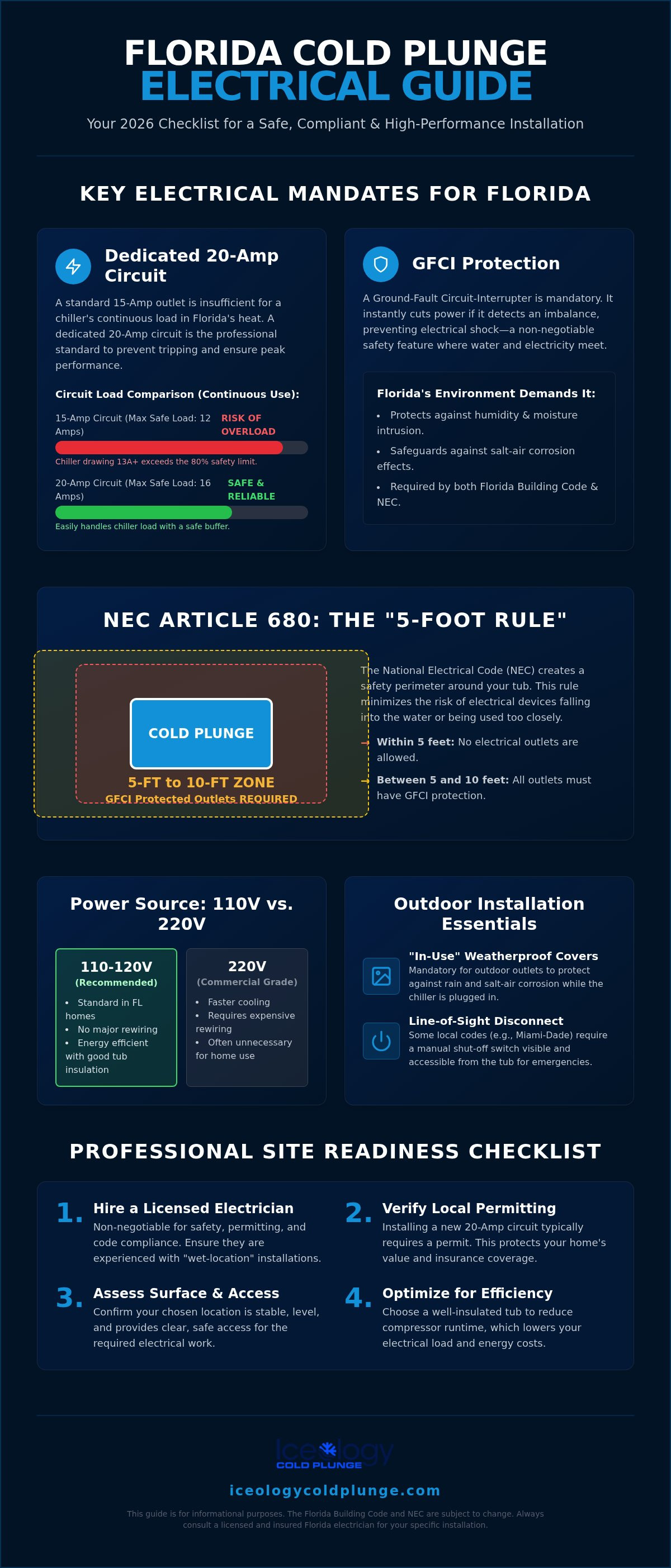
Local municipalities often add their own layers of oversight. In Miami-Dade or Tampa, you might encounter strict "line-of-sight" disconnect rules. This requires a manual shut-off switch to be visible and accessible from the tub. It ensures power can be cut instantly during an emergency. Whether you're installing indoors in a dedicated gym or outdoors on a lanai, understanding these cold plunge tub electrical requirements Florida homeowners face is the first step toward a worry-free recovery practice.
NEC Article 680 and Florida Compliance
The "5-foot rule" is a cornerstone of Florida electrical safety. NEC Article 680 mandates that no electrical receptacle be located within 5 feet of the inside wall of your tub. Any outlet positioned between 5 and 10 feet must be equipped with Ground-Fault Circuit-Interrupter (GFCI) protection. Your plunge chiller is classified similarly to a pool pump. It requires a dedicated branch circuit to prevent overloading shared lines. Because Iceology tubs are built as permanent, hard-sided units, they must meet the labeling requirements for permanent equipment rather than storable, seasonal appliances. This distinction ensures your setup is built for year-round performance in the Florida heat.
Permitting and Local Florida Regulations
Permitting isn't just about red tape. It's about protecting your home's value and your safety. In South Florida counties, installing a dedicated 20-amp circuit for your cold plunge typically requires a local electrical permit. This process verifies that your home's panel can support the additional load without compromising other systems. Meeting these codes is also essential for HOA compliance and maintaining your homeowner’s insurance coverage. Always consult with a Florida-licensed electrician to perform a "wet-location" verification. They'll ensure your outdoor outlets feature the necessary "in-use" weatherproofing covers to resist salt-air corrosion and tropical downpours.
Voltage and Amperage: Powering Premium Chillers in the Heat
Florida afternoons often climb toward 95 degrees. This intense heat forces your chiller to work overtime to maintain that crisp 39-degree benchmark. To handle this demand, understanding the cold plunge tub electrical requirements Florida climate dictates is essential. While many units claim to be "plug-and-play," a standard shared household circuit often fails under the pressure of a continuous summer load.
A chiller running for several hours in peak heat is classified as a continuous load. Per safety standards, you shouldn't exceed 80% of a circuit's capacity for these durations. On a 15-amp circuit, that leaves only 12 usable amps. If your chiller draws 13 or 14 amps during a cooling cycle, you risk nuisance tripping or, worse, equipment burnout. This is why a dedicated 20-amp circuit is the professional recommendation for any high-performance recovery station.
110V vs. 220V: Which is Right for Your Florida Home?
Most residential Florida patios are pre-wired for 110-120V outlets. Iceology chillers are engineered to thrive on this standard voltage, making them accessible for home installation without a total electrical overhaul. While 220V commercial-grade chillers offer faster cooling, they require expensive rewiring that many homeowners find unnecessary. A well-insulated tub, like our models featuring high-density polyurethane foam, allows a 110V system to maintain 39°F efficiently by reducing the compressor's runtime. This balance of accessibility and performance is perfect for the private athlete.
Dedicated Circuits and Load Calculations
A dedicated circuit means one breaker serves only your cold plunge. This prevents the chiller from competing with patio lights, fans, or pool pumps. Before your tub arrives, check your breaker panel for a spare slot. You'll want to ensure your electrician uses 12 AWG wire rather than the thinner 14 AWG wire. In Florida, outdoor runs from the main panel to the lanai can be long. Thicker wire prevents voltage drop, ensuring your chiller receives the full power it needs to function at peak capacity.
Adhering to Florida Building Code electrical standards ensures your setup is safe and compliant. Following the specific cold plunge tub electrical requirements Florida mandates will protect your home and your health. Investing in a USA-made premium cold plunge tub ensures that your home’s electrical system isn't under constant strain, even during the hottest July heatwaves.
Safety Essentials: GFCI Protection and Weatherproofing
Florida is the lightning capital of the United States. This reality, combined with the presence of water, makes safety the absolute priority when reviewing cold plunge tub electrical requirements Florida homeowners must follow. You aren't just protecting your equipment; you're protecting yourself. A Ground Fault Circuit Interrupter (GFCI) is your primary defense. It monitors the flow of electricity and cuts power in milliseconds if a leak is detected. Without this protection, a minor equipment fault could become a major hazard.
Standard outlets aren't built for the relentless Florida humidity. Moisture leads to internal corrosion, which causes "phantom" tripping or complete failure. To prevent this, Florida code requires weatherproof "In-Use" covers, often called bubble covers. These allow the chiller to stay plugged in while the outlet remains fully shielded from tropical downpours. Following Outdoor electrical safety guidelines ensures your recovery space meets these rigorous standards and keeps your daily routine uninterrupted.
GFCI Requirements for Wet Locations
Your setup requires Class A GFCI protection. This is specifically designed to trip if the current leakage to ground is between 4 and 6 milliamperes. You have two main options: a GFCI circuit breaker or a GFCI receptacle. While a GFCI outlet is easier to reset, a GFCI breaker in your main panel provides superior protection for the entire length of the wire running to your tub. Because of Florida's corrosive environment, we recommend testing these safety devices monthly. Simply press the "test" button to ensure the mechanism hasn't seized due to humidity or salt buildup. Meeting the cold plunge tub electrical requirements Florida mandates for wet locations is a small step that provides massive peace of mind.
Salt-Air and Humidity Protection
If you live within five miles of the coast, salt-air corrosion is your biggest enemy. Standard outlets will degrade in months. You must use "Weather Resistant" (WR) rated outlets, which are built with UV-stabilized plastics and corrosion-resistant metal parts. For an extra layer of durability, many professional installers apply dielectric grease to the plug terminals. This non-conductive silicone grease seals out moisture and prevents oxidation at the connection point. Our Iceology chillers utilize NEMA-rated enclosures to protect the internal control units, but the external connection point remains your responsibility to safeguard. High-density polyurethane foam in the tub body also helps by reducing the internal condensation that can affect nearby electrical components, adding another layer of protection to your investment.
Energy Efficiency: Managing the Electrical Load in Tropical Heat
Florida's relentless sun presents a unique challenge for thermal management. When ambient temperatures routinely soar above 85°F, your chiller faces a grueling "duty cycle" to keep the water at a therapeutic 39°F. This constant operation directly impacts the cold plunge tub electrical requirements Florida homeowners must plan for to avoid skyrocketing utility bills. Without proper thermal barriers, a chiller might run 18 to 20 hours a day just to combat the radiant heat of a Florida afternoon.
The most effective way to manage this electrical load is through superior engineering. High-density polyurethane foam insulation acts as a thermal vault, dramatically reducing the frequency of the compressor’s engagement. While uninsulated or inflatable tubs may draw three times the power in direct sun, a hard-sided, foam-insulated unit maintains its temperature with minimal electrical draw. This efficiency doesn't just save money; it extends the lifespan of your chiller by preventing mechanical fatigue during heatwaves.
Thermal Management and Insulation
Inflatables often struggle in the tropical climate because they lack the R-value needed to repel high humidity and heat. Iceology’s hard-sided design is built specifically for these conditions. By encasing the tub in professional-grade insulation, we ensure the "Chiller vs. Heat" battle is won before it even starts. This design choice allows the system to reach the 39-degree benchmark and stay there, rather than constantly cycling to compensate for thermal loss. The result is a consistent recovery experience that doesn't strain your home's electrical panel.
Smart Controls and Scheduling
Strategic timing is your best tool for lowering operational costs. Many Florida utility providers offer lower rates during off-peak hours, typically late at night or early in the morning. By using integrated timers, you can schedule the heaviest cooling cycles for these windows. Optimizing your schedule helps you meet the cold plunge tub electrical requirements Florida utilities favor by shifting the load away from the peak afternoon hours. Maintaining a "base cold" temperature is significantly more efficient than cooling the water from scratch every day. Modern chiller apps also allow for remote monitoring, giving you real-time data on your unit’s electrical health.
Estimated monthly usage for a year-round Florida setup varies, but a well-insulated unit typically consumes between 60 and 120 kWh per month, depending on usage frequency and shade availability. To ensure your home is ready for a high-performance recovery station, explore our Florida-ready cold plunge tubs and start your journey toward optimized physical well-being.
Professional Setup: From Delivery to First Dip
A successful cold plunge tub setup begins long before the delivery truck arrives. In the high-moisture environment of Florida, your physical foundation is as critical as your electrical one. You must place your tub on a level, non-conductive surface to prevent both structural stress and electrical grounding issues. Reinforced concrete or heavy-duty rubber mats provide the stability needed to support a water-filled tub that can weigh over 1,000 pounds. This foundation ensures the internal components remain dry and properly ventilated, which is a key part of meeting the cold plunge tub electrical requirements Florida inspectors look for during a home safety review.
Final safety checks are vital before you add a single drop of water. You must verify that your outlet is close enough to the unit to avoid the use of extension cords. Extension cords are strictly prohibited for long-term use. They aren't designed for the continuous high-amperage draw of a chiller, especially in 90-degree heat. They cause significant voltage drops that can starve the compressor and lead to permanent motor damage. If your outlet isn't within reach of the factory-supplied cord, you must have a licensed professional install a new, dedicated circuit.
Working with a Florida Electrician
When interviewing contractors, ask specifically if they are familiar with "wet location" wiring for spas and self-contained tubs. You should request a full load calculation for your home's main electrical panel. This confirms you have the capacity for a 20-amp dedicated line without overloading your existing service. Ensure they understand Florida’s equipotential bonding requirements. This involves connecting all metal parts near the water to a common grounding point to eliminate the risk of stray voltage. A professional who understands these nuances will ensure your sanctuary is both safe and code-compliant.
The Iceology Installation Checklist
Following a structured path to power ensures your first dip is as restorative as intended. Use this checklist to verify your cold plunge tub electrical requirements Florida compliance:
- Step 1: Confirm a dedicated 20A circuit is available and correctly labeled in your breaker panel.
- Step 2: Install a weatherproof GFCI outlet with an "In-Use" bubble cover to protect against tropical downpours.
- Step 3: Verify the grounding pin on your cold plunge tub made in USA is intact and securely plugged into the grounded outlet.
- Step 4: Perform the initial power-up. Once the chiller is active, calibrate the thermostat to your desired recovery temperature and check for any moisture near the electrical connections.
By taking these final technical steps, you transition from the planning phase to peak performance. Your commitment to safety ensures that your daily recovery practice remains a reliable tool for physical and mental optimization.
Elevate Your Florida Recovery Practice
Mastering the technical landscape of your home installation is the final bridge between a goal and a daily reality. By prioritizing a dedicated 20-amp circuit and adhering to the 2026 Florida Building Code, you protect both your investment and your safety. High-performance recovery shouldn't be compromised by the state's humidity or salt air. Utilizing high-density polyurethane foam insulation ensures your chiller maintains a crisp 39°F without placing unnecessary strain on your home's electrical panel. When you align your setup with the specific cold plunge tub electrical requirements Florida demands, you create a sanctuary built for longevity.
Iceology provides the expert support and USA-made craftsmanship needed for a seamless transition into cold water therapy. Our tubs are engineered for the unique challenges of the Sunshine State, featuring integrated chillers and superior thermal management. You've mastered the technical details; now it's time to focus on your personal results. Explore Florida-Ready Premium Cold Plunge Tubs today and take control of your physical and mental state. Your path to peak performance is ready when you are.
Frequently Asked Questions
Do I really need a dedicated circuit for my cold plunge in Florida?
Yes, a dedicated 20-amp circuit is essential for long-term safety and performance. Florida's high ambient temperatures force chillers to run for extended cycles, which often exceeds the 80% load limit of a shared 15-amp circuit. By providing a direct line to your breaker panel, you eliminate nuisance tripping and protect the compressor from voltage fluctuations. This setup ensures your unit consistently reaches that 39°F recovery benchmark without interference from other household appliances.
Can I plug my cold plunge into a standard outdoor Florida outlet?
You can only use an outdoor outlet if it meets specific safety standards. It must be a dedicated 20-amp line equipped with a Class A GFCI and a weatherproof "In-Use" cover. Standard outlets on a shared circuit often lack the capacity for a high-performance chiller. Overloading these lines can lead to overheating, especially in the tropical heat. Meeting the cold plunge tub electrical requirements Florida mandates ensures your outdoor setup remains resilient against humidity.
How much does it cost to run a cold plunge tub in Florida per month?
Monthly operational costs depend on your local utility rates and the unit's insulation quality. A hard-sided tub with high-density polyurethane foam typically consumes between 60 and 120 kWh per month in the Florida climate. Uninsulated models will draw significantly more power as they struggle to maintain temperature against the radiant sun. To minimize expenses, we recommend cooling during off-peak hours and keeping the insulated lid securely fastened when the tub isn't in use.
Is it safe to leave my cold plunge plugged in during a Florida thunderstorm?
It's generally safe if you have proper surge protection, but caution is advised. Florida is the lightning capital, and power surges can damage sensitive chiller electronics even through a GFCI. While your dedicated circuit provides a level of defense, a whole-home surge protector is a wise addition for any premium equipment. During severe weather events, many homeowners choose to temporarily disconnect the unit to provide absolute protection against high-voltage strikes that bypass standard breakers.
What happens if my GFCI outlet keeps tripping?
Frequent tripping is usually a sign of moisture intrusion or a ground fault. In Florida’s 90% humidity, condensation can build up inside the outlet box or the chiller’s connection point. If the GFCI trips, first check for any standing water or dampness around the plug. If the problem persists after drying, it may indicate salt-air corrosion on the internal terminals. You should have a licensed electrician inspect the circuit to ensure the wiring hasn't been compromised.
Do I need a special permit for a cold plunge on my Florida patio?
Most Florida municipalities require a permit for any new electrical work related to a "self-contained spa." This includes running a new dedicated line to your patio or installing a disconnect switch. While the tub itself is portable, the electrical infrastructure must meet the Ninth Edition of the Florida Building Code. Obtaining a permit ensures the installation is inspected for safety, which is vital for maintaining your homeowner’s insurance coverage and ensuring HOA compliance.
Can salt air damage the electrical components of my cold plunge?
Salt air is a major contributor to electrical failure in coastal regions. It creates a conductive film that can lead to short circuits and rapid oxidation of copper components. To mitigate this, always use Weather Resistant (WR) rated receptacles and NEMA-rated enclosures for your equipment. Applying dielectric grease to the plug prongs can also seal out moisture. These proactive steps are critical for maintaining the cold plunge tub electrical requirements Florida coastal environments demand for durability.
How far should the electrical outlet be from the cold plunge tub?
Florida codes require a minimum distance of 5 feet from the inside wall of the tub. This "5-foot rule" prevents accidental contact with the outlet while you're in the water. Any receptacle located between 5 and 10 feet from the tub must have GFCI protection. It's also important to ensure the factory-supplied power cord reaches the outlet without the use of extension cords, as these are strictly prohibited for permanent outdoor wellness installations.