
Cold Plunge Tub for Managing Anxiety: What to Know Before You Try It
Could a cold plunge leave you feeling steadier, or make an anxious moment feel more intense? If you’re considering a cold plunge tub for managing anxiety, both outcomes are worth considering. Personal stories can be powerful, but they aren’t evidence that cold immersion treats anxiety.
It’s understandable to want a clear answer before trying an intense physical practice. Research on cold water immersion as a direct anxiety treatment is limited and inconclusive. Some people say they feel more alert or less stressed afterward; others find the initial shock uncomfortable or unsettling. Your response matters, and a plunge shouldn’t replace professional mental-health care.
This guide separates possible appeal from proven benefits, explains what to consider before starting, and outlines practical boundaries. It also covers what a home setup involves, including Iceology Cold Plunge’s Grizzly 450 and its controlled, ice-free cooling. The goal is a grounded choice, not a promise of a particular mental-health outcome.
Key Takeaways
- Separate the immediate intensity of cold exposure from any later sense of calm. One doesn’t guarantee the other.
- Weigh the possible appeal of a cold plunge against discomfort and uncertainty. If cold feels overwhelming, consider gentler wellness practices.
- Before trying a cold plunge tub for managing anxiety, clarify what you hope to gain and whether the experience feels appropriate for you.
- Treat your first response as useful feedback, not a test of toughness. You can decide not to continue.
- When considering a home setup, assess practical features such as controlled, ice-free cooling separately from expectations about mental health.
Can a Cold Plunge Tub Help Manage Anxiety? A Realistic Starting Point
If anxiety leaves you feeling keyed up or disconnected from your body, a physical wellness practice may seem like a tangible way to focus your attention. Cold water immersion means briefly entering chilled water. It’s an optional wellness activity, not an anxiety treatment, and feeling anxious doesn’t mean you need to plunge.
So, can a cold plunge tub for managing anxiety help? Individual experiences vary. Some people describe feeling more alert or calmer afterward, while others find the cold intense or unsettling. Those responses may matter to the people experiencing them, but they don’t predict what someone else will feel.
What does managing anxiety mean in this context?
Everyday stress and an anxiety disorder aren’t interchangeable. Stress can arise around a specific challenge, while an anxiety disorder involves concerns that may persist or interfere with daily life. This article discusses cold immersion only as a possible addition to a personal wellness routine, not as a way to diagnose, prevent, or treat a mental-health condition.
If anxious feelings are ongoing, distressing, or affecting your ability to manage everyday activities, a cold tub shouldn’t take the place of care from a qualified mental-health professional. You don’t need to prove your resilience through cold exposure. Choosing not to try it, or stopping because it feels wrong for you, is a valid response.
What readers should expect from the evidence
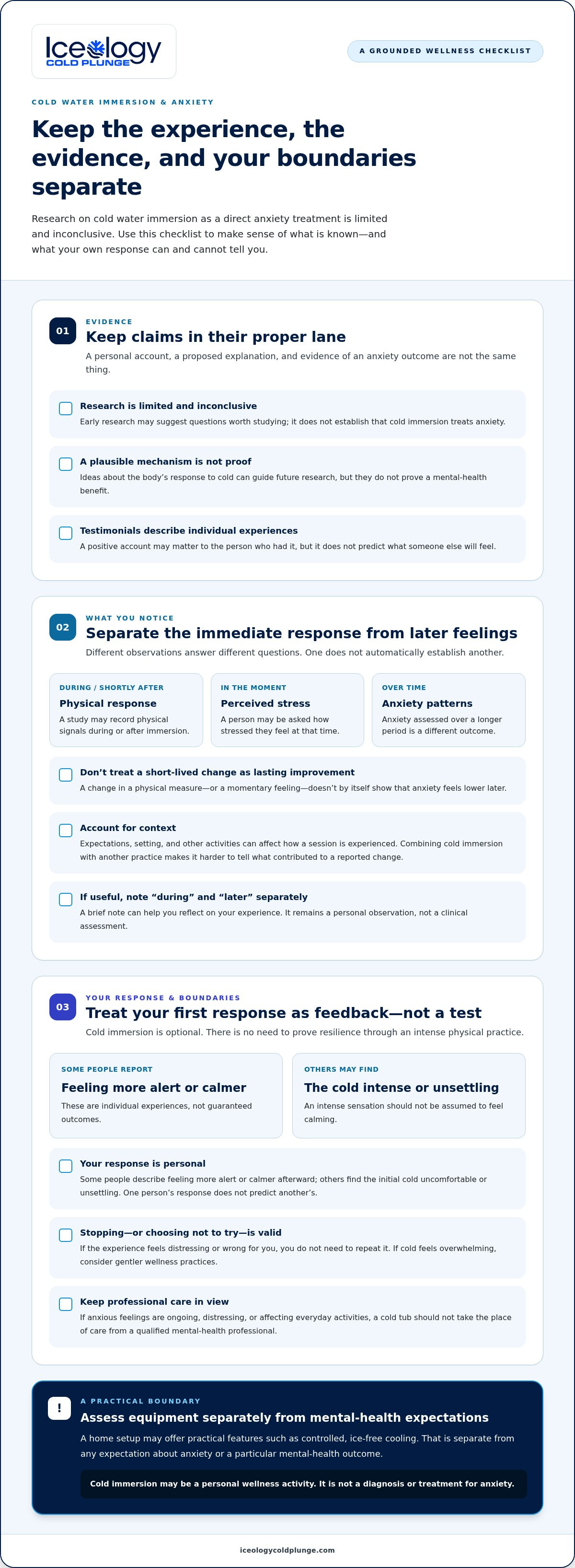
Keep three kinds of information separate. Early research can suggest questions worth studying, but it doesn’t establish that cold immersion treats anxiety. Proposed explanations about the body’s response to cold may help researchers frame future studies, but a plausible mechanism isn’t proof of a mental-health benefit. Personal testimonials describe individual experiences, not reliable outcomes for everyone.
Research on cold exposure and anxiety specifically remains limited and inconclusive. Findings about perceived stress may be relevant to well-being, but they shouldn’t be stretched into a claim that cold plunging treats an anxiety disorder. For broader context on recovery and resilience claims, see Iceology Cold Plunge’s guide to the scientific benefits of cold plunge, while keeping anxiety-specific evidence in its own category.
The immediate physical experience deserves attention, too. Sudden cold immersion can trigger a cold shock response, so don’t assume an intense sensation will feel calming. The body’s immediate reaction and a person’s later interpretation of the experience are distinct. A practice that feels grounding to one person may increase discomfort for another.
Cold immersion may be a personal stress-support practice, but it isn’t a diagnosis or treatment for anxiety. Keep that boundary in mind as you weigh possible appeal against uncertainty. It also helps to understand what research can and can’t say about the body’s response to cold.
How Cold Water Immersion May Affect Stress Responses
“Stress response” can refer to different things: the body’s immediate reaction, a person’s sense of stress in the moment, or anxiety patterns over time. Those outcomes aren’t interchangeable. Keeping them separate helps make sense of research and personal observations without assuming that a change in one means a change in the others.
The immediate response to cold
A study might record physical signals during or shortly after immersion, ask participants how stressed they feel, or assess anxiety over a longer period. Each approach answers a different question. A short-lived change in a physical measure, for example, wouldn’t by itself show that someone feels less anxious later or experiences lasting improvement.
Personal context also matters when interpreting an experience. Expectations, the setting, and what else someone is doing can influence how they describe a session. If cold immersion is combined with another practice, such as breathwork, it becomes harder to determine which part contributed to a reported change. A positive experience can still matter to the individual, but it doesn’t isolate a cause.
What research can, and can’t, say about anxiety
For a claim about anxiety, look for research that measures anxiety itself rather than relying only on general well-being or a physical response. Consider whether the outcome was assessed just after exposure or over a longer period, whether participants were compared with a suitable control group, and whether other activities were part of the study. These details help show what a result actually supports.
That distinction matters when considering a cold plunge tub for managing anxiety. A proposed explanation for how the body responds to cold may guide research, but it doesn’t establish that immersion improves anxiety symptoms. Likewise, a shift in perceived stress isn’t proof of treatment effectiveness. The broader cold water immersion therapy guide offers context on the practice, while anxiety claims still need direct evidence.
For your own reflection, separate what you noticed during the experience from how you felt later. A brief note about each can be more informative than a single overall judgment, but it remains a personal observation, not a clinical assessment. If the experience feels distressing, there’s no need to repeat it to gather more data.
Cold immersion can be approached as a wellness activity, with no assumed mental-health result. If you’re interested in a dedicated home setup, Iceology Cold Plunge offers cold plunge tubs for home use. The equipment provides access to cold water; whether the practice belongs in your routine is a separate, individual decision.
Cold Plunging for Anxiety: Potential Appeal, Discomfort, and Alternatives
A cold plunge may appeal if you want a structured, body-based activity or are curious about how you respond to a brief physical challenge. But the experience can feel intense, and it won’t suit every anxious reader. The useful question isn’t whether you can push through. It’s whether the practice feels appropriate and worthwhile for you, given its uncertainties and your other sources of support.
When cold exposure may feel like too much
Cold water can bring a strong physical sensation that competes with, rather than settles, your attention. If you notice rising distress, dread, or a sense that you’re forcing yourself to continue, treat that as useful information. Testimonials describe someone else’s experience, not a standard you need to match. Choosing not to plunge is a sound personal decision, not a failure of discipline.
There’s no anxiety-specific temperature or exposure duration to prescribe here. Avoid turning a wellness experiment into a test of endurance. If the idea alone feels overwhelming, you’re free to skip it and explore another practice, or simply revisit the decision later.
How to compare cold plunging with other support
Think of a plunge as one optional routine, not a substitute for support aimed at anxiety. Therapy and prescribed care serve different purposes and shouldn’t be stopped or replaced because you’re considering cold exposure. If you have health concerns, or aren’t sure how cold immersion fits with your circumstances, discuss the decision with a qualified healthcare professional.
For a cold plunge tub for managing anxiety, the most grounded choice respects both your comfort and the limits of the evidence. You can choose another form of support, combine a wellness routine with professional care, or decide that plunging isn’t right for you. No single option needs to define your commitment to well-being.
How to Decide Whether a Cold Plunge Fits Your Wellness Routine
A considered decision starts before you approach the water. Rather than asking whether you can tolerate a plunge, ask what role you expect it to play and whether the experience seems compatible with your needs. There’s no universal temperature, schedule, or duration for anxiety management, and a cold plunge shouldn’t replace professional care.
- Clarify your goal. Is this an optional wellness practice you’re curious about, or are you hoping it will resolve anxiety or take the place of treatment? If it’s the latter, pause. Cold immersion isn’t a substitute for care from a qualified professional.
- Consider your comfort. Think about how you usually respond to strong physical sensations, sudden discomfort, or feeling out of control. You don’t need to predict your reaction perfectly. Notice whether the idea feels manageable or already creates pressure.
- Review personal health concerns. If you have medical concerns, or questions about how cold exposure relates to your health or mental-health care, seek guidance from a qualified healthcare professional before deciding.
Questions to consider before trying cold immersion
Be honest about your expectations. If you’re looking for general wellness and understand that anxiety benefits aren’t guaranteed, you can weigh the practice on those terms. If you’re hoping to stop therapy or change prescribed care, don’t make that decision based on plunging. A healthcare professional familiar with your circumstances can help you consider relevant concerns without turning cold immersion into a treatment plan.
How to evaluate your response afterward
If you choose to try cold immersion, give yourself permission to stop if it feels distressing. Afterward, jot down what you noticed: your comfort, mood, and whether you felt more settled or more activated. Treat those notes as personal observations, not proof that the practice works or a basis for changing clinical care.
A single experience can be shaped by the day, your expectations, and how the cold felt in that moment. It doesn’t have to settle the question for good. You might decide to pause, opt out, or reflect further before considering another exposure. Make room for your response instead of judging it as a test of willpower.
For anyone considering a cold plunge tub for managing anxiety, the decision can be simple: proceed only if it fits your expectations, comfort, and health considerations. If uncertainty remains, choosing not to plunge is a complete decision. A wellness routine should support your sense of agency, not add another demand or become a substitute for help you need.
To explore a home setup for cold-water immersion, visit Iceology Cold Plunge.
Choosing a Home Cold Plunge Tub for a Controlled, Ice-Free Setup
A home cold tub can make cold-water immersion available in a dedicated setup, but access to chilled water isn’t a mental-health outcome. Equipment affects practical details, including how water is cooled and which features are built into the tub. It can’t establish whether cold exposure will feel helpful for anxiety, and it shouldn’t replace professional care.
What the Iceology Cold Plunge Grizzly 450 provides
The Grizzly 450 is a hard-sided cold tub with a built-in 1/4 HP Active Aqua chiller. An optional 1/2 HP upgrade is available. The chiller regulates water between 39°F and 41°F and can reach 39°F, providing controlled, ice-free cooling without adding ice to the tub.
The tub holds 450 quarts, with a recommended fill line of 90 to 95 gallons. Its exterior dimensions are 59.875 inches long, 38.5 inches wide, and 30.75 inches high. The total footprint is 77 inches by 40 inches, with 10 inches of clearance needed at the back, so plan for a total space of 77 inches by 50 inches. It uses a standard 110 V outlet and draws up to 7 A. A dedicated breaker with GFCI is recommended.
Other features include an integrated ozone system and 2-inch pressure-injected polyurethane foam insulation. Iceology Cold Plunge tubs are made in the USA. These details describe the equipment, not evidence of anxiety relief. A chiller’s temperature range, insulation, and sanitation system can’t show that a plunge will reduce anxious feelings or suit every user.
A realistic next step for interested readers
A dedicated home cold tub may appeal if you already want regular access to cold-water immersion and prefer a built-in chiller to adding ice. It may be less suitable if the cold experience feels distressing, if you’re looking for a guaranteed mental-health effect, or if you expect equipment to replace treatment. Keep the decision focused on your comfort and practical preferences.
Before choosing a tub, consider whether its core function matches what you want from a home setup. The Grizzly 450 is equipment for cold-water immersion, not an anxiety intervention. Its specifications explain how it provides chilled water, but your response to immersion remains personal and can’t be inferred from product features.
If you’re interested in a dedicated cold-water setup and have realistic expectations about what it can offer, explore Iceology Cold Plunge’s range of cold tubs. Weigh the equipment details alongside your comfort with cold exposure. There’s no need to rush toward a purchase or a plunge, and choosing a tub doesn’t commit you to using it as an anxiety-management method.
See the Iceology Cold Plunge website to explore the Grizzly 450 and cold-plunge accessories.
Choose a Next Step That Respects Your Needs
Your next step doesn’t have to be getting into cold water. Give yourself permission to choose a wellness routine that feels appropriate, or to focus on professional support if anxiety is affecting your life. If you’re still considering a cold plunge tub for managing anxiety, keep your expectations measured and let your comfort guide the decision. There’s no need to turn the choice into a challenge or prove anything through exposure.
If a dedicated home setup interests you for cold-water immersion, consider the Grizzly 450 as equipment for that practice, not as a promise of anxiety relief.
Wellness is personal. The right choice is one that supports your well-being, respects your limits, and leaves room for the care you deserve.
Frequently Asked Questions
Can a cold plunge tub help manage anxiety?
It may feel supportive to some people, but it isn’t an established anxiety treatment. If you’re exploring it, decide in advance what you hope to learn, such as whether the sensation feels grounding or uncomfortable, rather than expecting a particular result. Afterward, note how you felt during the experience and later in the day. Those observations can guide a personal wellness choice, but they can’t predict how others will respond.
Can cold plunging make anxiety feel worse?
Yes. The experience may feel overwhelming instead of calming, and responses differ from person to person. If you feel increasingly distressed, leave the water safely and don’t treat continuing as a measure of willpower. You can also decide that cold exposure isn’t for you. If you’re unsure whether your response raises a health concern, describe what happened to a qualified healthcare professional.
Can a cold plunge replace therapy or anxiety medication?
No. A tub can’t provide individualized mental-health care or make decisions about medication. If you’re thinking about changing treatment, discuss that directly with the professional who manages your care, rather than basing the decision on a plunge or someone else’s experience. You can ask whether adding cold exposure fits your circumstances and what signs would mean you should pause or avoid the practice.
Is there scientific proof that cold plunges treat anxiety?
No. Before relying on a claim, look for research that identifies who was studied, what anxiety outcome was measured, and how long participants were followed. A headline or a report of feeling better after one session may not answer whether cold exposure caused the change or whether it lasts. Be cautious about claims that promise the same result for everyone, especially when they don’t explain the evidence behind them.
Should I try cold plunging during a panic attack?
No. A plunge shouldn’t be treated as an emergency response to a panic attack, and the intense sensation may add to distress. If you have a plan from a healthcare professional for moments like this, follow that plan instead. If symptoms feel unusually severe or unsafe, seek appropriate medical support. Consider any cold-water practice only outside an acute episode and with your personal circumstances in mind.
What should I look for in a cold plunge tub for anxiety-focused wellness?
Choose based on practical fit, not promises that a tub can treat anxiety. Consider whether the setup suits your available space, preferred way of cooling water, and willingness to maintain a regular home routine. Iceology Cold Plunge’s Grizzly 450 is hard-sided and includes a built-in Active Aqua chiller and integrated ozone system. Those features describe the equipment, not its effect on anxiety.