
What Happens If a Cold Plunge Chiller Fails? A Complete Troubleshooting and Prevention Guide
You step out at dawn, anticipating the sharp, clarifying 39-degree embrace that centers your day, only to find the water is stagnant and the machine is silent. It's a moment of immediate frustration. It disrupts your mental focus and halts your physical recovery. You're likely wondering exactly what happens if a cold plunge chiller fails and whether your high-performance investment is permanently compromised. While a silent motor feels like a catastrophe, it's often a manageable maintenance event that you can navigate with the right technical knowledge.
We understand that your recovery routine is a non-negotiable pillar of your wellness journey. This guide provides the professional clarity you need to diagnose the issue quickly. It helps you distinguish between a minor flow restriction and a serious mechanical breakdown. We'll walk through a comprehensive diagnostic checklist, explain how to manage water hygiene during downtime, and share the preventative maintenance habits that protect your compressor's longevity. By the end, you'll have a clear roadmap for when to handle a fix yourself and when it's time to call in a professional.
Key Takeaways
- Identify the root cause of equipment silence or cooling loss by using a professional diagnostic checklist to differentiate between simple flow issues and mechanical failures.
- Discover exactly what happens if a cold plunge chiller fails, including the "thermal drift" phenomenon and how high-efficiency insulation preserves your water temperature during downtime.
- Learn the standard "hard reset" protocols and visual inspection techniques that can resolve many common issues without the need for an expensive service call.
- Protect your investment from environmental stressors like humidity and salt air through consistent preventative maintenance that extends the lifespan of your compressor.
- Understand the strategic advantage of USA-made components and integrated engineering for faster parts sourcing and superior resilience in your daily recovery routine.
The Immediate Impact: What Happens When the Chiller Stops?
The moment your system loses power or the compressor stalls, the active cooling process ceases immediately. Most high-performance units rely on a sophisticated vapor-compression refrigeration cycle to maintain precise temperatures. When this cycle is interrupted, the water begins a process called thermal drift. Without active heat extraction, the water temperature will slowly climb until it matches the surrounding environment. For dedicated practitioners, this isn't just a technical glitch. It's a disruption of the mental discipline and physical recovery that anchors your day. Understanding what happens if a cold plunge chiller fails is the first step toward protecting your investment and your routine.
Temperature Rise and the Role of Insulation
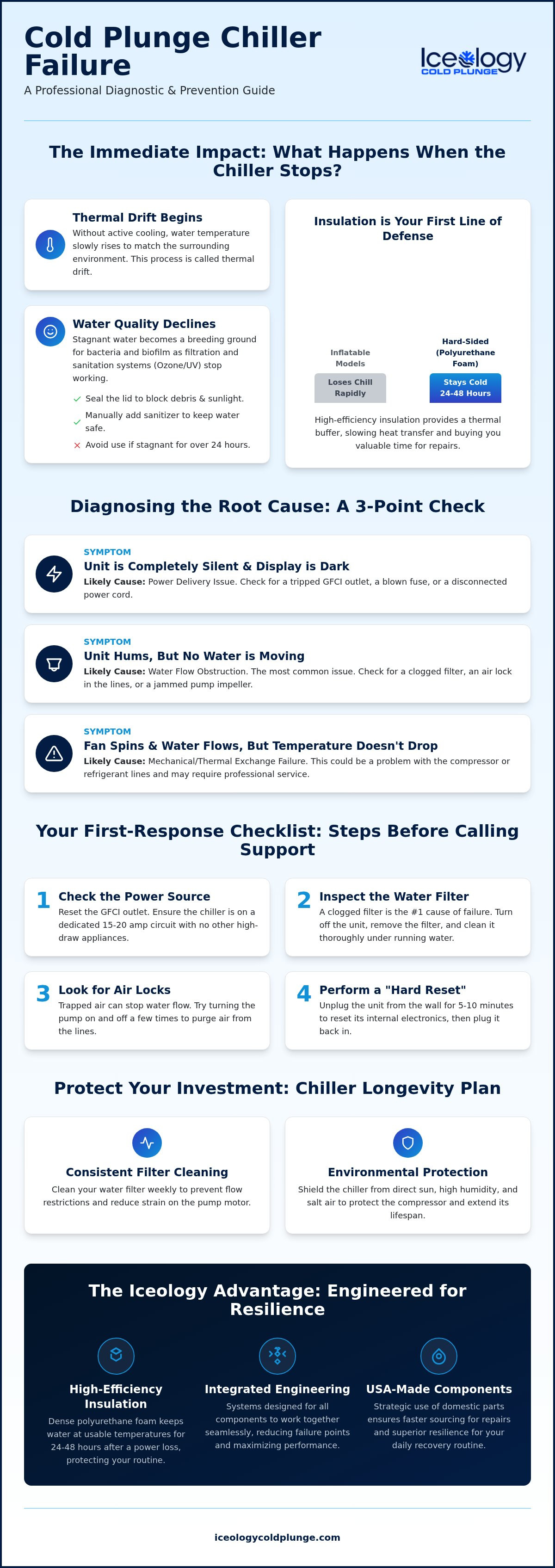
Ambient conditions play a massive role in how fast your water warms up. In regions like South Florida, the intense heat can turn a cold tub into a lukewarm bath within hours if the unit lacks proper protection. This is where the engineering of your tub becomes your greatest asset. While inflatable models often lose their "chill" rapidly due to thin walls, hard-sided tubs utilize dense materials to create a thermal buffer. A polyurethane foam cold plunge provides a high-efficiency barrier that slows heat transfer significantly. This premium insulation buys you valuable time, often keeping the water at usable recovery temperatures for 24 to 48 hours after a power loss. It's the difference between a minor delay and a total routine reset.
Water Quality Concerns During Downtime
Temperature isn't the only variable at risk. When the chiller fails, the internal pump usually stops as well. This leads to total water stagnation. Moving water is naturally harder for contaminants to colonize, but still water becomes a breeding ground for bacteria and biofilm. Most advanced systems use ozone generators or UV-C filters, but these tools require water flow to function. If you're wondering what happens if a cold plunge chiller fails regarding hygiene, the answer is a rapid decline in clarity. To manage this during downtime, consider these steps:
- Seal the lid: Keep the cover tightly closed to prevent debris and sunlight from entering, which fuels algae growth.
- Add sanitizer: Manually add a small dose of your preferred sanitizer to keep the water safe while the pump is offline.
- Monitor clarity: Avoid using the tub if the water has been stagnant and warm for more than 24 hours without filtration.
Taking these precautions ensures that once your chiller is back online, you won't be facing a full water change or a deep-cleaning crisis. Maintaining hygiene during downtime is just as critical as the mechanical repair itself.
Common Failure Points: Diagnosing the Root Cause
To resolve a cooling crisis, you must first isolate exactly where the breakdown occurred. Identifying what happens if a cold plunge chiller fails requires a systematic approach to three specific areas: power delivery, water movement, and thermal exchange. A common point of confusion for many users is distinguishing between a pump failure and a compressor failure. If the unit is completely silent and the digital display is dark, the issue is likely electrical. However, if you hear a low humming sound but see no water movement, the pump's impeller is probably jammed by debris. When the fan is spinning and water is flowing but the temperature refuses to drop, the problem typically lies within the compressor or the refrigerant lines.
Electrical and Flow Obstructions
Start with the most accessible components. Most high-performance chillers require a dedicated 15 to 20-amp GFCI-protected circuit to operate safely. If your breaker trips, it's often a sign of a localized power surge or moisture entering an electrical connection. It's a simple check. It saves you hours of frustration. Beyond power, the absolute most frequent cause of system failure is restricted water flow. Clogged filters force the pump to work harder, eventually triggering a safety shut-off to prevent permanent damage. You might also encounter air locks, where air bubbles trapped in the lines mimic a mechanical failure by preventing the pump from priming. Regularly inspecting your cold tubs for these basic obstructions can prevent the majority of downtime events.
- GFCI Check: Reset the outlet and ensure no other high-draw appliances are on the same circuit.
- Filter Inspection: Replace or deep-clean the 20-micron filter to restore proper GPM (gallons per minute) flow.
- Error Codes: Consult your manual for codes like "E01" or "FL," which specifically indicate flow-rate issues.
Compressor and Refrigerant Health
The compressor acts as the heart of the closed-loop cooling system, pressurizing refrigerant to facilitate the heat exchange required to drop water temperatures. This component is the most expensive part of the system, and its health depends heavily on its environment. Research indicates that chillers need at least 12 to 18 inches of clearance around intake and exhaust vents to function. Without this space, the unit recycles its own hot exhaust air. This leads to overheating and eventual compressor burnout. If you notice an oily residue near the copper coils or hear a persistent hissing sound, you may be dealing with a refrigerant leak. These issues generally require professional tools to resolve, as the closed-loop system must be evacuated and recharged to restore its cooling capacity. Precision engineering and proper placement are the best defenses against these high-stakes failures.
Troubleshooting Guide: Steps to Take Before Calling Support
When your system stops performing, it's natural to feel a sense of urgency. You don't have to wait for a technician to begin the recovery process. Most issues stem from environmental factors or minor maintenance oversights rather than total mechanical failure. A quick way to verify if the cooling system is still active is by checking the "Delta T." This is the temperature difference between the water entering the chiller and the water exiting it. If the outlet water is at least 1 to 3 degrees cooler than the intake, your system is functional but likely struggling with external heat or flow restrictions. Ensure there's adequate ventilation; a chiller trapped in a hot garage or pressed against a wall cannot breathe. This lack of airflow is often the primary cause of what happens if a cold plunge chiller fails.
The 5-Step Diagnostic Checklist
Follow this methodical sequence to rule out common operational errors. These steps can often restore your cooling cycle in minutes without requiring professional tools.
- Step 1: Verify Power and GFCI. Ensure the plug is secure and the GFCI outlet hasn't tripped. If it has, reset it and monitor if it trips again immediately, which indicates a short.
- Step 2: Inspect the 5-Micron Filter. A dirty filter is the number one cause of flow errors. Remove the filter cartridge; if the system runs better without it, you've found your culprit.
- Step 3: Resolve Air Locks. If you hear the pump but see no water movement, air is likely trapped. Open the priming valve or slightly loosen a fitting to let the air escape until water flows steadily.
- Step 4: Clean the Condenser Coils. Dust and pet hair act as insulation on your cooling coils. Use a soft brush or vacuum to clear the vents, allowing the heat to escape efficiently.
- Step 5: Document Error Codes. If the digital display shows a code like "P1" or "E3," write it down. This specific data helps technical support diagnose your unit over the phone.
When to DIY vs. Professional Repair
Knowing your limits protects your warranty and your safety. Tasks like cleaning coils, bleeding air from the lines, and swapping filters are standard user maintenance. However, if you suspect a refrigerant leak or a faulty internal fan, it's time to call an expert. Opening the chiller cabinet can expose you to high-voltage components and may void your protection plan. When repairs are necessary, the origin of your equipment matters. Choosing a USA made cold plunge tub often means replacement components are stocked domestically. This local availability reduces your downtime from weeks of waiting for international shipping to just a few days of local transit. It's a strategic choice for those who view cold therapy as a lifelong commitment.
Preventative Maintenance: Ensuring Chiller Longevity
Discipline is the foundation of any successful recovery practice. This same commitment must extend to your equipment. While understanding what happens if a cold plunge chiller fails is vital for troubleshooting, preventing that failure entirely is the more cost-effective strategy. Routine care is always cheaper than a single compressor replacement. By treating your chiller with the same respect you give your own physical limits, you ensure your sanctuary remains operational for years. Maintaining a consistent environment for your components prevents the gradual wear that leads to sudden, frustrating downtime.
Water chemistry is a silent factor in mechanical health. If your pH levels drift outside the ideal range of 7.2 to 7.8, the water can become corrosive to internal heat exchangers. We recommend establishing a physical maintenance log near your recovery station. Documenting filter changes, water tests, and coil cleanings creates a history of care that simplifies diagnosis if a problem ever arises. This proactive approach transforms maintenance from a chore into a reliable ritual of peak performance.
Weekly and Monthly Maintenance Tasks
Consistency in small tasks prevents massive mechanical headaches. Dedicating ten minutes a week to your system can significantly extend the lifespan of your pump and compressor.
- Weekly: Inspect the 20-micron filter for discoloration and ensure water levels remain above the intake port to prevent air from entering the lines.
- Monthly: Gently rinse the condenser coils with low-pressure air or a soft brush to remove dust.
- Monthly: Test the GFCI reset button to verify that your electrical safety protocols are fully functional.
Accumulation of debris in a dirty filter forces the motor to work 30% harder to maintain the necessary flow rate. Over time, this unnecessary strain leads to premature motor burnout and increased energy consumption.
Seasonal Deep Cleaning for Florida Owners
The climate in Miami, Tampa, and across South Florida presents unique challenges for thermal management. High humidity and salt-heavy air accelerate corrosion and make it harder for chillers to shed heat. During the peak summer months, your unit's exhaust system works at its limit. It is critical to verify your cold plunge tub setup allows for at least 12 to 18 inches of clearance on all sides. Without this breathing room, the unit recycles hot air, leading to the exact scenario of what happens if a cold plunge chiller fails due to thermal overload. Every six months, flush the entire system with fresh water to remove mineral buildup that can clog the internal heat exchanger. This seasonal reset keeps your cooling cycle efficient regardless of the external temperature. If you are ready to upgrade to a system built for these demanding conditions, explore our premium cold tubs designed with American-made resilience.
The Iceology Advantage: Engineering for Resilience
Choosing a recovery system is an investment in your long-term health. While many users focus solely on the lowest temperature or the initial price, the true value of a system is revealed when things go wrong. A professional build anticipates the reality of mechanical wear. It prioritizes serviceability over disposable design. If you are concerned about what happens if a cold plunge chiller fails, the answer lies in the architecture of your equipment. Integrated systems in hard-sided tubs are engineered as a cohesive unit, which eliminates the vulnerabilities found in fragmented DIY setups or external add-on chillers that rely on exposed hoses and fragile connections. We build our equipment to be a reliable partner in your discipline. This ensures that even a maintenance event is a minor pause rather than a total disruption.
Built for the 39°F Standard
Our engineering process begins with the most demanding thermal requirements. Every Iceology unit is stress-tested to maintain a consistent 39°F even in high-ambient environments. The advantage of a cold plunge tub with chiller integration is the protection it offers the internal components. By housing the cooling technology within a rigid, ventilated frame, we shield the compressor from the elements and accidental impact. This professional integration follows strict American quality control standards, resulting in a more durable cooling cycle. Our use of high-density polyurethane foam insulation serves as a critical safety net. This premium material provides a massive thermal buffer. It keeps your water cold for extended periods if the power is interrupted. You gain peace of mind knowing your water remains at recovery temperatures while you address any technical issues.
Reliable Support for Peace of Mind
Serviceability is at the core of our craftsmanship. We design our tubs with accessible internal layouts, which allows for straightforward filter changes and component inspections. This transparency is vital for those who want to understand what happens if a cold plunge chiller fails and how to resolve it efficiently. Being manufactured in the USA provides a distinct logistical advantage for our owners. We stock replacement parts domestically. This dramatically reduces lead times compared to brands that source components from overseas. Our team provides direct access to experts who understand the specific challenges of the South Florida climate, from humidity management to salt-air resilience. We are more than a manufacturer; we are a dedicated partner in your recovery journey. If you are ready to elevate your routine with a system built for longevity and performance, explore our resilient, USA-made cold plunge tubs today.
Master Your Recovery Environment
Your daily plunge is more than a simple habit; it is a non-negotiable commitment to your physical and mental peak. While technical challenges can feel disruptive, understanding exactly what happens if a cold plunge chiller fails allows you to move from anxiety to decisive action. By prioritizing consistent maintenance and choosing equipment engineered for resilience, you ensure your recovery routine remains a stable pillar of your lifestyle. High-density insulation and integrated cooling systems don't just provide a colder experience. They offer a vital thermal safety net that protects your progress during unexpected downtime.
Precision engineering meets local reliability. Our systems are Made in the USA to ensure expert craftsmanship and rapid access to support. Don't let inferior equipment or maintenance gaps stall your journey toward total-body optimization. Secure Your Recovery with a Premium Iceology Tub and benefit from the durability of a system designed specifically for the demanding South Florida climate. Take control of your recovery today with a partner dedicated to your long-term wellness and peak performance.
Frequently Asked Questions
How long can a cold plunge stay cold if the power goes out?
A premium hard-sided tub equipped with high-efficiency polyurethane foam insulation can maintain usable recovery temperatures for 24 to 48 hours. In the intense heat of Miami or Orlando, this thermal buffer is critical for protecting your water. While inflatable models lose their chill within hours, the dense foam barrier significantly slows heat transfer. Keeping the lid sealed tightly further extends this window, allowing you to manage the situation without losing your progress.
Is it safe to leave my chiller running 24/7?
Yes, high-performance integrated chillers are engineered for continuous operation to maintain a steady 39-degree baseline. Running the system 24/7 is actually more efficient than cooling a warm tub from scratch, which puts unnecessary strain on the compressor. Constant circulation also supports water hygiene by ensuring the filtration and ozone systems remain active. This prevents the stagnation that often occurs when users wonder what happens if a cold plunge chiller fails or is turned off.
Can I still use my cold plunge if I just add ice manually while the chiller is broken?
You can manually add ice to maintain your routine, but you must prioritize water sanitation. Without the pump running, the filtration and UV or ozone systems are offline. Stagnant water quickly accumulates contaminants, especially in humid Florida environments. If you use ice during downtime, limit your sessions and manually add a small dose of sanitizer. Ensure the water remains clear and odorless before submerging, as stagnant warmth invites bacterial growth.
What is the most common reason a cold plunge chiller fails?
Restricted water flow due to a clogged filter is the most frequent cause of system failure. When the 20-micron filter becomes saturated with debris, the pump struggles to move water, eventually triggering a safety shut-off. This protective mechanism prevents the motor from overheating. Regularly checking for flow obstructions is the best way to avoid the frustration of discovering what happens if a cold plunge chiller fails during your peak recovery window.
How often should I change the filter to prevent chiller strain?
We recommend inspecting your filter weekly and replacing it every month, depending on your usage frequency. In high-use scenarios or outdoor setups in dusty areas like Naples or West Palm Beach, filters may require more frequent attention. A clean filter ensures the motor operates at peak efficiency without the 30% increase in strain caused by debris. This simple maintenance habit is the most effective way to protect your compressor's long-term health.
Does a chiller failure void my warranty if I try to fix it myself?
Standard maintenance like filter changes, air bleeding, and coil cleaning won't void your warranty. However, opening the internal chiller cabinet or attempting to repair electrical wiring and refrigerant lines usually does. It's best to consult your documentation before attempting any invasive DIY fixes. Because Iceology products are made in the USA, we provide direct access to experts who can guide you through safe troubleshooting steps while protecting your investment.
How do I know if my chiller just needs more refrigerant?
If your pump is circulating water and the fan is spinning, but the water temperature won't drop, you may have a refrigerant leak. Look for oily residue near the copper coils or listen for a persistent hissing sound. Refrigerant levels shouldn't drop in a healthy closed-loop system. If they do, it indicates a breach that requires professional repair. This is a complex task that should be handled by a certified technician to restore cooling.
What should I do if my chiller is making a loud grinding noise?
Turn the unit off immediately to prevent permanent mechanical damage. A grinding noise usually indicates a physical obstruction in the pump's impeller or a failing bearing in the cooling fan. Check the intake for large debris that might have bypassed the filter. If the noise persists after clearing the lines, it suggests a mechanical failure that requires a professional diagnostic. Prompt action prevents a minor part replacement from escalating into a total system overhaul.