
Is a Cold Plunge Tub Noisy? The 2026 Guide to Quiet Cold Therapy
Can you truly achieve a state of meditative stillness when your recovery equipment sounds like a leaf blower? It's a common frustration for high-performers who find that the mechanical hum of a low-end chiller shatters the very focus they're trying to build. You've likely wondered, is a cold plunge tub noisy enough to disrupt your household or agitate the neighbors? It's a valid concern, especially since some units reach 77 decibels; that is loud enough to potentially cause hearing damage over time and certainly enough to violate local Florida noise ordinances in cities like Orlando.
We agree that your recovery space should be a sanctuary, not a construction zone. In this 2026 guide, you'll discover exactly how loud different chillers are and what technical features separate a rattling budget unit from a precision-engineered system. We'll explore how high-density polyurethane foam acts as both a thermal barrier and an acoustic shield, ensuring your tub stays cold while remaining quiet. By the end of this article, you'll know how to choose a high-end setup that protects your peace, satisfies your recovery needs, and operates at a comfortable conversational volume.
Key Takeaways
- Learn the decibel benchmarks to determine if a cold plunge tub is noisy, comparing premium 58 dB systems against budget units that can reach a disruptive 77 dB.
- Identify how mechanical vibration and fan velocity create sound so you can distinguish between a gentle hum and a disruptive mechanical roar.
- Understand why hard-sided construction and high-density foam insulation are essential for dampening resonance and preventing your tub from amplifying noise.
- Discover how strategic placement on your patio can reduce noise transmission and prevent your chiller from overworking in the Florida humidity.
- Explore the benefits of integrated, USA-made chilling systems that eliminate the rattle of external hoses for a more meditative recovery experience.
Understanding Cold Plunge Decibels: What is Actually 'Quiet'?
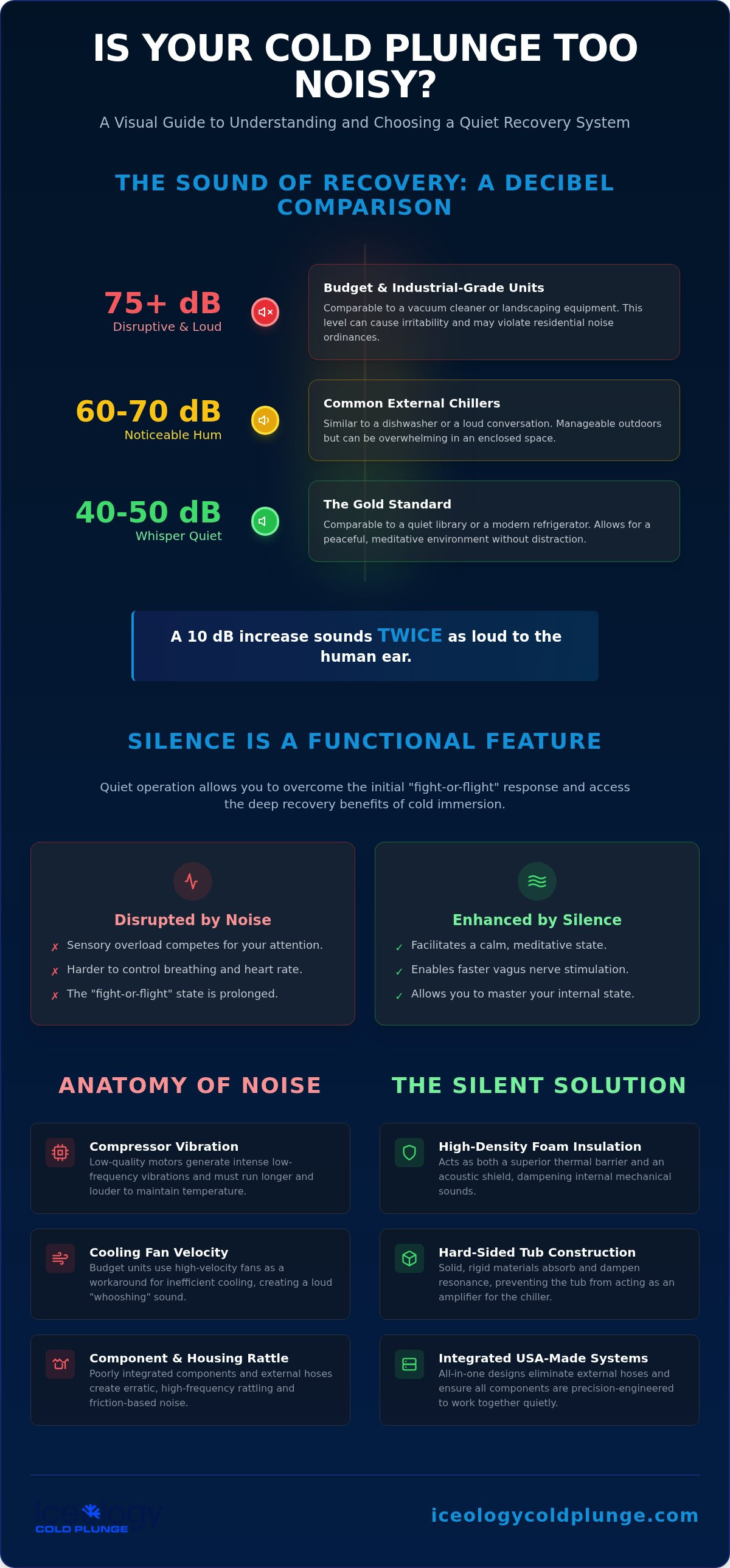
When you ask is a cold plunge tub noisy, you're likely evaluating whether your recovery ritual will fit into your lifestyle or become a source of friction. Understanding the scale of sound is the first step in making an informed decision. Sound intensity is measured in decibels (dB), which follow a logarithmic scale. To truly grasp what decibels measure, it helps to remember that a small numerical increase represents a massive jump in perceived volume. For instance, a 70 dB unit sounds twice as loud to the human ear as a 60 dB unit.
In the world of cold therapy, the quality of the sound matters as much as the raw volume. A low-frequency hum is often easy for the brain to tune out, acting almost like white noise. Conversely, a high-pitched mechanical whine or a rattling fan can be piercing and intrusive. Premium systems focus on precision engineering to ensure that the noise produced remains in a frequency range that doesn't trigger irritability or distraction during your session.
The Decibel Comparison Chart
To put these numbers into a residential context, it's helpful to compare a cold plunge chiller to everyday household sounds. Most units in 2026 fall between 50 and 70 dB, but the experience at either end of that spectrum is vastly different:
- 40-50 dB: This is the gold standard for indoor-safe luxury chillers. It's comparable to a quiet library or a modern refrigerator. This level allows for a peaceful environment where you can hold a conversation without raising your voice.
- 60-70 dB: Common for external, uninsulated cooling units. This level is similar to a background dishwasher or a loud conversation. While manageable outdoors, it can feel overwhelming in a small gym or spare room.
- 75+ dB: Found in industrial-grade or budget units. This volume level mimics a vacuum cleaner or landscaping equipment. It's loud enough to cause user irritability and may even violate local residential noise ordinances.
Why Silence is Essential for Vagus Nerve Stimulation
The first 30 seconds of cold immersion are critical for your mental resilience. Your body naturally enters a "fight-or-flight" state, characterized by the gasp reflex and a spiked heart rate. To transition into a state of calm, you need to focus on deep, rhythmic breathing. Mechanical rattle and loud cooling fans create sensory overload that competes for your attention, making it much harder to find that mental stillness. Quiet operation isn't just a luxury; it's a functional feature that allows you to maximize the scientific benefits of cold plunge by facilitating faster vagus nerve stimulation. When your environment is silent, you can master your internal state without external distraction.
The Mechanics of Sound: Why Some Cold Plunge Chillers Roar
To determine if a is a cold plunge tub noisy enough to disrupt your home, you have to look under the chassis. The sound profile of a recovery system isn't a single tone; it's a combination of different mechanical frequencies working in tandem. The heart of this operation is the compressor. As it works to pull heat from the water, it generates a consistent low-frequency vibration. While this is a normal part of the refrigeration cycle, the intensity of that vibration depends entirely on the quality of the motor. Cheap compressors often struggle to maintain target temperatures, leading to longer, louder run cycles that can exceed safe environmental noise levels for a residential setting.
Beyond the compressor, cooling fans and water pumps add their own layers to the acoustic environment. Fans produce a "whooshing" sound as they move air across the condenser coils. In budget units, high air velocity is often a workaround for inefficient cooling, resulting in a louder air-rush noise. Meanwhile, the water pump creates a rhythmic whirring as it circulates and filters the water. When these components are poorly integrated, they don't just create their own noise; they cause the entire housing to rattle. This friction-based noise is often the most irritating because it feels erratic and mechanical rather than a steady, predictable hum.
Component Quality and Noise Correlation
Precision is the primary enemy of noise. High-efficiency compressors are designed to run cooler and more quietly, utilizing tighter tolerances to reduce internal friction. The fan blades in premium cold water immersion therapy equipment are often aerodynamically shaped to slice through the air with minimal turbulence. This engineering choice significantly lowers the decibel output while maintaining high cooling performance. When you invest in quality, you're paying for components that work together in harmony rather than competing for space and creating a mechanical roar.
Vibration Dampening and Internal Mounting
Isolation is key to a quiet recovery experience. Premium units use rubberized mounts to suspend the motor and pump, effectively detaching the source of vibration from the tub's chassis. This prevents the tub from acting like a drum that amplifies every internal pulse. Choosing a cold plunge tub with chiller that is fully integrated into the design offers a significant advantage over external "hang-on" units. Integrated systems allow for better sound containment within the insulated walls of the tub itself. If you prioritize a serene environment, you can browse our collection of integrated systems designed for near-silent operation.
Hard-Sided vs. Inflatable: How Construction Impacts Noise Resonance
The material of your tub acts as the final stage of noise management. If you're still asking is a cold plunge tub noisy after researching high-quality chillers, the answer often lies in the tub's construction. Inflatable models frequently suffer from what engineers call the "speaker box" effect. Because the walls are thin and filled with air, they lack the density required to stop mechanical vibration. Instead, they act as a diaphragm, amplifying the low-frequency hum of the chiller and radiating it across your deck or patio. This can turn a standard 60 dB hum into an intrusive drone that rivals common household noise levels like a vacuum cleaner or a loud hair dryer.
Conversely, a hard sided cold plunge tub provides the structural rigidity needed to absorb and dissipate energy. The sheer mass of a solid-wall unit creates a stable environment that keeps sound contained. Premium construction also prevents the "rattle-trap" phenomenon where parts loosen over time. American craftsmanship ensures tighter tolerances in the assembly, meaning your tub stays as quiet in year three as it was on day one.
Acoustic Properties of Polyurethane Insulation
High-density polyurethane foam is the secret weapon for a silent recovery space. While most people value insulation for its ability to maintain 39°F water, its acoustic dampening properties are equally vital. This foam fills the cavities of the tub, effectively trapping sound waves before they can escape the chassis. This creates a dull, muffled sound profile rather than the hollow echo found in uninsulated plastic tubs. There's also a secondary benefit: better insulation means your chiller reaches its target temperature faster and stays there longer. Since the compressor runs less frequently, you enjoy more hours of total silence throughout the day.
Stability on Different Surfaces
Stability is essential for noise reduction, particularly on common Florida surfaces like concrete pool decks or wooden patios. A lightweight tub is prone to "walking" or vibrating against the ground, which creates a secondary, rattling noise. Hard-sided tubs are significantly heavier, and once filled with water, they provide an immovable anchor for the chilling system. This weight presses the unit firmly against its vibration-damping pads, ensuring that mechanical energy is absorbed by the tub's mass rather than being transferred into your home's structure. Whether you're placing your unit in a Miami sunroom or an Orlando backyard, this stability ensures your peace remains undisturbed.
Strategic Placement: Reducing Noise in Florida Homes and Patios
Where you choose to install your equipment is just as critical as the components themselves. Many owners ask is a cold plunge tub noisy because they've seen units that roar like an industrial air conditioner. In reality, the environment dictates much of the acoustic output. In Florida cities like Miami and Orlando, the primary challenge is the "heat load." When ambient temperatures climb above 90°F, your chiller's cooling fans must spin at maximum velocity to dissipate heat. This increased RPM leads to a higher-pitched air-rush sound that can be disruptive if the unit is placed directly under a bedroom window or near a neighbor's patio.
Ventilation is the second major factor in noise management. It's tempting to tuck a chiller into a tight corner or behind a decorative screen to hide it from view. However, restricting airflow forces the system to work harder, causing the compressor to run for longer cycles and at higher volumes. To keep your recovery ritual peaceful, ensure there is at least 1.5 meters of clearance around the cooling vents. This allows for efficient heat exchange, which keeps the fan speeds low and the mechanical hum to a minimum.
Managing Noise in High-Heat Climates
In high-humidity environments like Tampa or Naples, placing your tub in a shaded area can significantly reduce mechanical strain. Direct sunlight on the chiller housing can raise the internal temperature, forcing the fans to run even when the water is already at its target. A proper cold plunge tub setup includes choosing a location that minimizes sun exposure and utilizes a solid, level base. Placing the unit on vibration-damping pads is also essential; these pads can reduce noise transmission by 20% to 30%, preventing the "drumming" effect often heard on wooden decks or concrete pool surrounds.
Indoor Installation Secrets
If you're moving your recovery practice indoors to a garage or master suite, acoustics change dramatically. Hard, flat surfaces like drywall and tile reflect sound, which can amplify a minor hum into a noticeable drone. Avoid placing the chiller directly in a corner, as the two meeting walls act as a megaphone for low-frequency vibrations. To maintain a quiet environment, consider adding sound-absorptive materials like rubber gym flooring or acoustic panels to the surrounding area. Regular maintenance, such as dusting the condenser coils every few months, also ensures the system breathes easily and runs with minimal effort.
Ready to upgrade your recovery without the mechanical roar? Explore our quiet-running cold plunge tubs designed for the Florida climate.
The Iceology Cold Plunge Difference: Engineering Silent, High-Performance Recovery
When evaluating whether is a cold plunge tub noisy, the distinction between a mass-produced unit and a precision-engineered system becomes clear. At Iceology Cold Plunge, we view silence as a primary performance metric rather than an afterthought. A loud, vibrating chiller is often a symptom of loose manufacturing tolerances and inefficient thermal management. By focusing on meticulous American craftsmanship, we ensure that every component is fitted with the care required to eliminate mechanical rattle. Our hard-sided tubs aren't just built for durability; they are designed to act as a comprehensive acoustic shield for the high-performance machinery within.
The core of our quiet operation is the integrated chiller design. Many systems on the market rely on external cooling units connected by exposed hoses, which are prone to air bubbles, hose vibration, and external fan noise that escapes without any barrier. Iceology Cold Plunge units house the chiller within the insulated structure of the tub itself. This creates a sleeker profile and allows our high-density polyurethane foam to dampen sound at the source. You get the power to reach a consistent 39°F without the disruptive mechanical roar common in lower-end units, making it the ideal choice for South Florida's most demanding recovery environments.
Why Made in the USA Matters for Your Home Environment
Quality control is the most effective way to manage noise. Because Iceology Cold Plunge chilling systems are made in the USA, we maintain strict oversight over the assembly of every compressor and cooling loop. This ensures that the internal motors are perfectly balanced, which significantly reduces the low-frequency humming that often plagues budget imports. For our customers in Miami, Tampa, and Orlando, this local expertise means you're receiving a system built to withstand the rigors of the Florida climate while maintaining a conversational volume. It's a professional-grade tool that respects the tranquility of your home or gym.
Final Checklist for a Quiet Cold Plunge Experience
Before you finalize your investment in cold water therapy, use this checklist to ensure your recovery space remains a sanctuary of focus and calm:
- Verify Construction: Choose hard-sided tubs over inflatable options to avoid the amplification of mechanical hums.
- Check Insulation: Ensure the unit uses high-density polyurethane foam, which provides both thermal efficiency and superior acoustic dampening.
- Confirm Integration: Look for integrated chillers that contain noise within the chassis rather than external units with vibrating hoses.
- Assess Tolerances: Prioritize systems from Iceology Cold Plunge where tighter manufacturing tolerances lead to less internal friction and rattle.
- Plan Placement: Position the tub on a level, solid surface with at least 1.5 meters of clearance for optimal airflow and cooling efficiency.
By prioritizing these engineering details, you can focus entirely on the transformative power of the cold rather than the noise of the machine. True recovery requires mental stillness, and a quiet system is the foundation of that practice.
Elevate Your Recovery with Silent Precision
Determining if is a cold plunge tub noisy enough to disrupt your home comes down to the quality of its engineering. You now know that while budget units can reach disruptive decibel levels, premium systems prioritize silence as a core performance metric. By choosing hard-sided construction and high-density polyurethane insulation, you effectively dampen mechanical resonance at the source. Integrated chilling systems further protect your peace by eliminating the rattle and friction of external hoses.
Recovery is a mental journey as much as a physical one. You shouldn't have to compete with a loud compressor to find your focus. Our systems are hand-crafted in the USA to ensure tight tolerances and near-silent operation. With integrated 39°F cooling and superior acoustic management, you can finally master the cold in a state of absolute tranquility. It's time to invest in a system that respects your sanctuary.
Experience the silence of premium recovery—browse Iceology Cold Plunge Tubs
Take control of your wellness routine today. Your path to peak performance deserves an environment that supports your focus rather than distracting from it. We're here to help you build a recovery space that feels as good as the results it provides.
Frequently Asked Questions
Is a cold plunge tub louder than a standard refrigerator?
A premium cold plunge tub is typically comparable to a modern refrigerator, operating between 50 and 58 decibels. While you will hear a gentle mechanical hum while the chiller is active, it shouldn't disrupt a normal conversation. However, budget units can reach 77 decibels, which is significantly louder than a fridge. Investing in a high-end system ensures your recovery space remains a quiet sanctuary rather than a loud industrial zone.
Can I use my cold plunge tub indoors without disturbing the household?
You can absolutely use a cold plunge tub indoors if the unit is engineered for low-noise output. Modern integrated chillers are designed for residential use, making them suitable for garages, sunrooms, or master suites. To minimize disturbance, place the tub on a vibration-damping mat and avoid tight corners that can amplify sound. Proper insulation, like high-density polyurethane foam, is essential for keeping mechanical noise contained within the tub chassis.
Do inflatable cold plunges make more noise than hard-sided ones?
Inflatable units often seem louder because their thin, air-filled walls lack the density to absorb mechanical vibrations. This creates a "speaker box" effect that can amplify the chiller's hum. Hard-sided tubs are much quieter because their solid mass and specialized insulation dissipate energy before it becomes audible noise. If you're concerned about whether is a cold plunge tub noisy, a hard-sided model is the superior choice for acoustic control.
How can I make my cold plunge chiller quieter?
To make your chiller quieter, start by placing it on a heavy-duty anti-vibration mat to decouple the motor from the floor. Ensure there is at least 1.5 meters of clearance around the vents to prevent the fans from overworking and getting louder. Regular maintenance, like cleaning the condenser coils, also keeps the system running efficiently. For those in Florida, keeping the unit in a shaded area helps the chiller run shorter, quieter cycles.
Will my neighbors be able to hear my cold plunge tub on the patio?
Your neighbors shouldn't hear a premium cold plunge tub if it operates at a conversational volume of around 58 decibels. Most Florida residential noise ordinances in cities like Miami and Orlando allow for 55 to 65 decibels during the day, meaning a high-quality chiller is well within legal limits. To be extra cautious, place the unit away from shared walls or fences. Proper setup ensures your recovery ritual remains private and doesn't become a nuisance.
Does the chiller run constantly, or only when cooling the water?
The chiller only runs its compressor and fans when the water temperature rises above your set target. Once the water reaches your desired 39°F, the system enters a standby mode. High-efficiency insulation is the key to silence here; it prevents the water from warming up quickly, which significantly reduces how often the chiller needs to activate. This ensures you spend more time in quiet stillness and less time hearing the machine work.
Does a higher horsepower (HP) chiller mean more noise?
A higher horsepower chiller doesn't automatically mean more noise. In fact, a more powerful, high-efficiency motor can often reach target temperatures faster, leading to shorter run times. The noise level depends more on the manufacturing tolerances and the quality of the fan blades than the HP rating alone. Precision-engineered USA-made systems use superior components that provide high-performance cooling without the mechanical roar associated with lower-quality, underpowered budget chillers.
How does ambient Florida heat affect the noise level of my tub?
High ambient heat in cities like Tampa or Orlando forces the chiller to work harder to dissipate thermal energy. On a 95°F afternoon, the cooling fans will spin at higher speeds, which naturally increases the audible "whooshing" sound. To manage this, we recommend placing your tub in a shaded area or a well-ventilated lanai. This reduces the mechanical strain on the system, allowing it to maintain 39°F water while operating at a lower, more comfortable volume.